
When disagreement becomes a deficiency
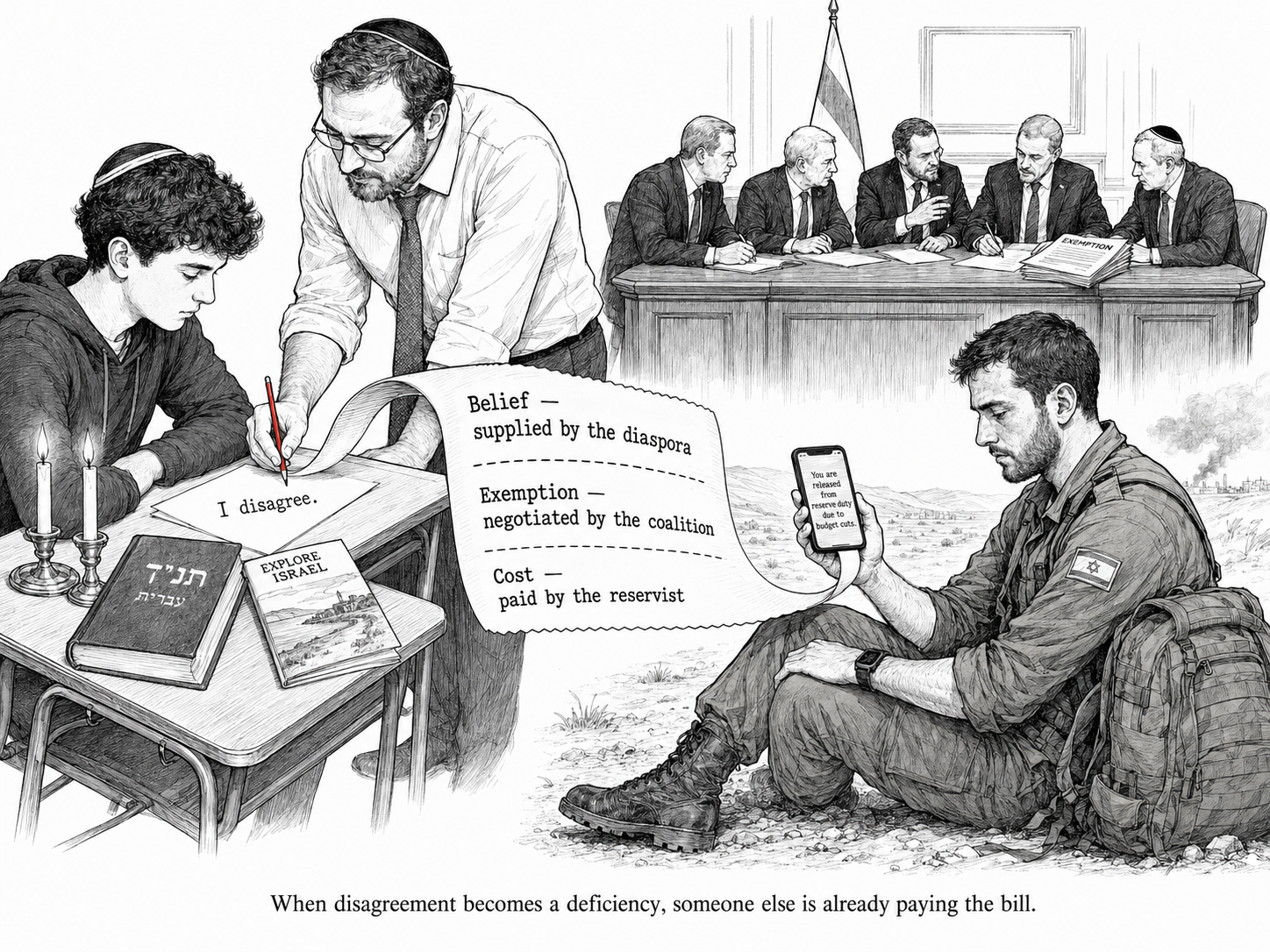
Rabbi Seth Winberg deserves credit for refusing the easiest accusation. The fact that many young American Jews support a binational state does not automatically mean that they hate Israel, reject Jewish collective existence or have joined an anti-Zionist crusade. That is already more responsible than the familiar communal reflex in which every departure from the approved answer is treated as betrayal.
Unfortunately, his generosity ends there. Having declined to call these young Jews enemies, Winberg turns them into pupils. Their political judgment is explained through insufficient historical knowledge, limited contact with Israel, weak Hebrew, attenuated communal bonds and an American moral imagination trained to see conflict through equality and civil rights. The remedy is predictable: more Israel, more Torah, more Hebrew, more Shabbat and more carefully organized encounters with Jewish belonging.
This is not quite a conversation but a curriculum correction in which the conclusion has already been reserved. The young Jews in question are allowed decent instincts, but not yet serious judgment. Their position is interpreted not as the possible result of knowledge, experience and moral reflection, but as evidence that their education remains incomplete.
The assumption hidden inside this pedagogical tenderness is severe. A properly educated Jew will eventually reach the expected conclusion, while a Jew who does not must have studied too little, visited too rarely or belonged too weakly. The system is perfectly protected from falsification because agreement proves understanding and disagreement proves deficiency.
One may call this education, but it is also the management of disobedience. What disappears from Winberg’s account is the obvious possibility that many young American Jews are not distant from Israel at all. Some have studied there, traveled repeatedly, spoken Hebrew, attended Jewish schools and camps, participated in Hillel, maintained Israeli friendships and family ties, and followed Israeli politics with an intensity unavailable to earlier generations.
Their disagreement may not arise from knowing too little. It may arise from having seen too much.
That does not make their conclusions automatically wise. A binational state may be politically dangerous, constitutionally implausible or incapable of protecting either Jewish or Palestinian collective life. But intellectual adulthood begins when a position is answered as a position rather than diagnosed as a developmental defect.
The asymmetry becomes especially stark when this pedagogical tone is compared with the way American political culture treats young supporters of Donald Trump and the ideological ecosystem around Steve Bannon and Charlie Kirk. Their views are not explained away as the product of too few visits to Washington, insufficient knowledge of the Constitution or a shortage of Sunday dinners with moderate Republicans.
They are granted political agency. Their media environment is studied, their language is taken seriously, and their nationalism, resentment and attraction to authoritarian power are treated as forces capable of transforming the republic.
The young follower of Bannon is regarded as an ideological subject, while the young Jew who questions Jewish political supremacy is treated as an educational problem. The Trumpist has a worldview; the dissident Jew has gaps. The nationalist participates in history; the Jewish critic needs a better Shabbat experience.
This double standard is not merely condescending. It is politically dishonest because it grants full intellectual agency to those moving toward the authoritarian right while withholding it from Jews who reach conclusions that unsettle the communal establishment.
The dishonesty becomes even clearer when equality itself is presented as an American cognitive distortion. Winberg suggests that young Jews have been trained to interpret the Israeli-Palestinian conflict through racial equality and equal citizenship, as though equality were an imported classroom reflex insufficiently sensitive to Jewish history and vulnerability.
Perhaps, however, the young are not confused because they ask whether millions of people living under one sovereign power should possess equal political rights. Perhaps they are confused by institutions that taught them equality as a Jewish value and then demand that they suspend it precisely where Jewish power is involved.
That contradiction cannot be repaired by another heritage trip, especially when Israel itself is providing a far more concrete lesson in political responsibility.
The IDF is reportedly reducing the number of reservists under budgetary pressure even while military leaders continue to warn of manpower shortages and the prolonged burden placed on soldiers, families, employers and communities. At the same time, the coalition’s survival remains tied to preserving broad exemptions from military service for Haredi yeshiva students.
The state is therefore not merely short of soldiers or money. It is distributing obligation according to the needs of coalition maintenance.
Some citizens repeatedly leave work, families and ordinary life to sustain the security system, while others remain institutionally protected from the same burden because their political representatives can threaten the government. The reservist pays in time, income, health and family life; the coalition partner negotiates the exemption; the young American Jew is asked to provide the belief.
This is the arrangement that communal pedagogy politely removes from view.
Young Jews abroad are told that their doubts may result from inadequate intimacy with Israel. Yet greater intimacy would reveal not an abstract Jewish state in need of emotional affirmation, but a political machine that distributes danger, duty and public resources unevenly.
They would see a government demanding loyalty to national survival while allowing the obligation to secure that survival to fall upon an increasingly narrow part of society.
The issue is not that every Haredi Jew must be placed in a combat unit, nor that military integration presents no cultural and institutional difficulties. The issue is more fundamental. A state cannot endlessly invoke existential necessity while treating participation in that necessity as a negotiable coalition commodity.
Nor can Jewish institutions abroad demand metaphysical loyalty to a sovereignty whose concrete burdens are distributed through political patronage. The reduction of reservists under budget strain exposes the difference between symbolic attachment and embodied responsibility.
Israel possesses enormous military commitments, persistent security threats and an acknowledged need for more personnel, yet its governing coalition preserves a structure in which political stability depends upon protecting some groups from burdens borne by others.
This is not merely a budgetary contradiction. It is a constitutional revelation because it shows who is considered indispensable, who is considered expendable and who is expected to provide moral cover from abroad.
The reserve system is often described as a covenant between the Israeli state and its citizens. But a covenant ceases to be a covenant when one side can turn obligation into exemption while another is repeatedly summoned in the name of collective survival. It becomes a mechanism for concentrating sacrifice.
This is where Winberg’s educational prescription becomes almost unbearable in its innocence. The young American Jew is instructed to deepen his connection to Israel, learn Hebrew, study history, experience Shabbat and overcome the abstractions of American political morality.
Yet a deeper connection would reveal reservists whose service has been repeatedly extended, families absorbing the cost of prolonged mobilization, an army declaring a manpower shortage and a coalition negotiating who need not serve.
Perhaps the young Jew does not need protection from American abstraction. Perhaps he is observing the Israeli concrete and noticing that the state demands solidarity as an absolute while administering obligation as a privilege, penalty or coalition concession.
None of this makes Jewish vulnerability unreal. October 7 made any casual dismissal of Jewish insecurity morally obscene. But vulnerability does not create an unlimited constitutional exemption, and the memory of persecution cannot permanently suspend the examination of what Jewish power does, whom it governs and which inequalities it requires for its continuation.
Jewish education will also lose credibility if its purpose is to produce attachment regardless of what the object of attachment becomes. There is a fundamental difference between education that deepens judgment and education that predetermines its outcome.
The first confronts students with Jewish vulnerability, Palestinian dispossession, terrorism, occupation, failed diplomacy and the consequences of every possible political order. It also asks who serves, who is exempted, who pays and which groups possess the political power to transfer their burden to others.
Such an education does not guarantee agreement. The second calls itself complexity while quietly reserving the correct answer in advance, and young Jews have noticed the difference.
The growing fracture in American Jewish attitudes cannot therefore be reduced to assimilation, ignorance or emotional distance. Something more serious is happening than a failure of transmission: the transmitted form itself is losing credibility.
For decades, Jewish institutions could assume that stronger Jewish identity would produce stronger identification with Israel and that stronger identification with Israel would reproduce the accepted political vocabulary. That sequence no longer holds.
Jewish learning can intensify criticism, familiarity can produce distance, religious seriousness can generate refusal, and contact with Israel can deepen attachment to its people while destroying confidence in its governing form.
This is not necessarily the end of Jewish solidarity. It may be the end of solidarity understood as supervised assent.
The most unsettling possibility for the Jewish establishment is not that the young have abandoned their inheritance, but that they are using parts of that inheritance against the institutions that administered it. They remember the prophetic suspicion of power, the prohibition against turning any fragment into the whole and the demand that law bind the strong as well as protect the vulnerable.
They may not have forgotten Jewish ethics. They may simply have noticed where Jewish institutions stop applying them.
A serious response would begin without the teacher’s red pen. It would ask what these young Jews know, what they have experienced and which contradiction they are trying to name. It would confront the dangers of a binational state without pretending that the present arrangement is politically neutral or morally sustainable.
It would also admit that Israel’s crisis of legitimacy among young Jews cannot be separated from the crisis of obligation inside Israel itself. A state that asks diaspora Jews for unconditional attachment while allowing its coalition to condition military responsibility upon political convenience should not be surprised when its educational message begins to sound hollow.
The question is no longer whether young Jews feel sufficiently connected to Israel, but whether the Israel to which they are instructed to connect still embodies a credible form of shared responsibility.
Shabbat suspends ordinary mastery. Work ceases, production is interrupted and the world is not completed by our management of it. Perhaps Jewish institutions could learn something from that interruption by ceasing, for one day, to manufacture the correct young Jew and by listening before explaining disagreement away.
They might then allow the uncomfortable possibility that the pupil understood the lesson, examined the teacher and noticed who received the bill. The young are not always right, but neither are they children merely because they no longer repeat us.
Yochanan Schimmelpfennig