
Urban Sociologist and Global Affairs Commentator
When does Campus Ideology Cross a Dangerous Threshold?
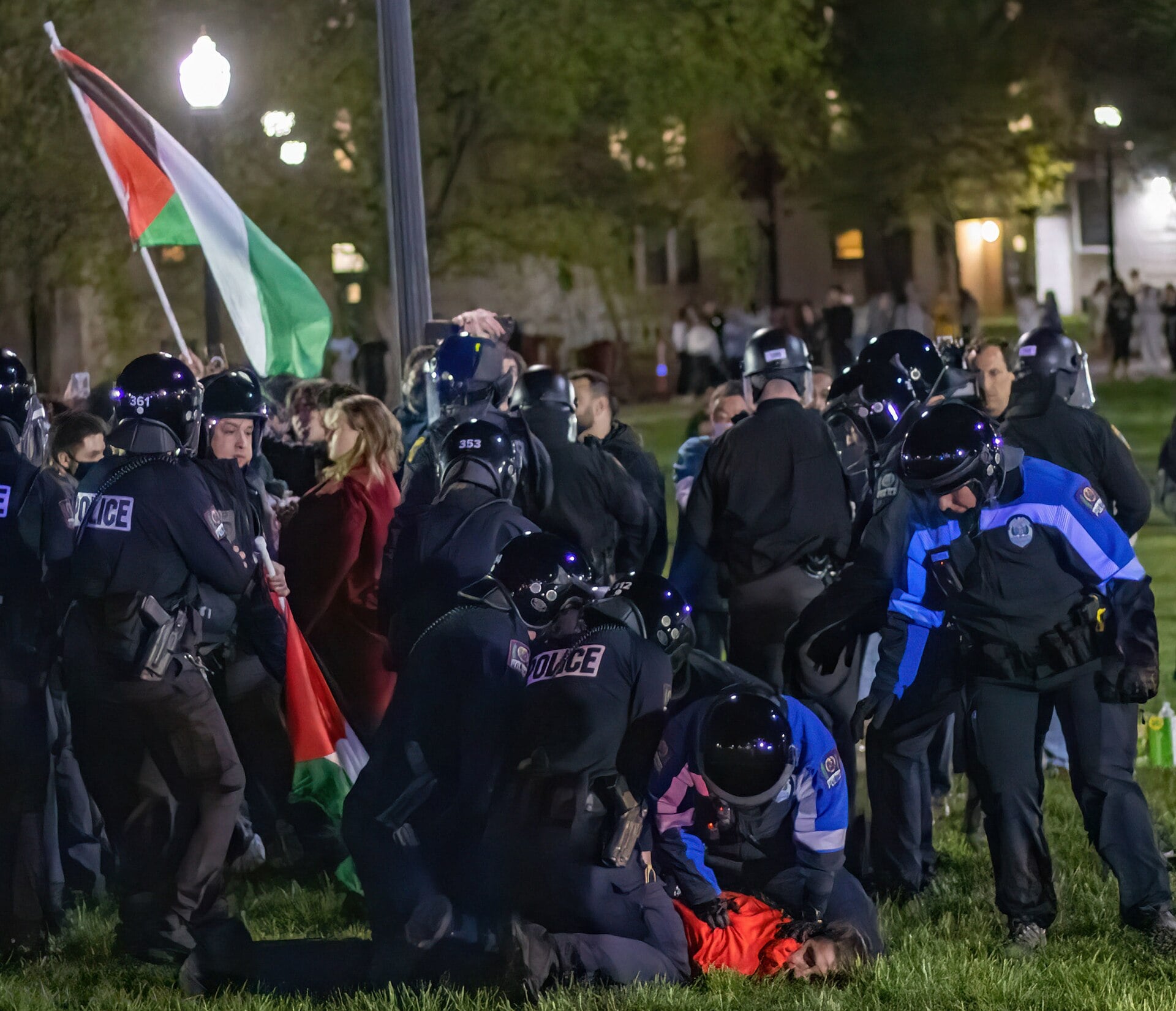
From Columbus OH, 1999 (Credit: Paul Becker/Wikimedia Commons)
Every institution has a line it believes it would never cross, and the interesting question is how it crosses it anyway. Universities do not decide one morning to tolerate hatred. They get there through a thousand reasonable-sounding exceptions: a protest that was “only rhetoric,” a group chat that was “just venting,” a student asked to “clarify his position” before being welcomed. The threshold is rarely a dramatic event. It is the point at which a community stops noticing that its definition of normal has moved.
The attack on Flydubai Flight 1073 has returned this question to the headlines. On 30 September, the Omani co-pilot Hamam al-Hammami allegedly struck his captain with a cockpit axe on a flight carrying Israelis to Tel Aviv. The UAE has called it a terrorist act. Australia’s counter-terrorism team is now examining his “links to Australia,” where he reportedly studied at a Melbourne university. Press reports say he visited radical mosques and extremist websites there, though Reuters could not verify them. Oman reportedly barred him from flying over suspected extremism.
The honest position is that we do not know where this man’s path began, and the evidence does not point to a lecture hall. The pull toward a tidy story, where an ideology is born on a campus and ends in a cockpit, is exactly what an essay on thresholds should resist. It is also exactly why the subject matters.
The threshold is not where we think it is
The usual debate treats the threshold as the border between acceptable and unacceptable opinions about Israel. This is the wrong place to look, and it traps both sides.
Criticism of Israeli policy, including fierce, unfair or wrong criticism, belongs in a university. So does opposition to Zionism, advocacy for Palestinian statehood, and the argument that a war is unjust. A university that cannot host these arguments has stopped being a university.
The real threshold lies elsewhere, at the moment a political grievance acquires a human address. It is crossed when a classmate is held answerable for a government’s conduct because of her religion, when a student must pass a political test before he is treated as a full member of the community, or when the vocabulary of resistance quietly expands from policies to people. The difference between “I oppose what that state does” and “you, personally, are part of what I oppose” is the difference between politics and persecution. Philosophers call it collective guilt, and every ideology that has ended in violence has needed it.
This is why the evidence worth examining concerns conduct, not opinion. France’s Interior Ministry recorded 1,320 antisemitic acts in 2025, a fall from the previous year but still historically high. These are national figures and cannot be attributed to universities, so they should not be used as campus evidence. But French campuses supply sharper cases. A Paris-Dauphine student was convicted after replacing Jewish classmates’ profile photographs with a Palestinian flag, and the court treated antisemitism as an aggravating factor. At Paris 1 Panthéon-Sorbonne University, students were reportedly prosecuted over messages excluding classmates identified as Zionists. In both cases no one was arguing about borders or ceasefires. People were being sorted by who they were.
The uncomfortable symmetry
Here the debate becomes more interesting than either camp wants. The mechanism that makes a Jewish student answerable for Israel is the same one that makes a Muslim or Arab student answerable for terrorism. Both substitute group membership for individual conduct.
Consider what is likely to follow Flight 1073 on campuses worldwide. International students from the Gulf and the wider Muslim world will be looked at differently. Some will be asked, openly or silently, to account for a man they have never met. If that happens, the lesson of the episode will have been learned backwards. A university that condemns holding Jews responsible for Israel while holding Omanis responsible for al-Hammami has not found a principle. It has found a side.
The honest standard is, therefore, the same for everyone: no student is a proxy for a state, a faith or a crime. It is a demanding standard, and it is the only one that protects Jewish students durably, because protections built on one group’s grievance collapse the moment another group’s grievance is more fashionable.
What campuses actually owe
None of this requires a crackdown on speech, and the loudest demands for one usually come from people who would be the first censored if the rules changed hands. It requires a more boring and more effective set of commitments.
The first is conduct rules that are viewpoint-neutral and actually enforced. Harassment, exclusion and intimidation are prohibited whatever the cause behind them. A rule that is applied only when the target is sympathetic is not a rule.
The second is transparency. Universities should publish incident data, outcomes and response times, so that a parent in Melbourne or Marseille can see what a statement of values is worth. Melbourne’s own acting vice-chancellor has told the royal commission that conflating Jewish identity with the Israeli state is antisemitic. That is the right position. The test is whether a student who reports being targeted sees the position acted upon.
The third is intellectual seriousness. A campus where “Zionist” is used as a euphemism for “Jew,” or where conspiracy theories about Jews pass as analysis, has failed at scholarship before it has failed at safety. Teaching students to tell critique from caricature is the oldest function of the university, and nothing outsources it.
The question the cockpit should force
If investigators find that al-Hammami’s radicalisation had roots in an Australian campus, universities everywhere will face a reckoning they have postponed. If they find it had roots in networks that no campus touched, the argument for reform will be neither refuted nor weakened, because the French cases and the testimony of Jewish students stand on their own evidence. Reform that depends on the cockpit investigation’s outcome is not reform. It is opportunism.
What the case does show is something quieter, and more uncomfortable for everyone. A single act of violence on an airliner fast becoming a Rorschach test: for some, proof that campuses breed extremists; for others, proof that campus concern is pretext for suppressing dissent. Each side sees its own convictions on the screen. That reflex is the real threshold, the point at which societies stop asking what happened and start asking whom it vindicates.
Aviation security reportedly failed in ordinary, boring ways, with vetting gaps and ignored warnings. Campus governance may be failing in equally ordinary ways, through the slow tolerance of small exclusions that nobody wants to be the first to name. Neither failure is dramatic. Both are fixable. Both are made worse by the appetite for a story in which one villain explains everything.
The fire metaphor, so popular in these debates, misleads in one respect. Fires spread by contact, and so do the habits that precede them: the casual exclusion, the collective accusation, the shrug. They are extinguished the same way, by ordinary people in ordinary institutions refusing, early and consistently, to treat a human being as a symbol of someone else’s crime.
That refusal is the line. It protects Jews from being made answerable for Israel, Muslims from being made answerable for terror, and everyone else from a world in which identity substitutes for evidence. Universities that hold it will have little to fear from the next tragedy, however it unfolds. Those that don’t will keep discovering, afterwards and too late, that the threshold had been crossed long before the headlines.
Related Topics