
CFO | Empower Society for Good I Author
When Does Revenge Become Justice?
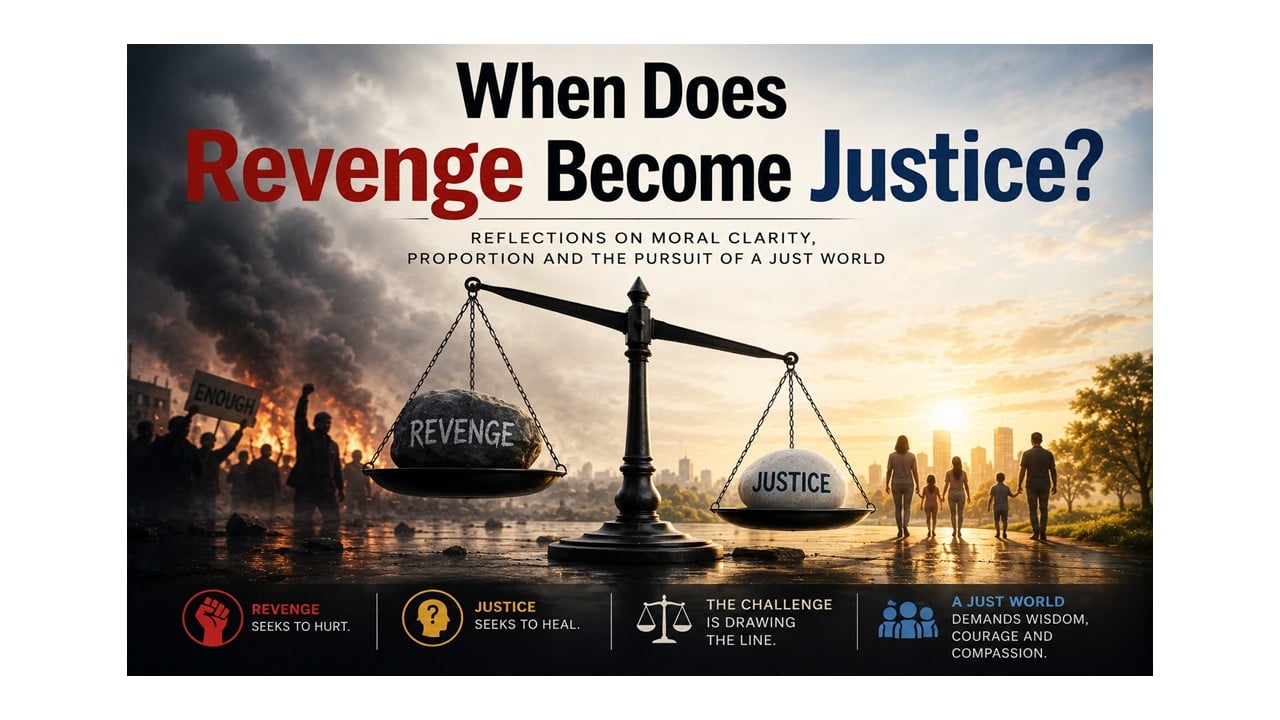
“Avenge the Israelite people on the Midianites…” (Numbers 31:2)
War is one of humanity’s greatest moral dilemmas.
Can war ever be just? Or is every act of war simply another expression of violence?
In an age when conflicts are reduced to slogans and hashtags, Parashat Mattot challenges us to think more deeply. It asks a timeless question that lies at the heart of every civilisation:
Why does a nation go to war?
The answer matters.
Not All Wars Are the Same
History is filled with wars of conquest.
Empires marched across continents seeking land, wealth and power. The Assyrians, Babylonians, Persians, Greeks and Romans expanded their kingdoms through force. European colonial powers built global empires. Nazi Germany sought domination. Imperial Japan invaded its neighbours. Today, Russia’s invasion of Ukraine is widely viewed as an attempt to seize territory and impose political control.
These wars were fundamentally about expansion.
But Parashat Mattot presents something different.
God commands Moses:
“Take vengeance for the Israelites on the Midianites.”
Yet Moses deliberately changes the wording:
“Arm some of your men to carry out the Lord’s vengeance on Midian.”
Why?
The commentators note that Moses transforms what could be understood as Israel’s revenge into God’s justice.
This is not presented as a campaign of hatred or conquest. Midian had already waged war against Israel—not primarily with armies, but by attempting to destroy Israel morally and spiritually through seduction, idolatry and corruption at Baal Peor. Thousands died in the resulting plague.
The war against Midian is therefore portrayed as an act of justice against an enemy committed to Israel’s destruction.
Revenge or Justice?
The Torah consistently forbids personal vengeance.
“Do not take revenge or bear a grudge.”
Yet here Israel is commanded to fight.
The difference is profound.
Personal revenge seeks satisfaction. Justice seeks restoration. Revenge is driven by anger. Justice is driven by responsibility.
Moses refuses to allow the war to become an emotional response. Even more strikingly, he does not personally lead the campaign. Pinchas leads instead. The objective is not to satisfy personal grief but to uphold a higher moral order.
A Timeless Distinction
This distinction did not disappear with the Bible.
Jewish tradition distinguishes between wars of necessity and wars of choice.
Christian Just War theory, developed by Augustine and Thomas Aquinas, makes similar distinctions.
Modern international law also recognises the inherent right of self-defence under Article 51 of the United Nations Charter.
Civilisations have long recognised an ethical difference between aggression and defence.
Yet modern public debate increasingly blurs that distinction.
October 7 and the Moral Purpose of War
The Hamas attacks of October 7 were not conventional military operations.
They deliberately targeted civilians. Families were murdered in their homes. Women were raped. Children and the elderly were kidnapped. Communities were devastated. The purpose was terror.
Following those atrocities, Israel launched a military campaign in Gaza.
Around the world, fierce debate erupted over Israel’s response. Many accused Israel of disproportionate force or genocide. Others argued that no nation could allow such an attack to stand unanswered.
Regardless of where one stands on particular military decisions, Mattot invites us to ask a prior question:
What is the purpose of this war?
Is it conquest? Is it empire? Or is it to dismantle those responsible, rescue hostages, restore security and deter future atrocities?
These are not trivial distinctions.
A democratic state has not only the right but the responsibility to protect its citizens. Justice requires more than mourning the victims. It also requires ensuring that such evil cannot easily be repeated.
The Hardest Moral Challenge
Modern warfare presents dilemmas Moses never faced.
What happens when an armed group embeds itself among civilians?
When schools, hospitals and residential areas become battlefields?
How does a moral army defeat an enemy that deliberately places its own civilians in harm’s way?
These questions have no easy answers.
But they should not lead us to conclude that all wars are morally identical.
What Makes a Good Society?
A good society does not glorify war. It does not seek revenge for its own sake. But neither does it abandon justice. If a society cannot distinguish between wars fought to conquer and wars fought to defend life, it risks creating a dangerous moral equivalence.
History teaches that aggression flourishes when democracies lose the confidence to defend themselves.
Parashat Mattot reminds us that the central question is not whether war is tragic—it always is.
The deeper question is:
Why is the nation fighting?
To dominate? Or to defend? To destroy? Or to restore justice?
Moses transforms revenge into responsibility.
That may be one of the Torah’s most enduring lessons on leadership.
Questions to Ponder
- Are all wars morally equivalent?
- Is there an ethical difference between conquest and self-defence?
- When does justice become revenge—and when does refusing to confront evil become moral failure?
- Does a government have a duty not only to punish atrocities but also to deter future ones?
- Can a society remain both compassionate and strong?
- If democracies lose the will to defend themselves after atrocities such as October 7, what message does that send to those who glorify terror?
“The first question is not whether war is tragic—it always is. The first question is why a nation fights. A good society must be able to tell the difference.”
I think this is one reflection where Rabbi Sacks would add one further emphasis: even a just war must be fought with humility. The goal is never vengeance for its own sake, but the restoration of peace. The ultimate measure of victory is not the defeat of an enemy, but the possibility that future generations may live without fear. That final note would give the reflection both moral force and moral restraint.
Related Topics
Related Posts