

When everyone talks no one listens anymore
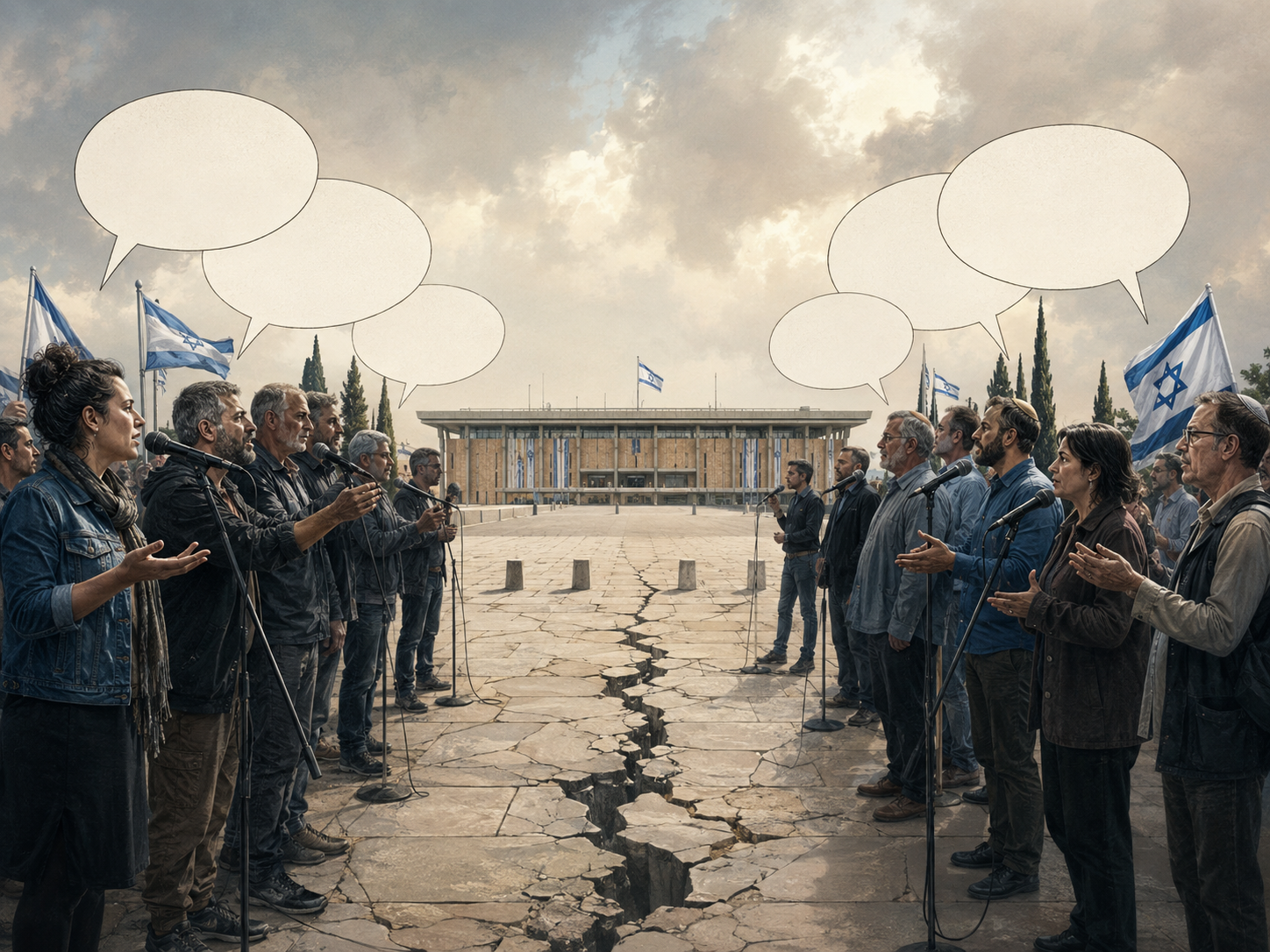
Israel has always been a country of debates. People speak loudly, they contest, they argue, they demonstrate. Political confrontation is almost a part of national culture, so it’s not disagreement that should worry. A democracy in which everyone thinks the same thing would be a very strange democracy. The problem lies elsewhere. What seems to be gradually deteriorating in Israel is not the ability to speak, but the ability to listen. Everyone speaks, but more and more often to their own camp. The right speaks to the right. The left speaks to the left. The religious speak to the religious, the laity to the laity. Television channels, social media, and sometimes even politicians seem to operate in parallel universes. The debate still exists. But it increasingly looks like a juxtaposition of monologues. This is probably where the real democratic problem begins.
We no longer try to convince
In a traditional democratic debate, there are three categories: those who think like you, those who think against you, and those whom you can still convince. Yet this third category seems to be gradually disappearing. Political discourse is no longer necessarily built to persuade those who hesitate; it serves first and foremost to mobilize those who are already convinced. A moderate sentence risks disappointing his camp. A violent sentence, on the other hand, can be immediately picked up on social networks, applauded by its supporters and commented on for several hours on television sets. Politics then changes its function: it is no longer so much a question of building a majority around an idea as of maintaining the permanent mobilization of one’s own camp. And this shift is not just on one side of the political spectrum; it is gradually affecting everyone.
The opponent becomes a threat.
This is probably the most worrying development. In a normal democracy, one can consider that one’s opponent is profoundly mistaken. One may think that his policy is bad, dangerous or irresponsible. But he remains a legitimate opponent. When polarization becomes extreme, this boundary begins to disappear. The other is no longer just wrong. It becomes dangerous. For some, the government threatens democracy. For others, those who oppose the government refuse the will of the voters. Some see judges as the last bastion of the rule of law. Others see it as an institution with excessive power over elected representatives. One can thus end up being convinced that they are defending democracy against the other, which is what makes the situation particularly difficult. Because how to find a compromise with someone who is considered an existential threat?
Two visions of democracy confront each other
Much of Israel’s political conflict may have originated there. For a part of the population, democracy is based above all on the majority principle: citizens vote, a majority is formed and this majority must be able to govern. For another party, democracy cannot be reduced to voting: it also presupposes checks and balances, an independent judiciary, and institutions capable of limiting the power of the majority. These two visions are not necessarily incompatible. But they become so when everyone considers that the other definition is illegitimate. The debate around justice, the powers of the Knesset, the government, the role of the Supreme Court or the relationship between religion and the state then takes a much deeper dimension than just an institutional dispute. He touches on the question: which Israel do we want? The Israeli Democracy Institute already noted in its 2025 index a low trust in many institutions and identified the divide between right and left as the most acute social tension in the country. In the run-up to the 2026 elections, its researchers speak of an exceptional polarization around the democratic character of the state, religion and the foundations of civic consensus.
October 7 could have brought things closer. It also worsened certain fractures.
The successive traumas suffered by Israel could have created a lasting sense of national unity. This happened at certain times. But the war, the question of responsibility on October 7, that of the hostages, the military service of the ultra-Orthodox, the military and diplomatic choices of the government or relations with the Palestinians have also added new fault lines to the old ones. The Israeli paradox is thus striking: faced with external threats, society can show an extraordinary capacity for collective mobilization, while remaining deeply divided politically at home. This creates two Israelis who sometimes share the same concerns but no longer use the same words to talk about them.
Compromise becomes a weakness
This is perhaps the most dangerous sign for a democracy. A democracy doesn’t work because everyone agrees. It works because people who do not agree still accept to live together. This requires a word that has become almost suspect: compromise. But when the camps become radicalized, compromise can be interpreted as treason. If I consider that the other side wants to destroy Israel as I understand it, why would I agree to negotiate with them? Every concession then becomes a capitulation. Every election becomes existential. Each victory on the other side looks like a national disaster. At this point, democracy can perfectly well continue to organize elections. Parties can continue to campaign. Citizens continue to vote. But the democratic spirit is still starting to weaken.
The real danger: a democracy without interlocutors
Israel will hold its next parliamentary elections on October 27, 2026. But perhaps the most important question will not be just who wins them, it will be what happens the next day. Will the losers regard the other side’s victory as legitimate? Will the victors consider that they also govern for those who did not vote for them? Will politicians continue to speak only at the grassroots level, or will they seek to rebuild a common language? For a democracy probably cannot live sustainably when each half of the country thinks that it must save Israel from the other half. That is the paradox. Israel does not lack debates. Perhaps Israel is gradually lacking interlocutors. Everyone is talking. Everyone argues. Everyone demonstrates. Everyone claims to defend the country and democracy. But everyone listens less and less to those who are facing each other. And when, in a democracy, one no longer seeks to convince his opponent but only to defeat him, the problem goes far beyond politics. It ends up touching on the very ability of a society to continue living together. So the real question for Israel may not be: who will win the next debate? It is much more fundamental: are we still able to debate with someone whose ideas we reject, without ending up denying their legitimacy? This is perhaps one of the most important democratic questions facing Israel today.