


When Fear Becomes Policy
In every era, societies have ultimately been judged not only by their military strength or economic prosperity, but by how they treat those who are entirely under their control. Prisons exist to enforce justice through the rule of law—not to transform punishment into a spectacle of fear.
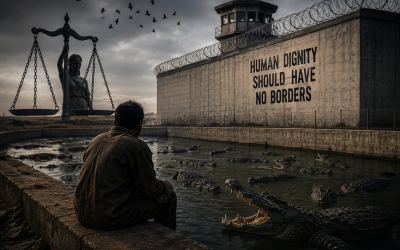
Recent reports about plans to construct a crocodile-filled moat around a section of an Israeli prison have sparked widespread public debate. Regardless of one’s political views on the Israeli–Palestinian conflict, the proposal itself raises a profound ethical question: What happens when deterrence begins to resemble intimidation, and when symbolism overtakes humanity?
The true measure of a democratic society is not how it treats the powerful, but how it treats those with the fewest rights and the least ability to defend themselves. Prisoners, regardless of the accusations or convictions they face, remain human beings. Their basic dignity is not a privilege granted by governments; it is a principle recognized by international human rights law and by the moral foundations of civilized societies.
History repeatedly demonstrates that states often justify extraordinary measures in the name of security. Yet history also reminds us that fear is a poor architect of justice. Policies designed primarily to humiliate or psychologically intimidate prisoners risk weakening the very legal and ethical standards they claim to protect.
Supporters may argue that such proposals are symbolic or intended solely as deterrence. But symbols matter. Governments communicate their values not only through legislation and court rulings, but also through the images they choose to project. A prison designed to evoke fear through predatory animals sends a message that extends far beyond its walls.
The debate, therefore, is not simply about crocodiles or prison infrastructure. It is about the direction in which modern democracies are willing to move when confronted with security challenges. If public institutions increasingly rely on theatrical displays of power, they risk replacing confidence in the rule of law with confidence in intimidation.
Justice and security are not competing ideals. The strongest legal systems are those capable of protecting society while preserving the humanity of those in their custody. Once punishment becomes a performance, the boundary between justice and vengeance begins to blur.
Political conflicts will continue to divide nations and shape public opinion. Yet one principle should remain beyond dispute: human dignity does not disappear behind prison walls. It is tested there.
The question history will ask is not merely who prevailed in moments of conflict, but whether humanity itself survived the choices made in its name.