


CEO of Jewish Federation of British Columbia
When Fire Sweeps Through, Jewish Community Remains
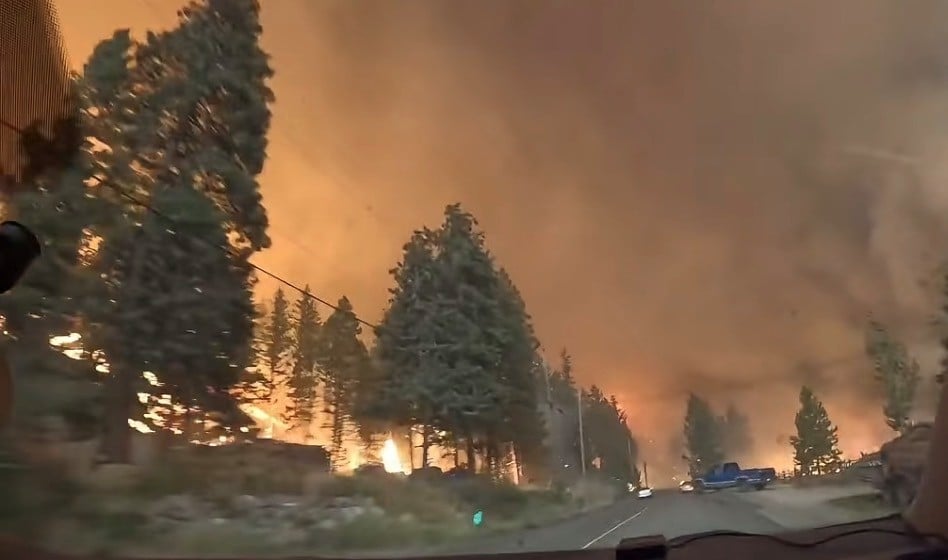
When Fire Sweeps Through, Jewish Community Remains (Photo by Michelle VanBalaan, courtesy of the author)
As I wait for my son to return home from Camp Hatikvah in the Okanagan, I find myself thinking about the families living beneath the smoke.
Here in Vancouver, we see the images. We follow evacuation alerts. We read the headlines. But distance has a way of softening reality. The true weight of these fires is felt by those who have packed their cars in the middle of the night, left homes and animals behind, crowded into hotel rooms, and wondered what will still be standing when they return.
Over the past several days, that reality has been arriving in my inbox.
As CEO of Jewish Federation of British Columbia, I have been in constant contact with our Community Connectors, volunteers, and Jewish leaders across the Interior. Many are people my wife, Rachel, and I sat with only weeks ago during our journey through British Columbia’s smaller Jewish communities. We shared meals, heard their stories, and talked about what it means to build Jewish life across a province where communities can be separated by hundreds of kilometres.
Today, those same people are sending evacuation updates, road closures, emergency needs, and stories of neighbours helping neighbours.
What I have read has been sobering.
It has also been inspiring.
Because beneath every update about smoke, fire, and uncertainty has been another story unfolding. A story about responsibility. A story about resilience. A story about Jewish community and people who simply show up.
One of the first messages I received was simple:
“Scary how quickly that came up.”
Within hours, community members were checking on one another. Families were accounted for. Outreach was underway.
The next day came another message:
“Everyone I know of has gotten out safely. They are in emergency accommodations and people’s homes, mostly in Penticton.”
That line stayed with me.
People’s homes.
In moments of crisis, community can move faster than institutions. Neighbours make room. Friends find beds. Volunteers organize food and supplies. The question being asked over and over again was not, “Who is responsible?” People asked a simple question: How can I help? That may be one of the most Jewish questions there is.
And it is why our decision this spring, the Jewish Federation of Greater Vancouver made a historic commitment to become the Jewish Federation of British Columbia. It was about far more than a name.
We recognized that Jewish life in this province does not stop at the borders of Vancouver. Our communities stretch from Vancouver Island to the Okanagan, from the Kootenays to the North. They are different in size, character, and geography, but they are all part of the same Jewish family. To reflect that reality, we became the Jewish Federation of British Columbia.
When we said that Federation would have a responsibility to Jewish communities across British Columbia, we meant it.
This week, that commitment has taken on a very real meaning.
One detail has stayed with me throughout this experience. The region affected by these fires is served by a single part-time Community Connector. One person helping connect Jewish communities spread across hundreds of kilometres of mountains, valleys, lakes, and highways.
Over the past several days, she has been checking on families, identifying needs, coordinating volunteers, and helping our team understand what is happening on the ground in real time.
What makes her efforts even more remarkable is that this crisis is not happening around her. It is happening to her.
When she is not responding to community concerns, she is helping manage a vineyard outside Kelowna with her husband. Like so many families and businesses in the region, they are living with the same uncertainty, smoke, and vulnerability as everyone else.
And yet she keeps showing up.
Supported by colleagues in Vancouver, fellow Community Connectors across British Columbia, and an extraordinary network of volunteers, she reflects one of the great strengths of our community: ordinary people doing extraordinary things for one another.
When the fires began, we already knew who to call. Years of building relationships became lifelines overnight.
That is also why Jewish Federation of British Columbia established our BC Wildfire Relief Fund, to ensure that when members of our community face evacuation, displacement, or other emergency needs, support is available.
The fund is more than financial assistance. It is an expression of a simple truth: when one part of our Jewish family hurts, all of us share responsibility for helping.
And then, amid all the wildfire updates, came another note.
“In happier Okanagan news…”
A young staff member at Camp Hatikvah had discovered earlier this summer that he was Jewish.
This week, while smoke kept campers indoors and wildfires dominated everyone’s attention, he celebrated his Bar Mitzvah.
Outside, fires burned. Communities evacuated. Families worried. Inside a Jewish camp, a young man entered Jewish adulthood. There is something profoundly Jewish about that image.
Jewish continuity has never depended on perfect circumstances. It has depended on people creating Jewish moments wherever they are, and on communities showing up for one another when circumstances are anything but perfect.
As I wait for my son to return home from Camp Hatikvah, I keep thinking about all the people whose stories have filled my inbox this week.
The families sharing hotel rooms. The neighbours opening their homes. The volunteers preparing meals. The community leaders checking on one another. The Community Connector continuing to serve her community while facing the same uncertainty herself. And the young man celebrating his Bar Mitzvah while smoke hung over the Okanagan.
Earlier this summer, Rachel and I travelled thousands of kilometres through British Columbia’s Interior. We went to meet people and learn about their communities. What we found was something I have come to believe deeply: Jewish life in British Columbia is not defined by geography. It is defined by connection.
Communities can be forged in much the same way. They may be separated by mountains, valleys, highways, and great distances. But responsibility is not determined by proximity. It is determined by commitment.
We would never choose these fires. But we can choose how we respond to them.
Moments of challenge continue to be moments of opportunity. Opportunities to care more deeply. Opportunities to strengthen relationships. Opportunities to demonstrate that no Jew in British Columbia stands alone.
We can check on a neighbour. We can open a door. We can make a meal. We can give what we can. We can make sure that someone who is frightened knows they are not alone.
And when the smoke finally clears, I hope we remember not only the devastation, but the people who showed up. We will remember the generosity, resilience, and quiet acts of kindness.
We will remember that as our geography grew, so did our hearts. Because sometimes a crisis reveals what already exists beneath the surface.
That the heat of this moment forged an even stronger Jewish community across British Columbia than the one that entered it.