When Genocide Studies turns against itself
TL;DR: The IAGS resolution declaring Israel guilty of genocide abandons established legal and scholarly standards by treating wartime harms as proof of intent and collapsing distinct legal categories. Allegations of war crimes or crimes against humanity must be addressed through proper legal channels, but calling them genocide without evidence reflects politics rather than scholarship. In doing so, the association dilutes the term’s meaning, undermines the field’s credibility, and risks harming public understanding at a moment when clarity is most needed.
*
How should genocide scholars evaluate ongoing conflicts?
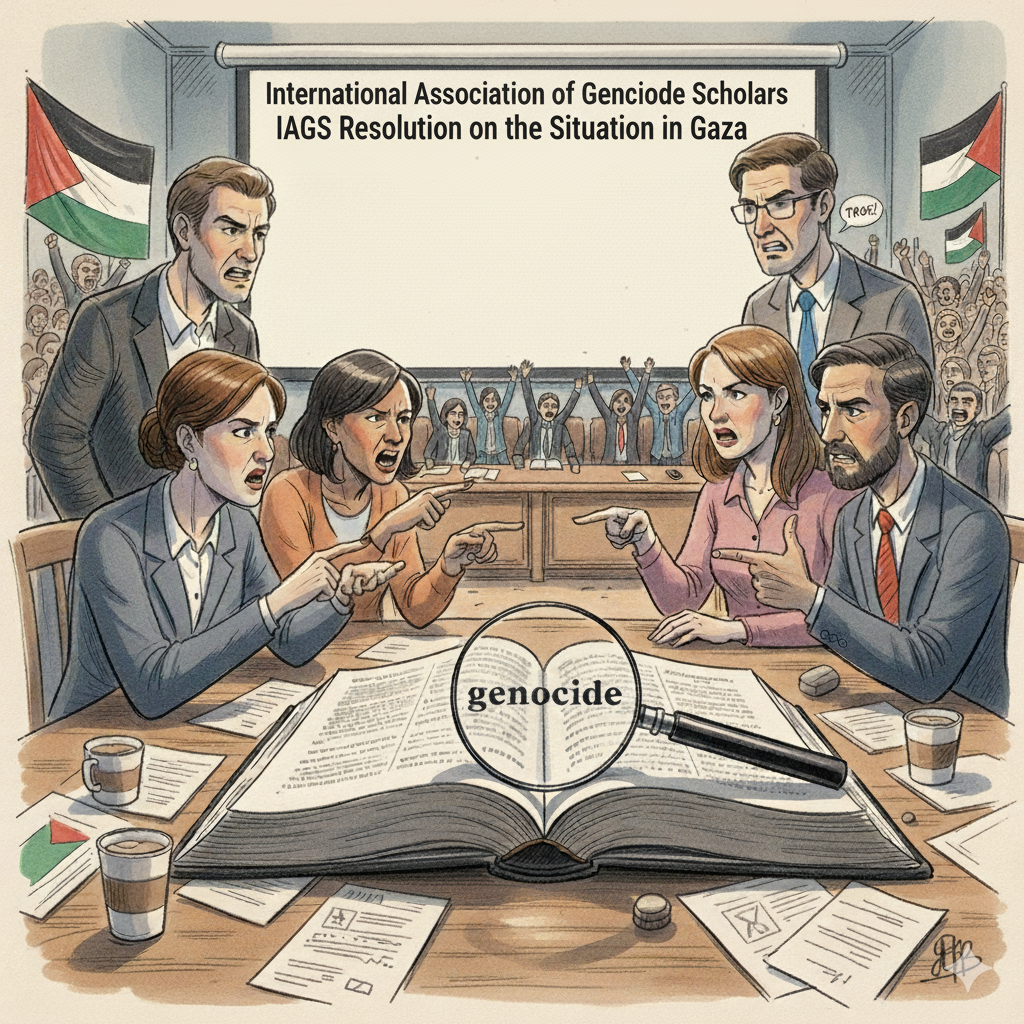
This question has taken on urgent relevance following the International Association of Genocide Scholars’ (IAGS) August 2025 resolution declaring Israel’s actions in Gaza constitute genocide. Cited as expert consensus, the resolution raises serious questions about methodological rigor, definitional precision, and the responsibilities of scholarship in politically charged contexts. A closer examination shows that its approach, prioritizing humanitarian outcomes over documented intent, marks a departure from established standards that threatens both the credibility of Genocide Studies and its capacity to serve society.
The legal framework and its purpose
Genocide is a precise legal concept under the 1948 United Nations Convention on the Prevention and Punishment of the Crime of Genocide. It requires acts committed with the specific intent to destroy, in whole or in part, a national, ethnic, racial, or religious group. This definition distinguishes genocide from other serious crimes through purpose rather than scale or suffering. Civilian casualties, infrastructure destruction, or widespread harm, however tragic, do not establish genocidal intent.
Historical precedent reinforces this principle. The Holocaust, Rwanda, Bosnia, Armenia, and Cambodia were recognized as genocides only after evidence revealed systematic targeting aimed at group destruction. Intent was established through planning documents, communications, and consistent patterns of behavior, not casualty counts or humanitarian suffering.
Standards, challenges, and scholarly responsibility
Assessing genocide in ongoing conflicts is difficult, and reasonable scholars may disagree about evidentiary thresholds. Yet these disagreements must remain within established parameters. Precision is not academic pedantry; it ensures consistency, protects the concept’s analytical power, and sustains public trust in scholarly expertise.
Some advocate for “evolving” definitions that infer intent from destruction patterns, but this approach collapses under its own logic. If wartime devastation suffices to prove genocide, then virtually every major conflict, from Dresden to Hiroshima, from Chechnya to Syria, would qualify. The result is a definition so broad that it ceases to carry meaning. Rigorous standards exist precisely to prevent this dilution, ensuring that genocide remains identifiable as a distinct crime rather than a synonym for wartime tragedy.
The IAGS resolution: Methodological departures
The IAGS resolution departs from these standards by assembling a catalogue of alleged harms, civilian casualties, infrastructure destruction, deprivation of basic needs, attacks on civilians and essential personnel, sexual and reproductive violence, forced displacement, and inflammatory rhetoric, and treating them as evidence of genocidal intent. Whether any of these allegations are substantiated, and if so, whether they constitute violations of international law, are questions for legal processes designed to investigate them. What the resolution does is aggregate them indiscriminately and present them as if they collectively prove genocide. This substitutes accusation for evidence and tragedy for intent.
In advancing this catalogue, the resolution also steps outside its mandate. Questions about humanitarian law violations are serious matters, but they are not the province of a scholarly association dedicated specifically to genocide. To gather unproven allegations and reframe them as evidence of genocidal intent is not scholarship but advocacy. It blurs the boundaries between distinct legal categories and reveals political judgment masquerading as analysis.
Procedural and governance concerns
The resolution’s passage also reveals troubling procedural failures. It was advanced without the open debates and town halls that IAGS traditionally held for such measures. Dissenting voices were marginalized, the authors were not publicly identified, and only a minority of members participated in the vote.
At the same time, the association’s expanded membership now includes NGO representatives, activists, and artists alongside scholars. Broader participation can enrich academic discourse, but when non-academic actors draft and promote resolutions under the banner of scholarly authority, it collapses the distinction between research and advocacy.
I salute whoever did this.
IAGS deserves every bit of the ridicule they are now getting.The International Association of Genocide Scholars can’t even be bothered to verify its members. Anyone with a credit card can join, as the current trolling campaign shows.
In this… pic.twitter.com/fdatrs79jZ
— Izabella Tabarovsky (@IzaTabaro) September 3, 2025
Together, these irregularities undermine the association’s credibility and compromise the professional standards on which its authority depends.
The question of comparative intent
Perhaps the most striking omission in the resolution is its silence on Hamas, the only actor in this conflict whose genocidal intent is explicitly documented. Its charter, public declarations, and operational objectives openly target Jews as a group, meeting the legal threshold for genocidal purpose with unusual clarity. No such evidence exists to suggest that Israel seeks to destroy Palestinians as a group, a distinction that must be central to any genocide analysis.
By inverting this reality, condemning Israel for genocide while disregarding Hamas’s stated aims, the resolution does not merely misapply legal standards. It undermines the credibility of genocide scholarship itself. To ignore the clearest instance of genocidal intent while projecting the charge elsewhere is not rigorous analysis but a distortion of the very principles the field is meant to uphold.
Why precision matters: Consequences of definitional inflation
Definitional precision in Genocide Studies serves purposes beyond academic clarity. When the term is stretched to encompass other forms of harm, it dilutes analytical power, fosters public confusion, and diminishes the ability to respond to genuine genocides.
Even worse, reckless accusations in politically charged contexts can amplify prejudice, legitimize harassment, and endanger vulnerable communities. When scholarly authority is invoked to cast collective blame, particularly on groups with histories of persecution, the result is not just analytical error but real-world harm. In today’s climate of rising antisemitism, accusations of genocide against the Jewish state, unsupported by evidence of intent to destroy Palestinians as a group, risk feeding hostility that extends far beyond the academy.
Broader implications: The future of the field
The deeper issue raised by this episode is not only the misapplication of legal definitions but the trajectory of the field itself. Genocide Studies derives its moral and scholarly authority from precision, restraint, and fidelity to evidence. If associations abandon those standards in favor of political advocacy, the field risks losing the credibility that gives it relevance. What is at stake is not just the interpretation of one conflict but whether Genocide Studies can continue to provide the clarity and moral seriousness that genuine prevention requires.
Final thoughts
The IAGS resolution illustrates how methodological shortcuts, procedural failures, and political agendas can converge to corrode scholarly integrity. By bypassing standards of evidence, collapsing legal categories, and ignoring documented genocidal intent while projecting the charge elsewhere, the association has traded authority for advocacy.
For Genocide Studies to serve its purpose, it must recommit to rigor, clarity, and fidelity to evidence. Scholars cannot allow the field to become a vehicle for political posturing at the cost of analytical precision. The alternative is not just academic irrelevance. It is a public sphere in which the term “genocide” is drained of meaning, antisemitism is inflamed, and the world is left less prepared to recognize and prevent real genocides when they emerge.