When Great Leaders Stop Believing in Their People
A Reflection on Parashat Chukat
There is a moment in the life of almost every visionary leader when experience begins to compete with hope. At first, they see possibility where others see obstacles. They inspire, build, persuade, and dream. But after years of setbacks, disappointments, resistance, and endless complaints, something shifts. They become a little less patient. A little more skeptical. A little less willing to believe that people can change. Parashat Chukat tells the story of one of the greatest leaders in human history reaching exactly that moment. Miriam has just died. The well that accompanied the Israelites in her merit has disappeared. The people are thirsty, frightened, and angry. Once again, they complain. And perhaps Moses has simply had enough. God instructs him:
“Take the staff… and speak to the rock before their eyes, and it shall give forth its water.” (Numbers 20:8)
But Moses does not speak to the rock. Before striking it, he turns to the people and says:
“Listen, you rebels, shall we bring forth water for you from this rock?” (Numbers 20:10)
Then he hits the rock. For generations, commentators debated whether Moses’ sin was striking instead of speaking. Yet when God explains the punishment, He says something surprising:
“Because you did not trust Me enough to affirm My sanctity in the sight of the Israelites…” (Numbers 20:12)
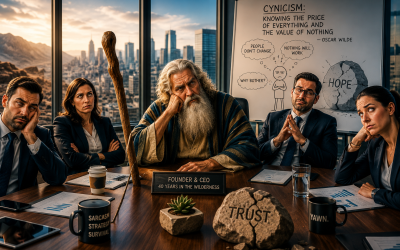
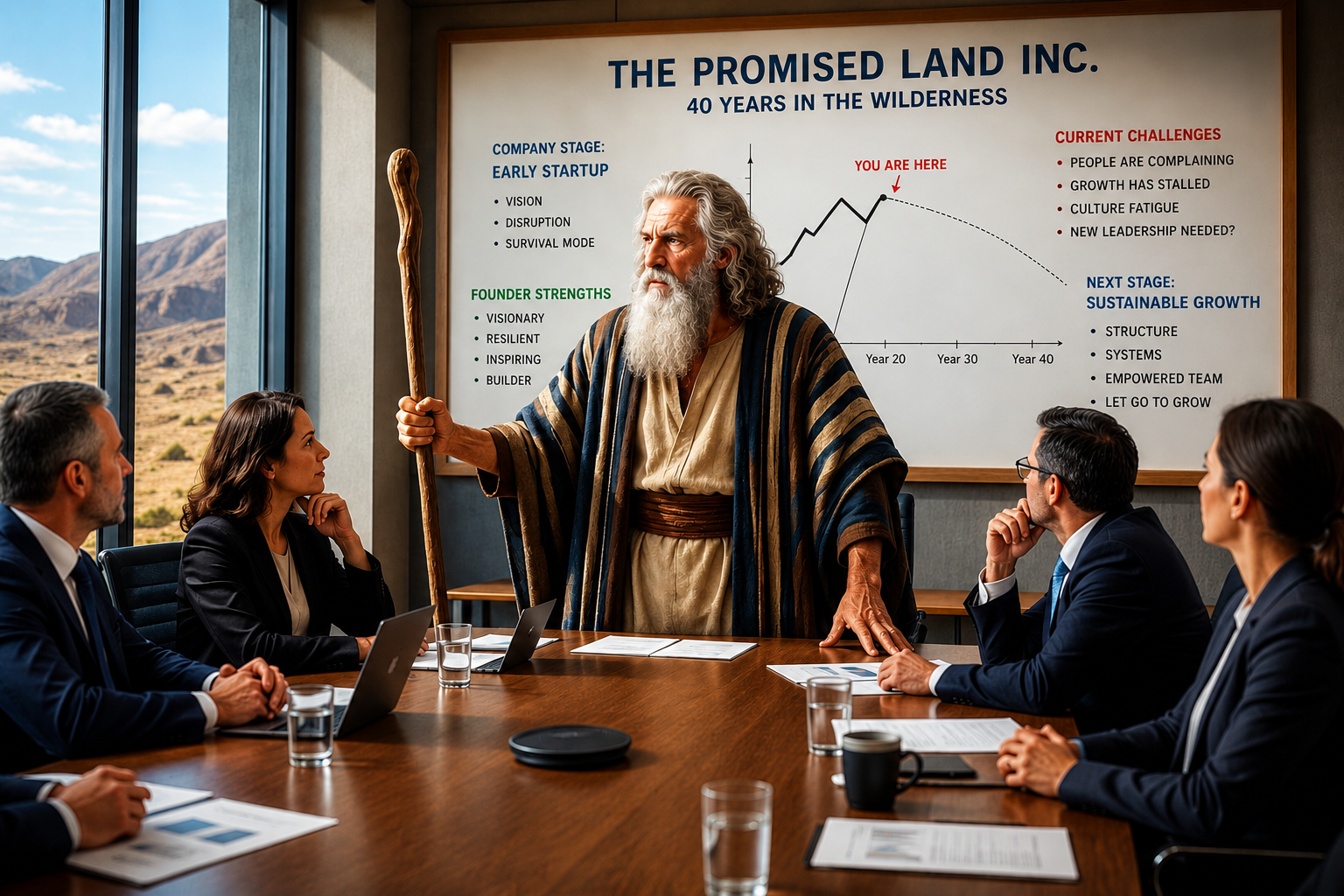
The problem was not technical disobedience. The problem was that Moses no longer believed. Not only in God, perhaps, but in the people themselves. The man who once saw slaves as future nation-builders now saw complainers. The leader who challenged Pharaoh no longer believed transformation was possible. And that may be why he could no longer lead them into the next chapter. Every stage of leadership requires different strengths. Founders often excel at creating something from nothing. They thrive on vision, courage, and persistence. But the qualities that launch a movement are not always the qualities needed to sustain it. In the business world, we call this the “founder’s syndrome”- the moment when a leader becomes so identified with an organization’s past that they struggle to guide it into its future. The Torah may be offering one of the earliest lessons in leadership succession. Moses was not a failed leader. On the contrary, he was arguably too successful. But after forty years in the wilderness, the generation had changed. The challenges had changed. The leadership style required for liberation was not necessarily the one required for entering the Promised Land. Sometimes the greatest leaders are not those who refuse to let go. They are those who recognize when it is time to pass the torch. Yet there is another lesson here, one that extends far beyond leadership. Moses’ real danger was cynicism.
Oscar Wilde famously defined a cynic as someone who “knows the price of everything and the value of nothing.” Cynicism often masquerades as wisdom. It sounds intelligent. It feels sophisticated. It protects us from disappointment. But it also prevents us from seeing possibility. Cynicism is rarely the sin of the naïve. It is usually the sin of the experienced. The more people disappoint us, the easier it becomes to assume they always will. The more institutions fail us, the easier it becomes to stop believing in change. The more often we are hurt, the more tempting it becomes to protect ourselves with sarcasm, detachment, and contempt. Yet every great social movement, every act of repair, every meaningful relationship begins with a refusal to surrender to cynicism.
The world we inhabit today offers endless reasons to be cynical. Political polarization, social fragmentation, environmental crises, war, and distrust all tempt us to lower our expectations of one another. But Jewish tradition has always been built upon a radical alternative: hope as a moral obligation. Again and again, the Torah asks us to see not only who people are, but who they might become. Perhaps that is why God asked Moses to speak to the rock. Because the future is rarely built through force. It is built through conversation. Through trust. Through the stubborn willingness to believe that transformation remains possible. The tragedy of Moses is not that he struck a rock. It is that, for one brief moment, he stopped believing in the people standing before him. And when leaders lose faith in people, people eventually lose faith in themselves. The challenge of Parashat Chukat is not merely to guard our words. It is to guard our hope. To resist the seductive comfort of cynicism. To keep believing in the possibility of growth, in communities, in democracy, in one another. Because the Promised Land has never belonged to those who know why change is impossible. It belongs to those who continue to believe it is.
Shabbat Shalom!!!
*This essay is inspired by “Biblical CEOs” a lecture series that brings biblical leaders into conversation with modern leadership theory and explores what today’s organizations can learn from ancient journeys of leadership, failure, and transformation.