
A Moroccan Journalist
When Hassan II Urged Israel’s Entry Into the Arab League [1/3]
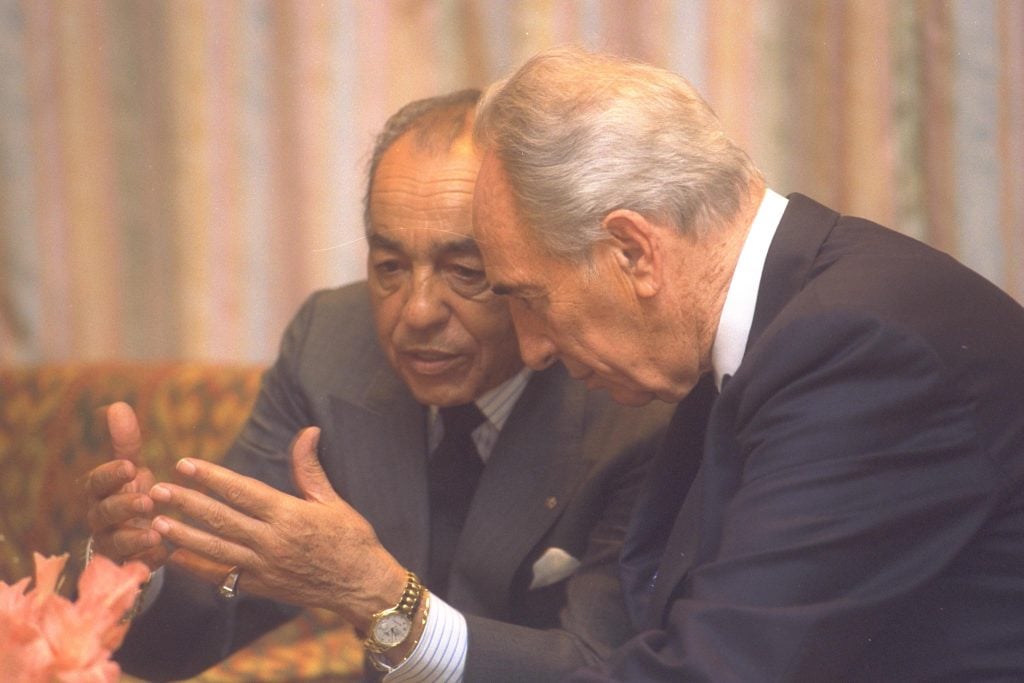
Shimon Peres and King Hassan II at the Sharm el-Sheikh summit, 1996. Credit: Avi Ohayon, GPO
Long before the Abraham Accords, long before Oslo, and long before Camp David reshaped Middle Eastern geopolitics, Morocco’s King Hassan II had already articulated one of the most extraordinary political ideas of the 20th century: that Israel should be recognized, integrated, and even admitted into the Arab League. What makes this moment extraordinary is not only what he proposed, but when he proposed it.
This proposition – today still shocking for many, and virtually unknown to younger generations – was not made during the diplomatic openings of the 1990s, nor in the hopeful diplomatic climate of the post-Cold War peace efforts, but in 1958-1959, at a private dinner in Lebanon, at a time when merely whispering such an idea could end a political career, while much of the region was still intoxicated with anti-Israel populism.
Well before peace was even part of the regional vocabulary in the 1990s, and years ahead of the traumatic wars that defined Arab political consciousness, Hassan II had already concluded that the Arab world would one day have to confront a simple geopolitical truth: Israel was not going to disappear.
This vision – radical, heretical, and prophetic – is preserved in La Mémoire d’un Roi (The Memory of a King), published by Plon in 1993, in which Hassan II recounts the arc of his political life, his philosophy of statecraft, and his direct role in nearly every Arab-Israeli diplomatic development between the 1950s and 1980s. The book, crafted as a long-form dialogue between Hassan II and journalist Éric Laurent, is unlike any other memoir produced by an Arab ruler.
Structured as a series of extended interviews, it is neither a memoir in the traditional sense nor a political manifesto; it is a window into the mindset of a ruler who believed that reason, not rhetoric, should guide the future of the Arab world. It is not defensive, not propagandistic, and not written to impress foreign allies or domestic constituencies.
Instead, it is the intellectual archive of a monarch who believed that statesmanship demanded lucidity, historical awareness, and freedom from the intoxicating illusions of Arab populism. The book offers page after page of frank, unfiltered analysis. It contains bombshell statements, candid reflections, and political diagnoses that – if uttered today – would still make headlines.
Among the most striking revelations in the book is Hassan II’s account of his earliest encounters with the Arab-Israeli conflict. He explains that his political awakening began in 1956 during the Suez Crisis, when he noticed a paradox that changed his entire worldview: when he observed a detail that most Arab leaders ignored. The Soviet Union had supported Israel’s entry into the United Nations while Britain opposed it – and then, during the Suez conflict, Britain reversed course and militarily supported Israel.
This contradiction, to him, tore through the myths of the era and unveiled a reality the Arab world insisted on denying. In his own words, he concluded that Israel was not going to disappear – not by force, not by rhetoric, and not by denial. As he recounts with absolute clarity: “When I noticed the reversal of the British, supporting Israel during the Suez war, I concluded that everyone was in agreement that Israel would endure and that this country would never be destroyed.”
This realization paved the way for the moment that would shock the Lebanese intellectuals at his 1958-1959 dinner. Hassan II, then still very young, uttered the forbidden sentence. Speaking with a clarity that was decades ahead of its time, he told them: “If I were in their place, I would recognize Israel and I would integrate it into the Arab League… It is a State that cannot disappear.”
The reaction, he recalls, was outrage. But this remark reveals the early intellectual independence of a sovereign who refused to be hypnotized by slogans. It also marks the beginning of Rabat’s unique and sometimes clandestine relationship with the Herbew state.
From this recognition emerged the seed of a grand strategic doctrine that would guide his diplomacy for decades – and that would make him, quietly but decisively, one of the earliest Arab leaders to imagine a future in which Israel was not the exception in the Middle East, but a permanent and acknowledged actor within it. It is a realism rooted in centuries of coexistence with Jews, a deep historical memory, and a refusal to surrender to the hysteria that dominated Arab political rhetoric.
Long before any formal “normalization,” Moroccan-Israeli relations were already lived, embodied, and sustained by nearly one million Moroccan Jews who eventually built lives in Israel. As Morocco’s FM Nasser Bourita would later say to Yedioth Ahronoth in 2020, normalization was merely the acknowledgment of an already-existing reality: “From our perspective, we are not talking about normalization because relations were already normal… Morocco has an important history with its Jewish community, unique to the Arab world.”
Hassan II on Israel’s identity, Ashkenazi leadership, and Arab Jews
And indeed, the king’s memoir confirms this continuum. He reminds the reader that in the 1950s, Jews in Palestine still lived culturally like their Arab neighbors: “They spoke Arabic, ate the same food, were born and raised in the same neighborhoods.” In Morocco, he adds, Jewish-Arab coexistence was not an interventionist policy or a forced ideal; it was simply a fact of life: “For centuries, Jewish-Arab coexistence formed one of the constitutive elements of this country.”
This background explains why Moroccan Jews became an integral part of early Israel. Many analysts famously say: “Israel was envisioned by Ashkenazim, but built by Moroccans.” The king shares a similar intuition: he believed Israelis of Arab origin would one day lead negotiations more effectively than the European-born elite. He explained that some were brilliant but culturally distant, whereas Jews from Arab societies “cohabited very well” with Muslims.
Hassan II himself puts this more sharply in the book. Reflecting on the voices he heard on Israeli radio in the 1950s and 1960s, he says: “In those days, some Israeli leaders I heard on the radio spoke an extremely refined Arabic. Some of them even had an excellent knowledge of the grammar of the Qur’an, like Abba Eban, who was for a long time Minister of Foreign Affairs.”
Then he contrasts this cultural proximity with the image of Israel projected by its Ashkenazi leadership: “But when I saw Israel symbolized by Mrs. Golda Meir – probably a respectable woman, but who had been a teacher in the United States and who did not speak a single word of Arabic – personally, it shocked me.”
For him, this was not a superficial issue of language. It shaped diplomacy itself: “This, moreover, is what made a solution increasingly difficult.” He then articulates a conviction that marked his entire reading of Arab-Israeli relations: “I am convinced that when Israelis of Arab origin have a real responsibility in conducting negotiations, we will seriously approach peace. They are the ones who will negotiate best.”
To understand his point, one must recall the social structure of early Zionism. In the first decades of the Zionist project, the political and intellectual elite was overwhelmingly European – Austrian, Russian, Polish, and German. They dominated the state’s founding institutions, its diplomacy, its military command, and its ideological canon. They were the Ben-Gurions, the Golda Meirs, the Moshe Sharetts, the Berl Katznelsons: all products of European political culture, socialist movements, and nationalist thinking.
By contrast, Jews from Morocco and other Arab countries arrived in Israel as part of mass immigration waves and were often placed in peripheral development towns, transit camps, and agricultural kibbutzim. They built roads, factories, farms, and new border towns, while the strategic leadership remained almost exclusively Ashkenazi. In those early years, the gap was pronounced: European-born Jews ran the state; Mizrahi Jews, especially Moroccans, physically built it.
Hassan II saw this dynamic more clearly than any of his contemporaries. He believed that Jews who had grown up in Fez, Meknes, Casablanca, Tunis, Baghdad, or Sana’a – Jews who spoke Arabic, ate the same food, lived in the same cities, and shared the same cultural codes as Muslims – would eventually become Israel’s most effective interlocutors with the Arab world. Their familiarity with Arab norms, gestures, and worldviews gave them an intuitive diplomatic advantage that Europe-born leaders lacked.
This differed profoundly from the outlook of the Ashkenazi political elite, whose formative experiences were marred by European antisemitism and pogroms. Hassan II captures this psychological transfer explicitly: “Take the case of Mr. Shamir or Mr. Begin. They were witnesses to pogroms – but those who killed Jews were not Arabs. Arriving in Israel, they immediately transposed those memories, by homothety.”
This, he argues, explains why Arab Jews approached the conflict differently: “Arab Jews generally lived very well with Muslims. In any case, without dramas comparable to those experienced in the West.”
This is why he insisted that Israelis of Arab origin “cohabited very well” with Muslims. In his mind, they were the bridge – the future mediators – long before anyone else recognized it. This observation remains astonishingly relevant: decades later, Moroccan-origin Israelis became ministers, diplomats, and influential public figures shaping Israel’s politics today.
Related Topics
Related Posts