
CEO of Time to Stand Up for Israel
When Hate Becomes Social Media Policy
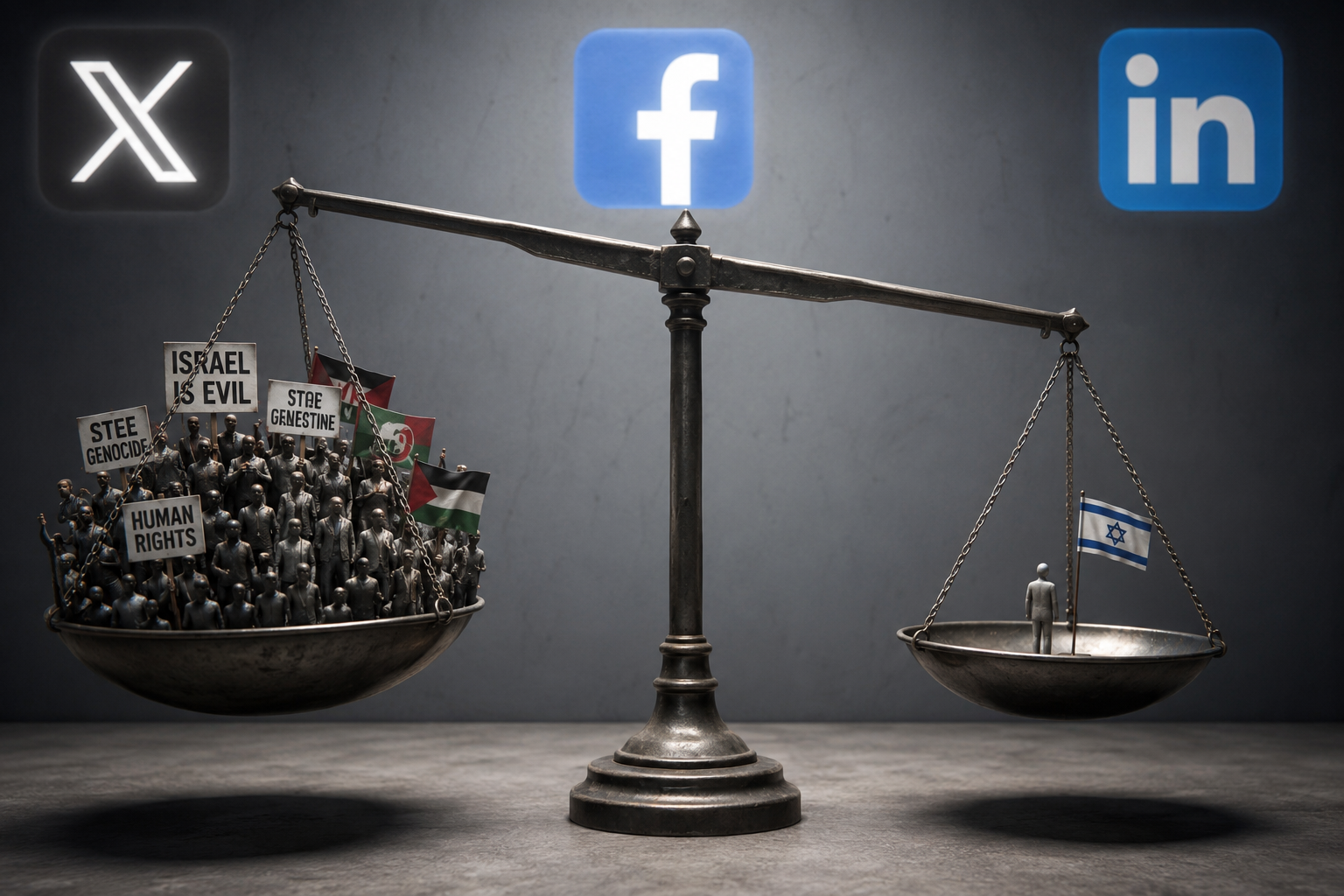
Photo Credits: Sabine Sterk (AI)
There was a time when social media promised to connect humanity. It promised dialogue, understanding, and the free exchange of ideas. It claimed to give everyone an equal voice. Today that promise feels increasingly hollow. For many supporters of Israel and for countless Jews around the world, platforms such as Facebook, X, and LinkedIn have become places where hatred is not merely tolerated but amplified on an unprecedented scale.
The most disturbing part is not simply that criticism of Israel exists. Every democracy should be open to criticism. Israel itself has one of the most outspoken and diverse public debates of any democratic nation. The real problem begins when criticism transforms into dehumanization, when Israelis are denied the same humanity granted to everyone else, and when Jews everywhere are collectively blamed for the actions of the Jewish state.
The line between anti Israel activism and antisemitism has become increasingly blurred. In many online discussions there is hardly any distinction anymore. The word Zionist has become little more than a socially acceptable substitute for Jew. People who would never openly write that they hate Jews feel perfectly comfortable writing that Zionists deserve death, that Israel should disappear from the map, or that every Israeli is a legitimate target.
Imagine replacing the word Zionist with any other ethnic or religious group. Imagine thousands of posts declaring that another nation has no right to exist, that its people deserve violence, or that they should be expelled from their homeland. Such language would rightly provoke immediate outrage. Yet when the target is Israel or Jews, many remain silent.
That silence has become one of the greatest moral failures of our time.
Facebook, X, and even LinkedIn increasingly host content that would have been unimaginable just a few years ago. Calls for violence. Celebrations of terrorism. Glorification of those who deliberately murder civilians. Conspiracy theories recycled from the darkest periods of European history. Blood libels dressed up as political commentary. Images comparing Jews to Nazis. Open praise for terrorist organizations. The sheer volume of such material would have shocked previous generations.
Even more troubling is the unequal treatment of users.
Many people who post factual information about Israel, document terrorist attacks, defend Israel’s right to exist, or simply express solidarity with Israeli victims find themselves reported, suspended, shadow banned, or subjected to coordinated harassment campaigns. At the very same time, accounts spreading misinformation, glorifying violence, or openly celebrating the murder of Israelis often remain active for weeks or months.
Whether this reflects deliberate policy, inconsistent moderation, or the overwhelming scale of content moderation is a matter of debate. The effect, however, is clear to many users. They perceive a system in which hateful speech directed at Israel and Jews receives far more tolerance than comparable speech directed at many other groups.
This creates an environment where hatred becomes normalized.
Perhaps the most alarming development is how quickly moral standards disappear online. People who would never scream at a Jewish family in the street suddenly write comments celebrating the deaths of Israeli children. Highly educated professionals share conspiracy theories that would once have appeared only on extremist websites. Business executives, academics, lawyers, teachers, and journalists repost slogans that reduce an entire nation to monsters.
The anonymity of the internet has become a mask behind which conscience often disappears.
Social media algorithms worsen the problem. Anger generates engagement. Outrage creates clicks. Hatred spreads faster than nuance. Lies travel further than facts. Every inflammatory post attracts thousands of reactions, rewarding the very behavior that poisons public discourse.
This is not merely an Israeli problem.
History has repeatedly shown that antisemitism never remains confined to Jews alone. It is often the first symptom of a society losing its moral direction. Once hatred against one minority becomes acceptable, the barrier protecting everyone else becomes weaker. The same mechanisms that normalize hatred against Jews today can be redirected against any other group tomorrow.
Supporting Israel does not require believing that every Israeli government decision is perfect. No democracy is perfect. Governments make mistakes. Policies deserve scrutiny. That is normal in any free society.
What is not normal is denying only one nation its right to exist.
What is not normal is celebrating terrorism against civilians.
What is not normal is holding Jews around the world responsible for every action taken by Israel.
What is not normal is accepting slogans calling for the elimination of the world’s only Jewish state while pretending they are merely expressions of political opinion.
A healthy society possesses a moral compass. It recognizes the difference between disagreement and hatred. Between criticism and incitement. Between political debate and racism. Increasingly, many online spaces seem to have lost that compass altogether.
Those who genuinely care about human rights should oppose hatred consistently, regardless of the target. If calls for violence against one people are unacceptable, they should be unacceptable against all people. If racism is wrong, it remains wrong when directed at Jews. If genocide is evil, then calls for the destruction of Israel should never be excused as activism.
The future of social media should not be determined by those who shout the loudest or hate the hardest. It should be shaped by truth, facts, and respect for human dignity.
Israel has the same right to exist as every other nation. Jews deserve the same protection from hatred as every other people. Those principles should not be controversial. They should be the minimum standard of any civilized society.
If our digital public square can no longer recognize those basic truths, then the problem is no longer Israel.
The problem is that we have allowed hatred to become fashionable, selective morality to replace universal principles, and silence to become complicity. A society that accepts hatred against Jews because it is politically convenient is not progressing. It is repeating one of history’s oldest and most dangerous mistakes.
Related Topics