


Bridging faith. Defending truth. Confronting hate
When Ideas Still Mattered: Remembering Liah Greenfeld
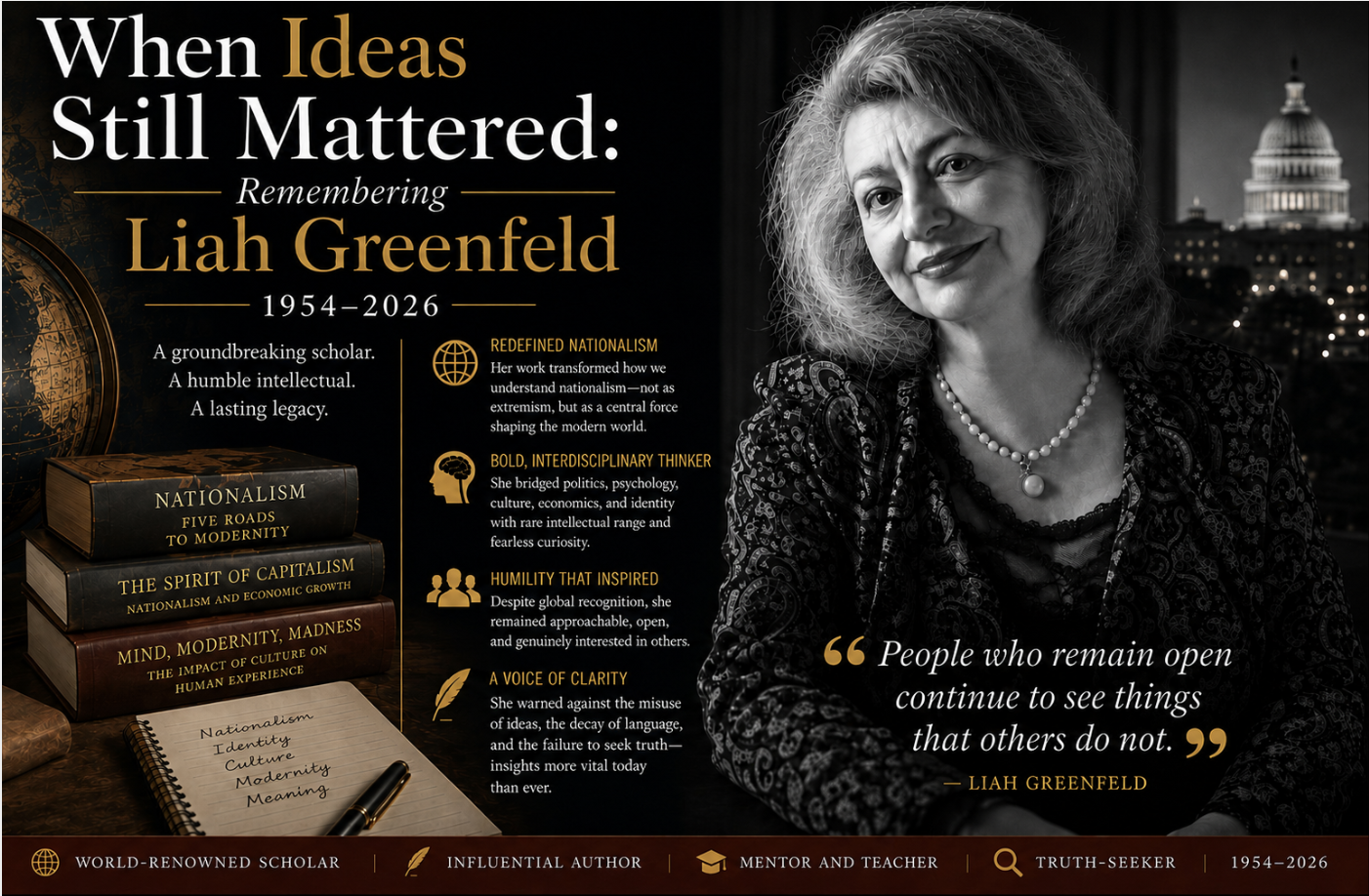
Image created from ChatGPT by Tim Orr
Liah Greenfeld’s death genuinely saddened me. While I did not know her well, we spoke every year at the Association for the Study of the Middle East and Africa conference in Washington, DC. We often ended up sitting together at breakfast before the conference sessions started, talking about politics, religion, nationalism, Islam, and whatever else happened to come up. What always struck me about her was how approachable and intellectually curious she was. Here was a world-renowned scholar and distinguished professor at Boston University, yet she never carried herself with the kind of arrogance that sometimes exists in academic circles.
I always thought that was a breath of fresh air because it’s so easy for the academic world to get wrapped up in showing off who’s more accomplished, instead of being about learning, listening, and figuring out what’s true. It wasn’t like that with Greenfeld. She had a way of being genuinely interested when she talked to people, even with someone like me who was far less accomplished academically. That really stuck with me. There was a humility about her that made conversations with her feel relaxed and natural. And maybe, looking back, it also was something that made her scholarly work so innovative and influential. People who remain open continue to see things that others do not.
Her influence on the study of nationalism was enormous. Her book Nationalism: Five Roads to Modernity, helped reshape how many scholars understood nationalism and modern identity. Greenfeld argued that nationalism was not simply extremism or tribal politics, but one of the major forces shaping the modern world itself. She connected it to democracy, economics, culture, identity, and even psychology. Later works like Mind, Modernity, Madness: The Impact of Culture on Human Experience explored how culture and systems of meaning shape human experience and mental life. What made her work stand out was that she was willing to ask large civilizational questions at a time when much of academia was becoming increasingly narrow and specialized.
One conversation with her especially stayed with me after hearing of her passing. During breakfast one morning, I asked her about the phrase “Christian nationalism,” which has become increasingly common in political and academic discussions. Obviously, there are legitimate historical situations where Christianity and nationalism have been closely connected. But I mentioned that the phrase often seemed to function today as a broad catch-all category that gets applied to everything from patriotism and religious conservatism to populism and extremism. She immediately agreed that the term was often being used far too loosely and imprecisely. I remember thinking to myself at that moment, “We are going to get along just fine.”
What I had appreciated about her response wasn’t just its politics. It betrayed something more fundamental about how she thought. Greenfeld had spent her career studying nationalism and understood how concepts can lose their precision over time, eventually becoming ideological labels rather than analytical categories. Once they do, language ceases to illuminate reality and instead becomes a tool for moral condemnation, ideological positioning, and political maneuvering. That insight has stuck with me because so much of contemporary public discourse fits that description.
In many ways, Greenfeld represented a kind of scholar that feels increasingly rare today. She belonged to a generation that believed ideas should be tested against history, evidence, and reality rather than simply evaluated according to political usefulness. Even when people disagreed with her, there was always seriousness and depth behind the argument. She approached questions about nationalism, identity, and modern society with unusual intellectual range, connecting politics to psychology, meaning, culture, and social fragmentation. She remained genuinely interdisciplinary without sacrificing depth.
Her academic career was incredibly accomplished and reflected the wide range of her intellectual interests. Before arriving at Boston University in 1994 as University Professor and Professor of Political Science and Sociology, she taught at Harvard University and held visiting positions at places like Massachusetts Institute of Technology and École des hautes études en sciences sociales. Her book The Spirit of Capitalism: Nationalism and Economic Growth influenced debates far beyond political science and sociology and also won the Donald Kagan Best Book in European History Prize. She was one of those rare scholars whose ideas spread far beyond academia, extending into conversations about culture, identity, economy, psychology, and the evolution of modern society. Most recently, a death announcement was reported by the International Political Science Association on May 13, 2026, calling her one of the leading scholars of nationalism and modernity.
But when I think about Liah Greenfeld now, I honestly do not first think about awards, titles, or academic accomplishments. I think about sitting across from her at breakfast during ASMEA conferences and having long conversations about religion, politics, nationalism, and the modern world. I think about someone with tremendous intellectual depth who still treated people with kindness, curiosity, and humility. She never came across like someone trying to impress people. She seemed truly curious about understanding things and hearing what others had to say. That kind of intellectual spirit feels harder and harder to find today. Liah Greenfeld will be deeply missed.