When Liberty Met Faith
Several years ago, I went with my family to visit the Liberty Bell in Philadelphia.
Like so many Americans, we stood there looking at that famous cracked bell and tried to imagine how much history had passed through that room. As we stood in Independence Hall, we spoke about liberty and freedom. We took a moment to appreciate the blessing of living in America as proud Jews.
But this week I read something I had never known before.
The Previous Rebbe, Rabbi Yosef Yitzchak Schneersohn, the sixth Lubavitcher Rebbe, had been there as well. He actually laid a floral wreath at this very site.
Here is the fascinating historical background.
Just over two years before this historic visit, the Previous Rebbe had been miraculously freed from a death sentence in a Soviet prison for leading Judaism underground. It was on the 12th day of Tammuz in 1927, which we will be celebrating on the Hebrew calendar tomorrow, that he was released.
He was forced to leave Russia, and eventually the Frierdiker Rebbe arrived in America for the first time on September 17, 1929, to raise money for the Russian Jews he was supporting, and also to awaken the spirit of American Jewry.
At the time, many Jews were worried about America. They called it the “treife medina,” the “unkosher country.” Along with the financial opportunity of America came great difficulty in living a Jewish life. Shabbos observance was hard. Keeping kosher was hard. Jewish education was weak and these Immigrant parents were watching their children become Americanized.
For ten months, he traveled across America, going to New York, Philadelphia, Baltimore, Chicago, Milwaukee, Detroit, St. Louis, Boston, and ending in Washington, D.C.
Jewish newspapers from that time detailed every stop with dramatic reports. It seemed like America had been transformed into a vibrant Chassidic court. Train stations filled with huge crowds. People waited for hours to see him. Jews who had drifted far from Jewish life came to see him, to hear him speak, and to have a chance to meet him.
When the Rebbe arrived at the train station in Philadelphia, a remarkable delegation of thirty rabbis came to greet him, along with prominent lay leaders, and a special delegation from the city representing the mayor, and thousands of people.
I read the Previous Rebbe’s descriptions of this day from his private diary, as well as the news reports.
The Rebbe was officially invited for a formal visit of Independence Hall, the birthplace of American liberty.
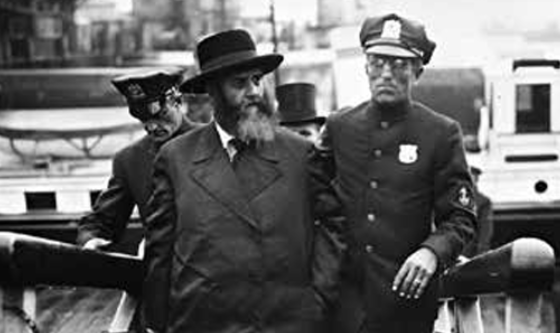
They arrived at 2:30 in the afternoon. A packed crowd was waiting, and hundreds of cars followed his procession from the train station. Streets were closed and a police honor guard escorted him.
The Rebbe himself commented on the contrast, between the Russian police who had come to arrest him, and the American police who were coming to honor him instead.
Inside Independence Hall, they entered the room where George Washington’s chair stood, the chair he sat in while presiding over the historic deliberations that helped shape the American system of government. The chair was placed high up on a stage and the area was roped off.
Normally, nobody was allowed to go up the stage.
A representative of the mayor addressed the crowd and spoke about the city’s privilege to welcome a guest who had fought so bravely for freedom of religion, one of the foundations of the American dream.
Then the Rebbe spoke from the heart. He shared how, having been imprisoned because of his religious and moral work, he could hardly find the words to describe what such a warm reception meant to him. He thanked G-d. He blessed the American people and the citizens of Philadelphia. He praised the country’s support for religion, spirit, and humanitarian values.
And then, the Frierdiker Rebbe was given the tremendous honor of being asked to sit on Washington’s chair and give the crowd a blessing.
He did indeed bless the crowd, but for me, trying to imagine that image is what gives me chills.
Imagine. A Jewish leader whom the Communist regime tried to kill was now being honored in the cradle of American freedom. The Rebbe our enemies had tried to crush was now sitting in the chair of George Washington, in the very room where the structure of American liberty had formed.
From there, they escorted him to the Liberty Bell.
There too, he was given a special honor. In those days, placing a laurel wreath near the Liberty Bell was an honor given to people who had fought for, and been victorious in, a struggle for liberty.
In his diary, the Rebbe wrote that as the community leaders handed him the wreath, he suddenly felt how the crowd became very serious. Everyone seemed to sense that this was not a regular ceremony.
At that moment, as he placed the wreath near the Liberty Bell, the Rebbe said one sentence.
“Liberty based on faith is the most proper and the strongest.”
Since reading those words, that sentence has stayed with me all week.
Because freedom is one of the most beautiful words in the world, but it is also one of the most misunderstood.
Many people think freedom means, “Nobody can tell me what to do.” I can live how I want. I can say what I want. I am free to choose what I want, when I want it, how I want it.
And of course, political freedom is a tremendous blessing. We should never take it for granted. A country that allows us to build shuls, teach Torah, keep kosher, observe Shabbos, put up a mezuzah, and raise proud Jewish children is an incredible gift from G-d.
But the Frierdiker Rebbe was expressing something much deeper. That true freedom comes from faith.
America was blessedly different from Communist Russia. In Russia, the government tried to destroy both freedom and religion. In America, the government protected the rights to both.
But even in America, in the land of the free, a Jew still must choose what kind of freedom he wants to live with.
The freedom from tyranny, or the freedom to be who I was meant to be.
On July 7, we will begin a new JLI mini-course called Sinai and Civics. This will be one of the major ideas we will be exploring in the first class on the founding ideals of America and their source in Torah values.
We will share fascinating details about how the Founding Fathers were inspired by the story of the Exodus, and how they saw their own journey across the ocean through the prism of the great Biblical story of a people leaving slavery, walking toward their destiny.
But we will also talk about the difference between “liberty” and “freedom.” Between “freedom from oppression,” and “freedom for purpose.”
That is why liberty based on faith is the strongest liberty.
Because faith gives freedom direction. Faith gives freedom dignity. Faith teaches us how to use freedom properly.
As America prepares to celebrate 250 years since its founding, we are not only approaching a milestone. We are approaching 250 years of a miracle.
For 250 years, this country has given Jews a freedom our ancestors could only dream of. Freedom to build. Freedom to learn. Freedom to educate. Freedom to speak. Freedom to gather. Freedom to be fully Jewish in the open.
That kind of freedom is not just a privilege. It is a responsibility.
We must use our freedom to live as proud Jews. Not intimidated. Not embarrassed. Not trying to blend in so completely that nobody notices we are different.
The Previous Rebbe stood at the Liberty Bell and taught America what liberty means.
He had seen how a promise of freedom without faith can turn into tyranny.
But he also saw how the American foundation of freedom built on faith can become a source of deep holiness, dignity, and connection to something greater than ourselves.
The question we must ask ourselves this coming week is how we will use our American freedom.
Will we use it just to be comfortable, or will we use it to be courageous? Will we use it to blend in, or will we use it to stand tall? Will we use it to become less Jewish, or will we use it to become more deeply, openly, and proudly who we are?
Tomorrow is the day the Previous Rebbe stood up against the Communist regime and proved that freedom will win.
But it is also the day we must remember that liberty is strongest when it is based on faith.
So let liberty ring.
Let it ring from Jewish homes filled with Shabbos light. Let it ring from doors with mezuzahs, from children learning Torah, from Jews who walk through this country with gratitude to America and pride in who they are.
Because the greatest tribute we can give to the gift of American freedom is to use that freedom to live more openly, more proudly, and more faithfully as Jews.
Good Shabbos,
Rabbi Yankie & Chana Denburg