When my Israeli son asked me ‘What is Jewish?’
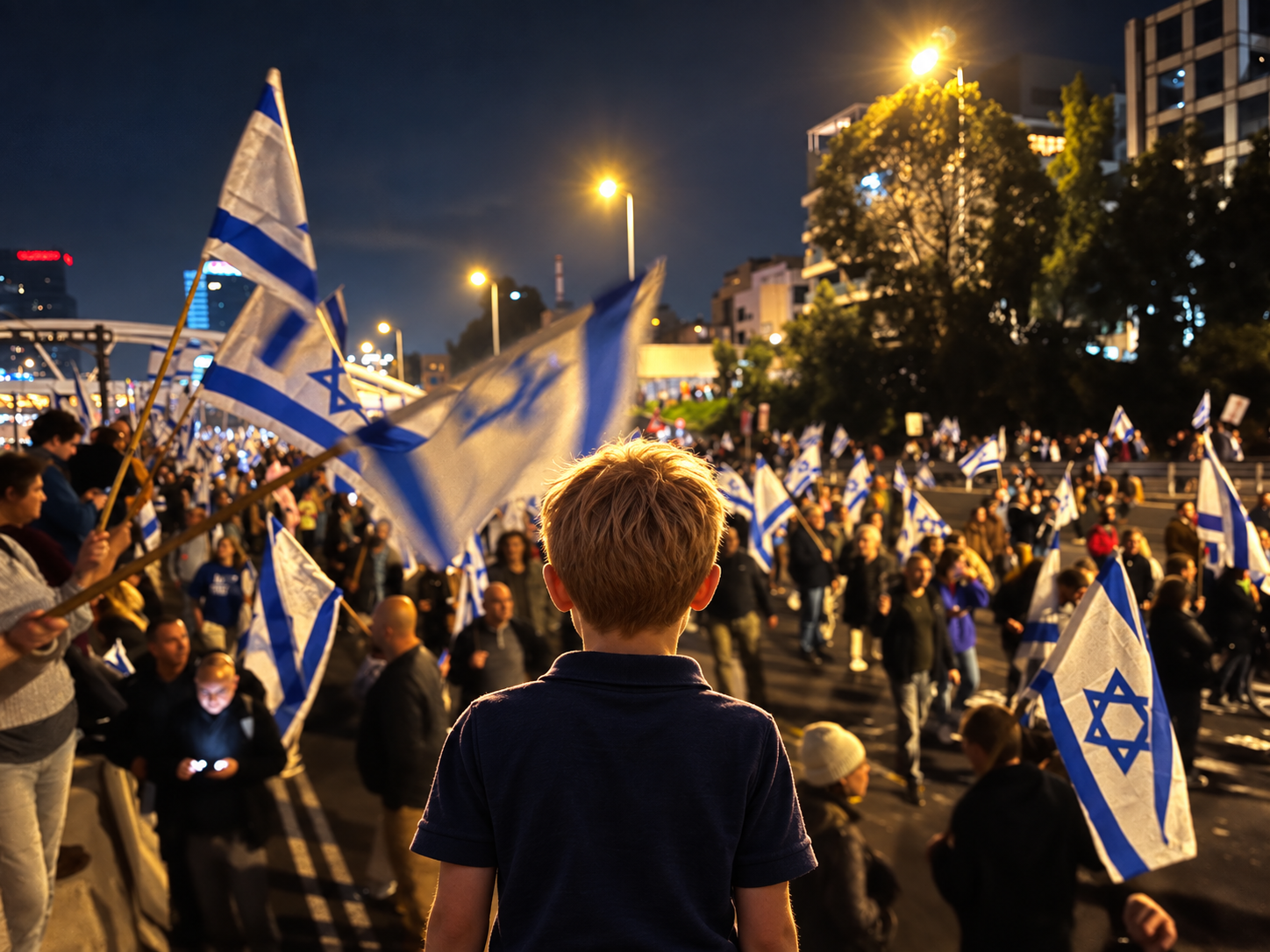
A few months ago, my nine-year-old son asked me a question I was completely unprepared for: “What is Jewish?”
It was not a philosophical question about what it means to be Jewish. He genuinely wanted to understand what the word itself meant. For a moment, I just stared at him.
We were living in Sydney, thousands of miles from Tel Aviv, where he had spent most of his childhood. We are Israeli. Hebrew is his mother tongue. He knows the songs, the food, the holidays and the slang. He knows how to stand for the siren on Yom HaZikaron. He knows that Friday afternoon has a particular feeling to it, even if nobody lights candles. He knows Purim means costumes, Hanukkah means sufganiyot, and that somehow every Israeli has an opinion about where to find the best hummus.
And yet he looked at me and asked, “What is Jewish?”
My first reaction was disbelief. How could my child not know? I also felt, for a moment, that I had failed to teach him something obvious.
I grew up in Israel, and for more than a decade I have built my professional life around Hebrew and Israeli culture, working with thousands of people around the world who are actively trying to get closer to something my son had simply been born into.
Then it hit me: maybe that was exactly the point.
The fish doesn’t know it’s wet
For generations, Zionism offered an extraordinary answer to the challenge of Jewish identity and continuity: create a place where Jews would not need to consciously manufacture Jewish life, because Jewish life would become ordinary life.
And in a profound way, it worked.
For most secular Israelis, Jewishness is not something we consciously practice. It is the water we live in.
You don’t necessarily need to light candles on Friday night because Friday night itself is Jewish. The stores close, the bus schedules change, the radio plays different songs, people start asking what you’re doing for dinner.
You don’t need to put Jewish holidays into your calendar because the country does it for you. You don’t have to explain why your children are learning Hebrew; it is simply what happens when they open their mouths.
You don’t have to construct a Jewish life because somebody has already constructed an entire Jewish ecosystem around you.
There was something magnificent and revolutionary about that.
What Happens when you leave the water
When we decided to spend a few years living in Australia, I began seeing things I had never been able to see from inside Israel. Suddenly, Shabbat was Saturday, Hanukkah competed with Christmas, Hebrew became the strange language my children spoke with their parents rather than the language of the playground.
Jewish holidays stopped arriving automatically. If we wanted them to exist, we had to create them. For the first time in my life, Jewishness required intention.
And that changed something in me.
Many Jews in the Diaspora grow up consciously choosing things that many Israelis simply inherit. They choose whether to join a Jewish community, whether to send their children to Jewish schools or camps, whether to speak Hebrew, and whether Shabbat, holidays, Israel or Jewish traditions will occupy meaningful space in their lives.
That can create its own anxiety and sense of fragility, but it also means they are often required to confront a question Israelis can avoid for years: What does being Jewish actually mean to me?
In Israel, Jewish identity can feel almost like gravity. You do not wake up every morning thinking about gravity, but you notice very quickly when it disappears.
My son’s question made me realize that perhaps Jewish identity has always required both inheritance and choice. We inherit language, stories, traditions, memories, family and history. Yet at some point, inheritance alone is no longer enough. Eventually, we have to decide what we want to make our own.
I do not want my children merely to know that they are Jewish. I do not want them to perform Jewishness correctly. I certainly do not want fear, antisemitism or a sense of obligation to become the reason they stay connected to it.
I want them to understand what they have inherited. I want them to have enough language, memories, experiences, people, rituals, arguments and love around them that one day they can decide what being Jewish means in their own lives.
I want them to be able to see the water.
Because maybe that is where identity really begins. Not when you are simply born into something, but when you become conscious enough to ask what it is.
My son may have been doing exactly that when he asked me his question. For maybe the first time, he had stepped just far enough outside the water to notice it.
And maybe my job is not to immediately give him the perfect answer; maybe my job is to make sure there is enough there for him to eventually discover his own.