

When Omissions Speak as Loudly as Words
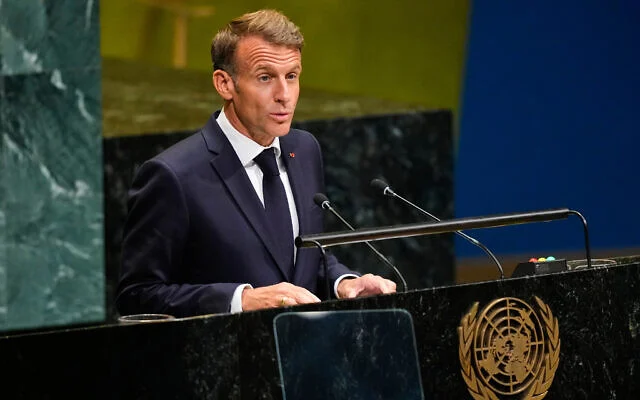
Emmanuel Macron’s speech at the UN on the Middle East deserves to be read carefully, not only for what he says, but also for what he no longer says. The official position of France remains known: security of Israel, two-state solution, Palestinian sovereignty and respect for international law. Yet, the speech of September 22, 2026 gives the impression of a shift. The doctrine displayed remains the same, but the narrative changes.
The most surprising passage concerns the West Bank. Emmanuel Macron claims that “Hamas has never cracked down on the West Bank.” This sentence is factually false. Hamas does not govern the West Bank, but it has long had networks and carried out attacks there. In response to Israeli reactions, a French diplomatic source explained that the president meant that Hamas did not govern the West Bank. It’s not the same thing.
Should we see a simple mistake? It is possible. But in a speech prepared for the UN, this error raises questions. Was this a clumsy simplification intended to strengthen the French demonstration on colonization and Palestinian sovereignty? Was this also a phrase intended for a very divided French public opinion on Gaza and Israel? Nothing allows us to confirm this second hypothesis as a fact. But the question can be asked, because an international speech is rarely addressed only abroad.
Another element is perhaps even more significant: the absence of 7 October and the hostages. In his 2025 speech, Emmanuel Macron spoke at length about the attack of October 7, 2023, the Israeli victims, the abducted people, and the demand for the release of the hostages. A year later, in his passage on the Middle East, these references disappeared.
This absence does not mean, of course, that France denied it on 7 October or that it had ceased to condemn Hamas. But it modifies the construction of the speech. In 2025, the story began with the Israeli trauma before addressing Gaza and the need for a political solution. In 2026, the center of gravity is different: Gaza, the West Bank, Palestinian rights, violations attributed to Israel, and then Israeli security.
This is where the French paradox lies.
E. Macron clearly reaffirms his commitment to the existence and security of Israel. Officially, therefore, there is no rupture. But at the same time, most of the political and moral pressure of this passage concerns Israel. France always says, “we are committed to your security,” while increasingly explaining that Israeli policy itself weakens this security.
We can therefore speak less of a change in doctrine than of a change in tone and priority. France continues to display the traditional balance between Israel and the Palestinians, but its rhetoric is becoming markedly more critical of the Israeli government.
And this message is not just about Jerusalem.
When President Macron declares that “some people are flattering themselves about a supposed peace” in Gaza, while the humanitarian routes are still not really reopened according to him, he also challenges the American narrative. Paris responds in substance: one cannot call peace a situation in which the humanitarian and political question remains unresolved.
This is a significant discrepancy. Israel is criticized for the way it seeks its security; the US is criticized for the way it defines peace.
The speech of the French president then becomes more readable. France wants to defend a line of its own: sovereignty of states, international law, two states for Israelis and Palestinians, rejection of a peace based solely on the balance of power.
But the problem lies in how to show it.
When 7 October disappears from the narrative, when the hostages are no longer mentioned, when Hamas’s role in the West Bank is denied by an erroneous formula and when criticism of Israel becomes central, the sense of balance becomes more difficult to maintain.
This is perhaps the real lesson of this speech.
France claims that its position has not changed. Formally, it is true. It continues to advocate for Israel’s security and a two-state solution. But in diplomacy, words matter, priorities matter and silences also.
Yet the silences of the 2026 speech are not those of 2025.
So the question is not whether France is ‘against Israel’. That would be too simple. The question is whether, under the guise of diplomatic continuity, Paris is not gradually shifting its center of gravity to the Middle East: still linked to Israel, but increasingly critical of it, and now also ready to challenge directly the American narrative on Gaza.