When one door closes…
Will one family’s search for roots help another discover theirs?
—
They had been there before.
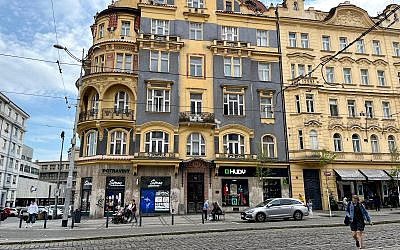
The quaint, six-story Art Nouveau building sitting on a corner in the residential Letna neighborhood of Prague seemed like a lovely place to live. Built around the turn of the 19th century, its decorative gables and arched windows sported a fresh coat of exterior yellow and gray paint and radiated Old World charm.
The building had borne witness to two world wars, the rise and fall of Communist rule following World War II, and the countless comings and goings of untold myriads of passersby. Like any structure of a certain age, the stucco-faced walls harbored stories and secrets of lives overlooked or long forgotten.
The paramount interest of two very special visitors — my wife Chana and her sister Liz — was the family that resided there in the 1920s and ‘30s. Until the family was taken from their home and transported to Tereizenstadt and Treblinka and Auschwitz.
Almost a century ago, their father, Harry Bush, and his siblings would sit out on the second-floor patio, their feet dangling through the balusters of the iron railing, watching the vibrant street life unfold below. They would spend their free time people-watching, joking, and basking in the easy laughter of childhood.
Chana and Liz had been there a few days before, on Wednesday. After completing a tour of a local castle, they had taken a cab to Letna, hoping to gain entry to their father’s building, to visit the halls where Harry and his brother Otto once caused mischief, where their sisters Helen and Greta invented magical worlds populated by their simple rag dolls.
The entrance to the complex was secured by a weathered, traditional key lock. No modern buzzers, with buttons to push in the hope of gaining access. So they sat across the street sipping Pilsner beer, their eyes trained on the building, their minds racing with scenarios of what must have transpired there all those decades ago.

No one approached the building. Their hopes faded. Their mission was as fulfilled as it was likely to get, and they returned to their hotel.
That was Wednesday.
—
Fast forward to Shabbat, and Chana and Liz were enjoying the hospitality of the Chabad house, where the Rebbetzin and her faithful crew fed hundreds of Jews from around the globe. At some point, Chana, Liz, and the Rebbetzin got to schmoozing. They explained their father’s roots and history in the city, and mentioned that he had grown up in Letna, which, they assumed, was quite far from Chabad house.
“We live in Letna!” the Rebbetzin exclaimed. “It’s only a 20-minute walk from here.”
After lunch, the sisters agreed to head to Letna. “Agreed” might be an overstatement. One of them was excited. The other wanted a Shabbat nap. Really, really wanted a Shabbat nap. But the reluctant sibling assented, and the inseparable sisters set off once again — this time on foot — to the old neighborhood.
They perched themselves on the bench outside the building and again began to wait. Not two minutes passed, wondering how they could gain entry, when a man approached, key in hand. With adrenaline flowing and eyes wide with anticipation, they approached him.
Liz quickly stated their case. “Do you speak English? Our father grew up here. We were hoping we could come in just to see the building.”
“No English. No English,” he replied with a confused and irritated look, as he nervously stuck his key in the cylinder and retreated inside.
The door was shut in their faces. The lock tumbled closed.
—
Without even time for disappointment to set in, a woman’s voice came from behind:
“I speak English.
“I live in this building.
“Would you like to come up for coffee?”
Their reaction was a mix of excitement tinged with a dose of fear. “What if she’s the daughter of a Nazi and recognizes us as Jews—or just a garden-variety European anti-Semite?” But they had come this far and were anxious to see it through.
They ascended the stairs to the top floor, along the way admiring the intricate mosaic tiles which adorned the floors and walls. Their host let them in.
They took a seat in her kitchen. She opened the cabinet to get some glasses. Inside, there was a box. It was the last box they ever expected to see in the building from which their father was deported almost nine decades prior.
—
Liz’s eyes opened wide. She quickly turned to Chana in disbelief.
“She has a box of matzah!” she whispered, trying to contain her excitement.
Ever the gutsy one, Liz posed the obvious question: “Are you Jewish?”
“YES!” the woman answered. “I am”.
Revealing her background, she explained that she had grown up in Germany after the Holocaust. Her parents, badly scarred and ever-fearful of history repeating itself, had made her promise not to divulge her heritage. They faithfully — or perhaps faithlessly — took her to church, so that her government identification would label her as Catholic. They were careful not to affiliate with anything Jewish.
But there sat the box of matzah. Not due to any religious epiphanies, but because she was in possession of her grandmother’s recipe box. And she needed matzah to grind up and make her bubbbie’s delicious knaidlach.
There are people who are Jewish in their hearts.
There are those who are Jewish in their minds.
She was Jewish in her stomach.
But it didn’t end there. They spoke at length of heritage, and belonging, and how, despite a successful career, she felt alone, and was longing to connect with her Jewish roots.
She had no idea that the Chabad rabbi and his family were her neighbors — or that she could explore Shabbat, delve into spirituality, and build Jewish connection just steps from her door.
She wanted to know more.
—
The conversation shifted from the spiritual to the historical. The yellow and gray building had been owned by an eccentric, elderly lady, who had recently passed away. The lady had grown up in the building, her parents — the previous owners — having passed it along to her.
The timeline checked out. Those parents would have owned the building when Harry and Otto and Helen and Greta and their parents, George and Elizabeta Bush, lived there. It was the last place that most of them would ever call home, before their lives were snuffed out in the death camps.
Did the owners of that infamous era take that apartment for themselves? Did they sell — and profit from — the furniture and valuables left behind? Did they rent it out to a family that was loyal to the Nazis?
In any case, the most recent owner had an impressive litany of quirks. Living in the building came with inviolable conditions:
- No couples with children — or even thinking of having children — were allowed to rent
- Tenants had to bring the monthly rent payment to her in cash, sit with her in her apartment, and share a vodka
- The front entrance would remain with a key-lock only
- Every tenant was required to play a musical instrument
- Cats were allowed, dogs were not
Certainly, a building with a colorful past. Many of those hues, no doubt, were dark and somber indeed.
—
Oh, did I mention that Miriam is the name of the woman with the covert box of matzah?
After Shabbat, Chana found Miriam on Facebook and sent her the contact information for Chabad of Prague. She seemed eager to make the connection. We hope she has, and that a fresh new chapter of her story is just beginning. Perhaps one day we will see.
—
After their first unsuccessful attempt that Wednesday, Chana and Liz returned to Letna on Shabbat with little more than a thread of hope — to brush against their father’s past, to stand where he once played, to feel some lingering warmth from a world lost.
They didn’t just find echoes. They found a soul still stirring in the walls.
A stranger with a box of matzah.
A neighbor seeking her roots.
A connection waiting, just behind a closed door.
Perhaps that door didn’t stay shut after all.
—
When one door closes, another opens.
And sometimes, if you knock softly enough — and wait long enough — it opens into the past, and into the future, all at once.