A New York City Cantor
When Prayers Precede Politics
I am not the political voice of my congregation. I am a spiritual voice. My calling is not to tell people how to vote, but to remind them that our prayers provide inspiration and meaning and that they tie us to a shared legacy and destiny. I teach how prayer lifts our hearts, our memories, and our voices toward something higher than the noise of the day.
But sometimes the sacred and the political collide so forcefully that silence feels like complicity, a sin of omission. The recent mayoral election in New York City, and the candidacy of Zohran Mamdani, among many other similar candidates across the country, have brought us to such a moment.
My rabbi, Ammiel Hirsch, modeled how moral leadership can sound when it is rooted in conscience rather than partisanship. He didn’t tell his congregation how to vote. He spoke directly to Mamdani himself, appealing to him as a fellow New Yorker, urging him to consider the danger of his words and the pain they cause our community.
When Rabbi Hirsch spoke, I felt the same ache: a sense that our very identity was being twisted into a political weapon in NYC and beyond. That is why I joined over a thousand other clergy in signing A Rabbinic Call to Action: Defending Our Jewish Future, a letter that spoke clearly for Zionism as the Jewish Majority and against the normalization of antizionism in public life.
The letter’s purpose was simple: to decry the use of antizionism as a political strategy and to call for moral clarity among clergy. We did not endorse a candidate or a party. We stood for a principle: that Jewish safety and dignity cannot be negotiated away by campaign slogans.
The backlash was swift. Clergy supporters of Mamdani labeled the letter “divisive,” a “witch-hunt,” and “anti-Mamdani.” Yet many of those same critics have themselves signed onto multiple organizations and letters since October 7 that have made false accusations against Israel of war crimes, famine, and denying Israel’s right to defend itself as early as October of 2023. When those same voices call our defense of Zionism “divisive,” the hypocrisy speaks for itself.
In recent weeks, a new letter titled Jews for a Shared Future has begun circulating among the same familiar circle of rabbis, cantors, kohanim, kohanot, maggidim and other Jewish spiritual leaders. Its text reads, in part:
“In response to Jewish concerns about the New York mayoral race, we recognize that candidate Zohran Mamdani’s support for Palestinian self-determination stems not from hate, but from his deep moral convictions… Jewish safety cannot be built on Muslim vulnerability… Our traditions teach us that justice is indivisible.”
At first glance, it sounds compassionate and measured. It invokes pluralism, interdependence, and mutual safety. But beneath the pastoral language lies a troubling moral equivalence. The letter affirms Mamdani’s moral integrity while offering not one word of concern for his rhetoric, his alliances, or his policies and the threats they pose to Jewish safety in New York.
Even more concerning is who is promoting it as part of a broader pattern. Dozens of the signatories are activist graduates of the Reconstructionist Rabbinical College and leaders, often without pulpits, working within Jewish antizionist organizations who have signed on to multiple efforts critical of Israel since October 7. They have been actively recruiting students from other rabbinical schools to sign on to letters that do not represent the mainstream of the Jewish community, part of a strategy of ideological outreach masquerading as “dialogue.” This pattern, framed as coexistence, shared values, and interdependence is, in truth, an effort to normalize antizionist equivalence under the banner of moral progressivism. It seeks to transform future clergy into ambassadors of a theology that blurs the distinction between compassion and capitulation.
These are the same voices who denounced our rabbinic call for Zionism as “too divisive,” even as they now circulate their own “Shared Future” letter, lobbying fellow clergy to sign. Their moral inversion is staggering. The very people who spent years condemning Israel are now preaching about pluralism, accusing those of us who defend Zionism of causing division. It is a performative unity that demands silence from Jews who refuse to renounce our homeland. The media cannot continue to place these fringe groups of clergy on an equal footing with the signatories of the first letter who represent the mainstream majority of the Jewish community.
Many people, even some Jews, think of Zionism as a modern political ideology born in the cafés of 19th-century Vienna. But as a cantor, I see something far older, deeper, and holier. Zionism runs through our ancient prayer books, our Torah, and our daily longing.
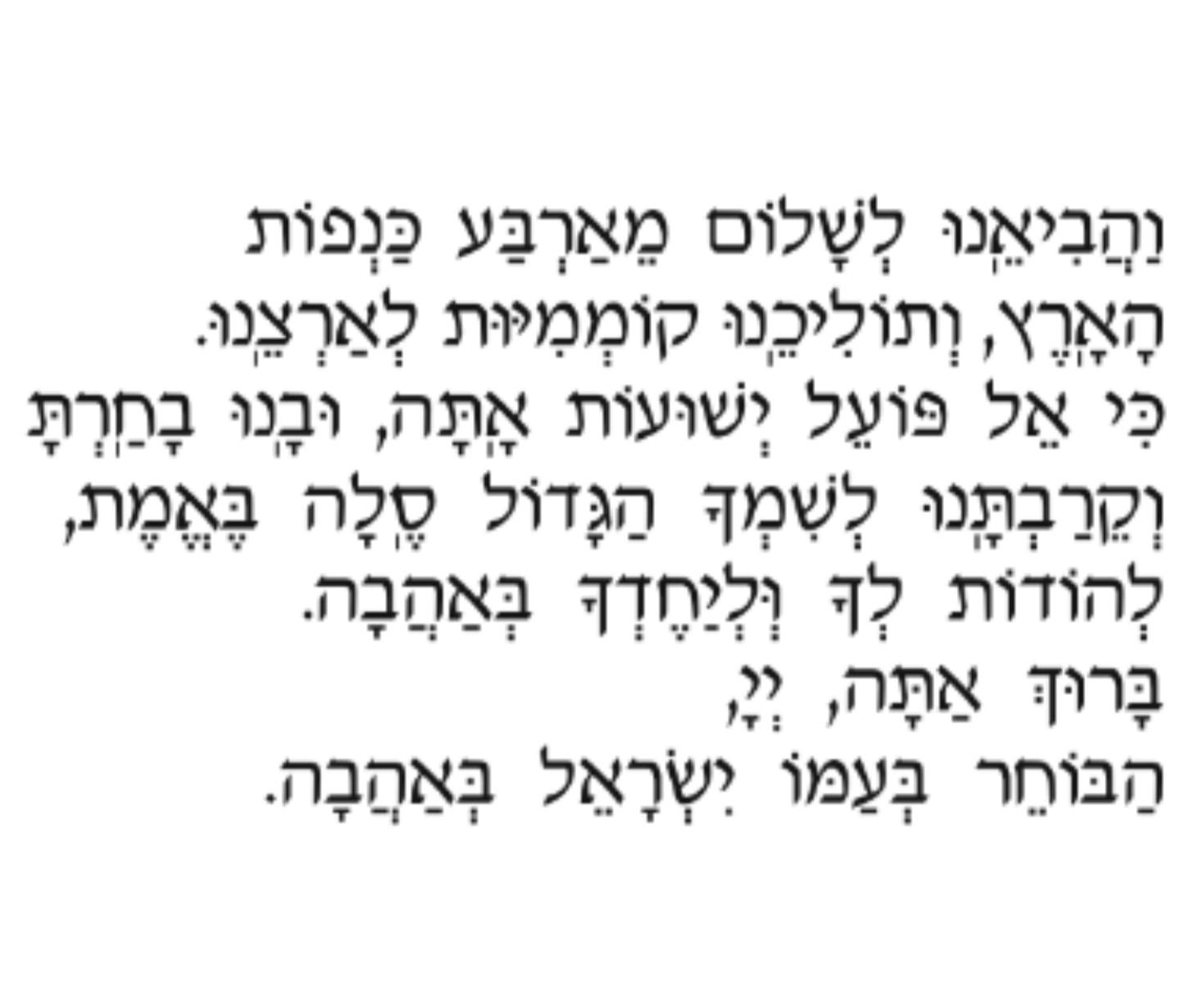
V’haviyeinu l’shalom, “Lead us in peace,” we sing before the Shema. It is not simply a request for calm; it is a plea to be gathered from the four corners of the earth, me’arba kanfot ha’aretz, so that we may stand upright, komemiyut, in our land, b’artzeinu. When we touch the four fringes of our tallit, we recall the four unfinished corners of our world that we are commanded to repair through mitzvot: not mere good deeds, but divine obligations meant to bind us together in unity as a Jewish people.
That prayer was written long before Herzl, long before Ben-Gurion. It is, at its heart, a Zionist prayer. It does not ask for domination. It asks for dignity: to stand upright, not bowed, not humiliated, not scattered, but home.
When we pray for the ingathering of exiles, we are praying for unity and renewal, for a world in which Jewish sovereignty is a sacred trust, not a political bargaining chip. When we say L’shanah haba’ah b’Yerushalayim, “Next year in Jerusalem,” at the close of both our religious and agricultural new years, Yom Kippur and Passover, we affirm a truth that transcends politics: the right of the Jewish people to live freely and safely in our ancestral homeland.
This election forced New Yorkers to confront a question too many clergy have been reluctant to answer: what happens when political rhetoric erases moral boundaries?
Mamdani’s refusal, for months, to disavow the slogan “Globalize the Intifada,” a phrase historically bound up with violent uprisings against Jews, revealed how easily moral relativism replaces moral courage. Only after significant backlash did he announce he would stop using it, but we miss the forest for a tree when we focus only on one dangerous catchphrase. Mamdani is still a very proud founder and member of Students for Justice in Palestine and the Democratic Socialists of America, groups that champion this phrase and far worse, terrorize Jewish students on campuses across America.
His troubling associations deepen the concern. Mamdani was photographed with Imam Siraj Wahhaj, once named an unindicted co-conspirator in the 1993 World Trade Center bombing, a preacher who has advocated for the erosion of democracy in favor of Islamic law and made violent anti-LGBTQ+ statements. Mamdani praises this Imam as “one of the nation’s foremost Muslim leaders.” He also met with Rebecca Kadaga, the Ugandan official associated with that country’s infamous “Kill the Gays” legislation. And his close mentor, Linda Sarsour, who plans to hold Mamdani accountable to her agenda, announced that the largest contributor to Mamdani’s campaign, by far, was CAIR, the media arm of the Muslim Brotherhood, a rebranding of the Holy Land Foundation, the same “Holy Land Five” that Mamdani praised as a rapper that had been found criminally guilty for funding Hamas.
To point this out is not Islamophobic; it is factual. Even Gazan-born activist Ahmed Fouad Alkhatib, a Palestinian voice for peace and Hamas critic, warned that Mamdani’s failure to call on Hamas to disarm after the Trump-brokered ceasefire was dangerous and morally indefensible. If a Palestinian from Gaza can say so plainly, surely New York’s Jewish leaders can as well.
And yet, the “Shared Future” letter refuses to acknowledge any of this. It excuses Mamdani’s moral evasions as “deep convictions,” sanctifies his political ideology as “self-determination,” and chides Jews for not being sufficiently pluralistic in response. It confuses empathy with surrender.
The contrast between the two letters could not be starker. A Rabbinic Call to Action calls for moral clarity in the face of rising antisemitism and antizionism. Jews for a Shared Future calls for moral equivalence in the face of moral crisis.
One confronts hate; the other accommodates it.
One is anchored in faith; the other drifts in sentimentality.
One believes that Jewish self-determination is sacred; the other treats it as negotiable.
To pretend both letters speak from the same moral tradition is to confuse conscience with comfort.
When clergy elevate platitudes about “shared humanity” over the real threats facing their own community, they transform compassion into cowardice. Our tradition commands empathy, but never at the expense of truth. Lo ta’amod al dam re’echa, “Do not stand idly by the blood of your neighbor.” Silence in the face of incitement or terror is not empathy; it is abdication.
Before B’nai Mitzvah, I remind students that there is no commandment for this rite of passage. The mitzvah they’re fulfilling, for their parents, is V’shinantam l’vanecha, “You shall teach them diligently to your children,” in the Shema, a daily reminder we’ve carried with us in every mezuzah and tefillin box for millennia, which immediately follows our Zionist prayer. That is what it means to become a Jewish adult: to carry forward our people’s story with clarity and courage.
Remaining silent about moral threats, whether from the far right or the far left, betrays that commandment. To normalize alliances with bigots or extremists under the banner of “shared humanity” teaches our children that boundaries are bigotry. That is a spiritual failure.
We cannot allow that confusion to take root. To teach Torah without Zionism is to remove the spine from the body.
Zionism isn’t a campaign slogan. It’s not owned by a political party. It is a faith position, a belief that our people’s return to our land is part of a divine story still unfolding. It is why our prayers end not with despair but with direction. It is why our Torah ends with the word “Israel” – the entire story of our people leads us back to our land.
That’s what our prayers tell us. That’s what our clergy should be teaching. And that’s what I, as a cantor, will keep singing, even when others call it divisive.
Because when our politics grow ugly, our prayers must grow louder. And when the voices around us chant for intifada, I will answer in the language of our ancestors:
“Gather us together in peace from the four corners of the earth, and lead us upright to our land.”
That’s not hate. That’s hope.
That’s not politics. That’s prayer.
Related Topics
Related Posts