When Protest Forgets Its Purpose
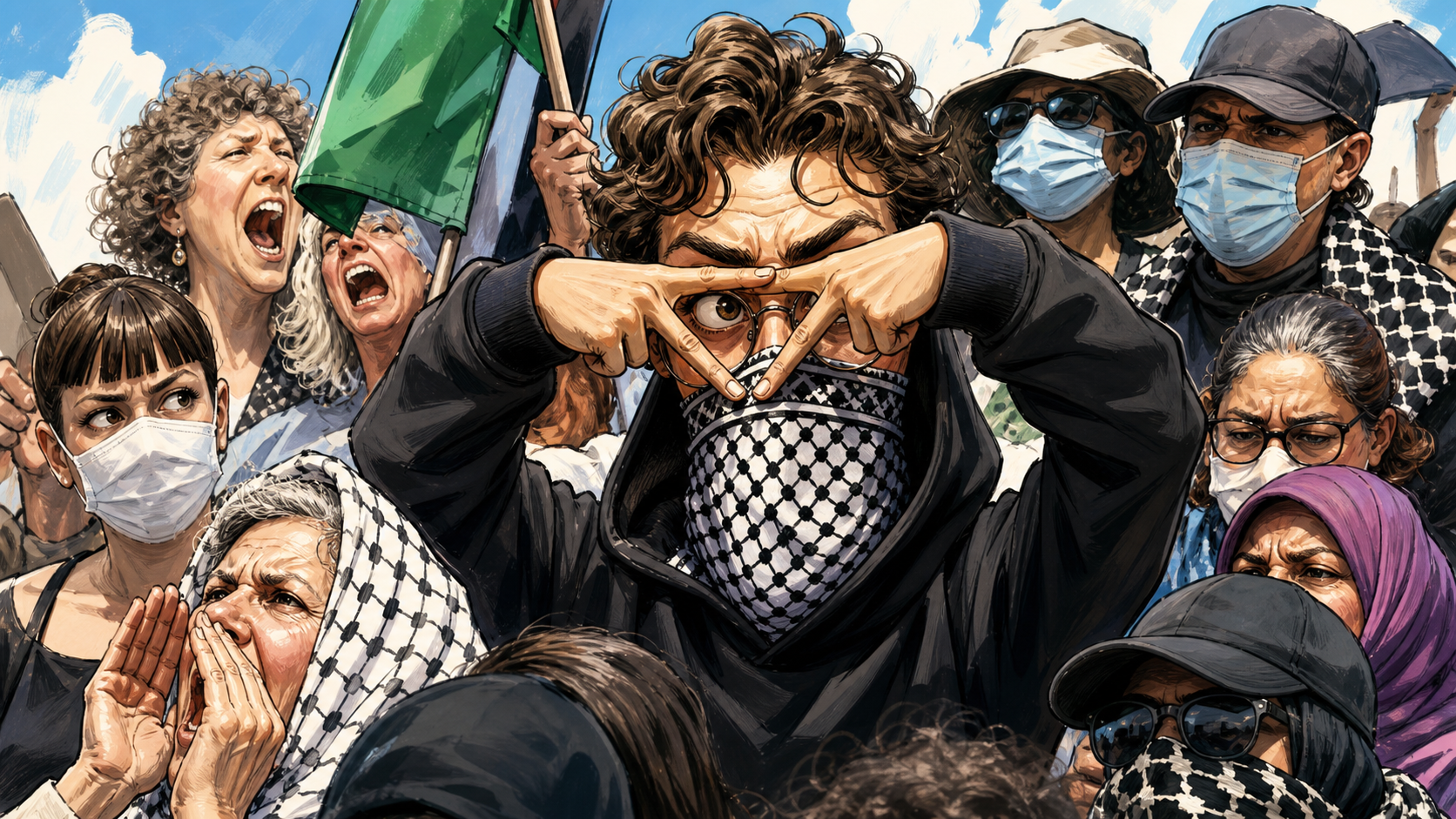
There is a venerable tradition in democratic life called protest. It is noisy, inconvenient, often theatrical, and at its best morally serious. It exists to put pressure on power, to embarrass the complacent, to remind the powerful that they are not, in fact, ordained by heaven. It is one of the finer inventions of civic life.
What it is not is a licence for intimidation dressed up as conscience.
That confusion appears every time a campaign against Israeli policy, Israeli businesses, or Israeli cultural activity drifts, predictably and with growing bad faith, towards Jewish communal life itself. One moment we are assured that the target is politics. The next, a synagogue is surrounded, a community event is hounded, and a foreign conflict is neatly transformed into local hostility against Jews.
That is not brave dissent. It is moral laziness with a placard.
Criticism of Israel is neither novel nor forbidden. Democracies do not require agreement to remain democratic. Disagreement, if expressed properly, is part of the bargain. One may oppose settlements, condemn ministers, challenge military conduct, denounce policy, and do so with all the force one can muster. That is legitimate political speech.
But when protest stops distinguishing between a state and a people, between a government and a synagogue, between policy and identity, it loses the moral clarity it claims to have. It becomes less an act of conscience than an exercise in selective blindness.
The defenders of these campaigns are fond of solemn disclaimers. None of this, they insist, has anything to do with Jews. It is all about Israel, as though that settles the matter. But geography and motive have a way of exposing what slogans try to conceal. If the objection is to Israeli policy, why is the protest aimed at a Jewish venue in London rather than at a political institution, a diplomatic office, or any place that bears a direct relation to the state in question?
The answer, plainly, is that the venue matters. The symbolism matters. The pressure matters. And once a campaign chooses Jewish communal space as its theatre, it has crossed a line that no amount of rhetorical polishing can erase.
There is a particular cowardice in this kind of activism, though it likes to dress itself in the language of righteousness. It relies on the hope that the public will be too polite, too confused, or too frightened of seeming insufficiently enlightened to say what is obvious: that intimidating a community because of events in the Middle East is not principled politics, but collective blame in more fashionable clothes.
And let us not pretend this confusion is harmless. Public life depends on telling the difference between criticism and persecution, between argument and harassment, between protest and menace. When those distinctions blur, it is not only Jewish communities that suffer, though they do. It is the civic order itself. If one minority can be made to answer for the sins, real or imagined, of distant actors, then the principle protecting every minority has begun to fail.
That is why so much of the language surrounding these incidents is revealing. We are told to contextualise, historicise, understand the emotion, as though any act becomes respectable once enough explanatory footnotes are attached. But sometimes context does not soften the offence. It sharpens it. A protest outside a synagogue is not made more noble by the fact that the protesters have opinions about geopolitics. A crowd is not a seminar simply because it arrives carrying slogans.
The real test of principle is whether it still holds when inconvenient. If collective blame is wrong, it is wrong for Jews as much as for anyone else. If religious spaces deserve protection, then they do not stop deserving it when their congregants hold views that anger activists. And if protest is to remain legitimate, it must know where protest ends and menace begins.
We should also be suspicious of the modern performance of moral seriousness. Some of the loudest voices in these campaigns speak as though they alone possess the key to justice, while everyone else is a dupe, a collaborator or an idiot. It is a style of politics that flatters the speaker magnificently and enlightens nobody. It replaces persuasion with assertion, argument with choreography, and empathy with certainty.
The result is spectacle. And spectacle, unlike conscience, is easy to amplify.
There is an old test of moral consistency: apply your principle universally and see whether it still holds. If you would be appalled by a crowd outside a mosque because of the policies of a Muslim-majority state, or outside a Hindu temple because of events in Delhi, then you should be appalled by the same behaviour outside a synagogue. If the principle changes depending on the target, it is not a principle. It is preference, with a better publicist.
And so we arrive at the uncomfortable point many prefer to avoid: some campaigns, though they claim the language of justice, are animated by a far uglier instinct. They do not merely oppose policy. They make Jewish life more conditional, more fearful, more contestable. That is coercion wearing a moral badge.
Democracy can survive criticism. It cannot survive hypocrisy forever. Jewish communities, like all communities, have the right to live, gather, worship and celebrate without being dragged into someone else’s ideological war.
A healthy protest movement knows whom it is addressing and why. A sick one keeps finding itself at a synagogue door, then wonders why it is not being applauded for nuance.