


Critiquing Ireland's "anti-Zionist" mindset
When Push comes to shove will ‘Unity Shape Love’
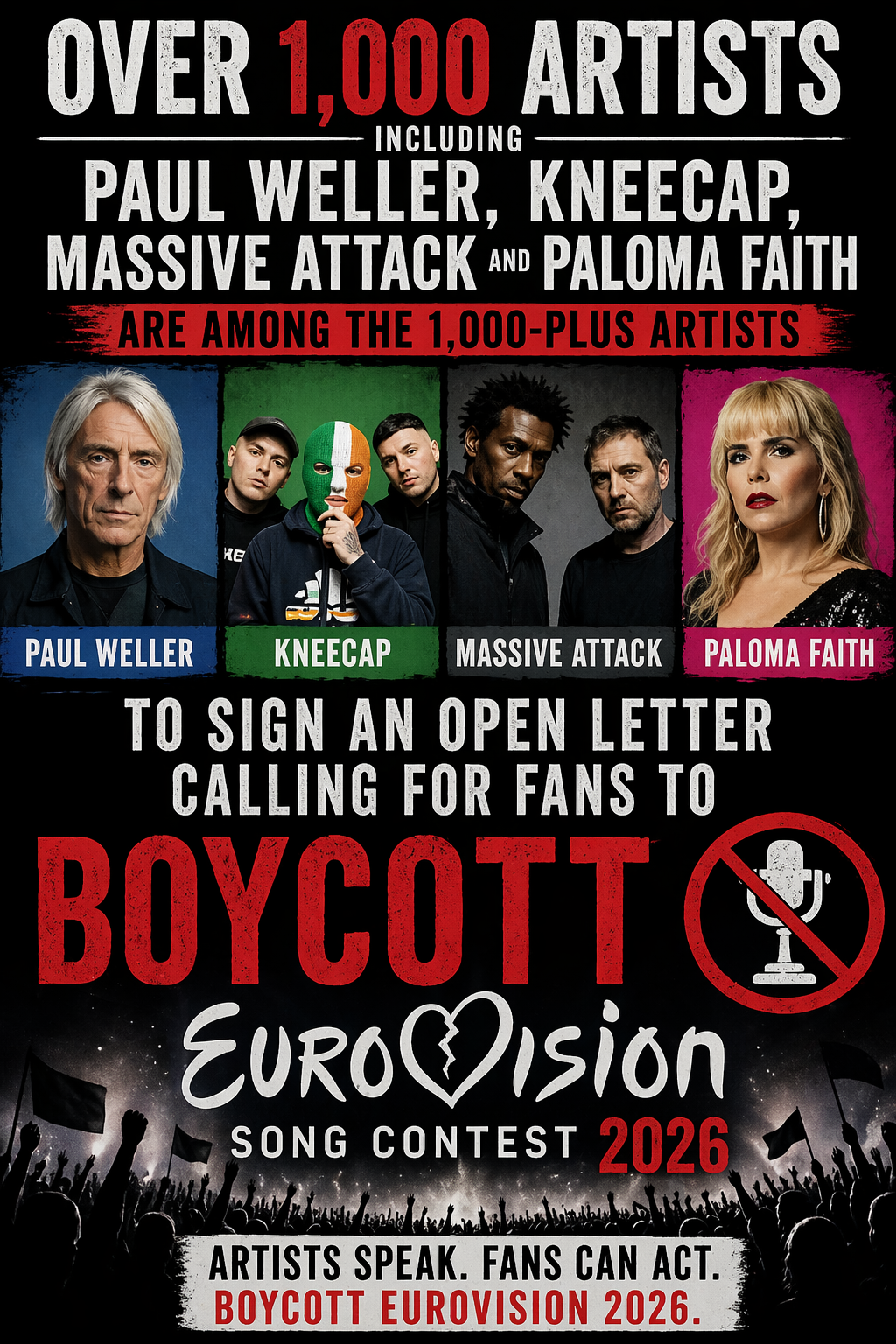
On Tuesday (21 April, 2026), a letter organised by No Music for Genocide and the BDS movement called on fans and performers to boycott Eurovision unless the European Broadcasting Union (EBU) bans Israel’s public broadcaster, KAN from the contest.
“As musicians and cultural workers, many living within the reaches of the [EBU], we reject Eurovision being used to whitewash and normalise Israel’s genocide, siege and brutal military occupation against Palestinians,” the letter states, in part.
Israel has consistently denied that it is committing genocide in Gaza, framing its attacks as self-defence against Hamas following the 7 October 2023 attacks. (1)
Political controversy is not new to the Eurovision. So far, in recent times, the contest has been politically affected by the following:
Russia’s disqualification (2022) after the invasion of Ukraine is one of the most significant modern examples, but it’s not mentioned in your list.
Ukraine 2016 (“1944” by Jamala) — widely discussed as a political entry despite EBU rules.
Belarus exclusion (2021) due to political content in submitted songs.
Voting bloc politics (e.g., Nordic/Balkan bloc voting) has long been debated as a structural “political” issue.
- Azerbaijan-Armenia tensions are mentioned, but not the broader recurring incidents (voting controversies, alleged surveillance issues in past contests).
- Is Eurovision an appropriate cultural space that should remain politically neutral in participation? Some argue yes, and that it should stay inclusive of all member broadcasters regardless of geopolitical disputes.
- Is it legitimate for artists and audiences to withdraw participation or support to protest decisions they see as ethically unacceptable? In liberal democracies, that’s generally considered a protected form of expression—even when it’s controversial or unpopular.
And then we have Israel’s involvement in the Eurovision…
In 1973, Israel became the first country from outside of Europe to enter the Eurovision. Impressive! It has remained a regular competitor in the contest and been crowned winner on four occasions.
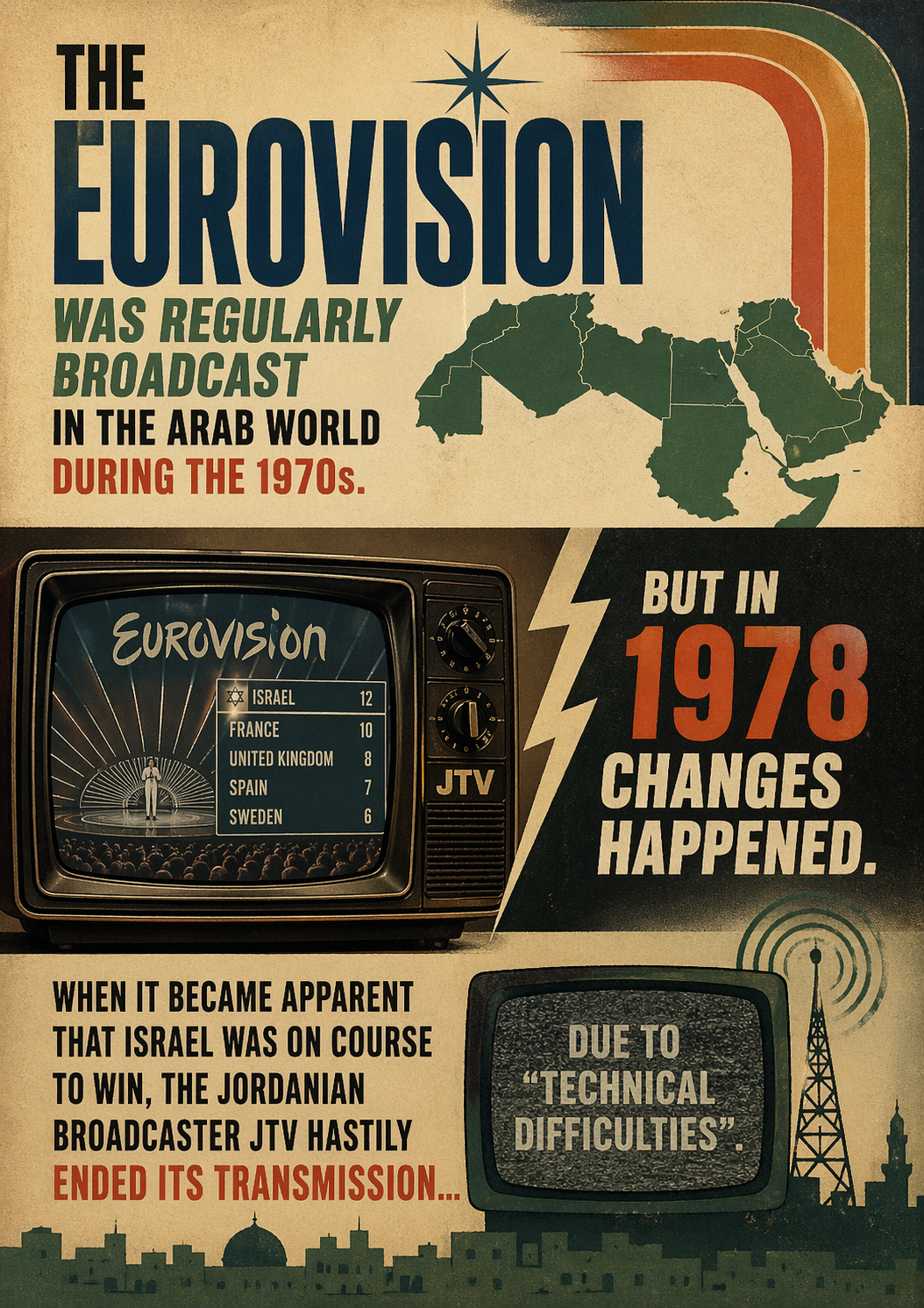
The Eurovision was regularly broadcast in the Arab world during the 1970s. But in 1978 changes happened. When it became apparent that Israel was on course to win, the Jordanian broadcaster JTV hastily ended its transmission… due to “technical difficulties”. (1)
Many Eurovision-eligible Arab states choose not to enter because of Israel’s presence. Perhaps Koranic cultural deficit hampers song-writing abilities in those countries? Or is the real reason for abstention because the mullahs state that music is ‘haram‘ (forbidden)? (2)
Those absentions are hardly due to petty political pique and point-scoring, are they??
What are the idealistic aims of the Eurovision?
Every May, many millions of viewers watch Eurovision. Some people groan at the banal bubblegum lyrics; others gasp at the outrageous costumes. Social media evolves with many memes, nerds learn about contestants and express opinions of the asinine songs.
But where and how did it all start? After World War 2, some European countries wanted to collaborate together, leading to the beginning of the European Broadcasting Union in 1950. For sixty years Eurovision has featured 1,500 songs, spanning many different genres, sung in a polyglot panoply. Ireland has won Eurovision seven times.
The case that Eurovision is not meant to be political
Supporters of the EBU’s position argue that Eurovision is fundamentally a cultural and artistic event, and that political interpretation is imposed externally rather than built into the contest itself.
The official rules are clear: songs must not contain political messages, and performances that breach this principle can be disqualified. This is intended to protect Eurovision as a shared entertainment space rather than a diplomatic battleground. That aspirational theme belies the simmering tensions behind the scenes.
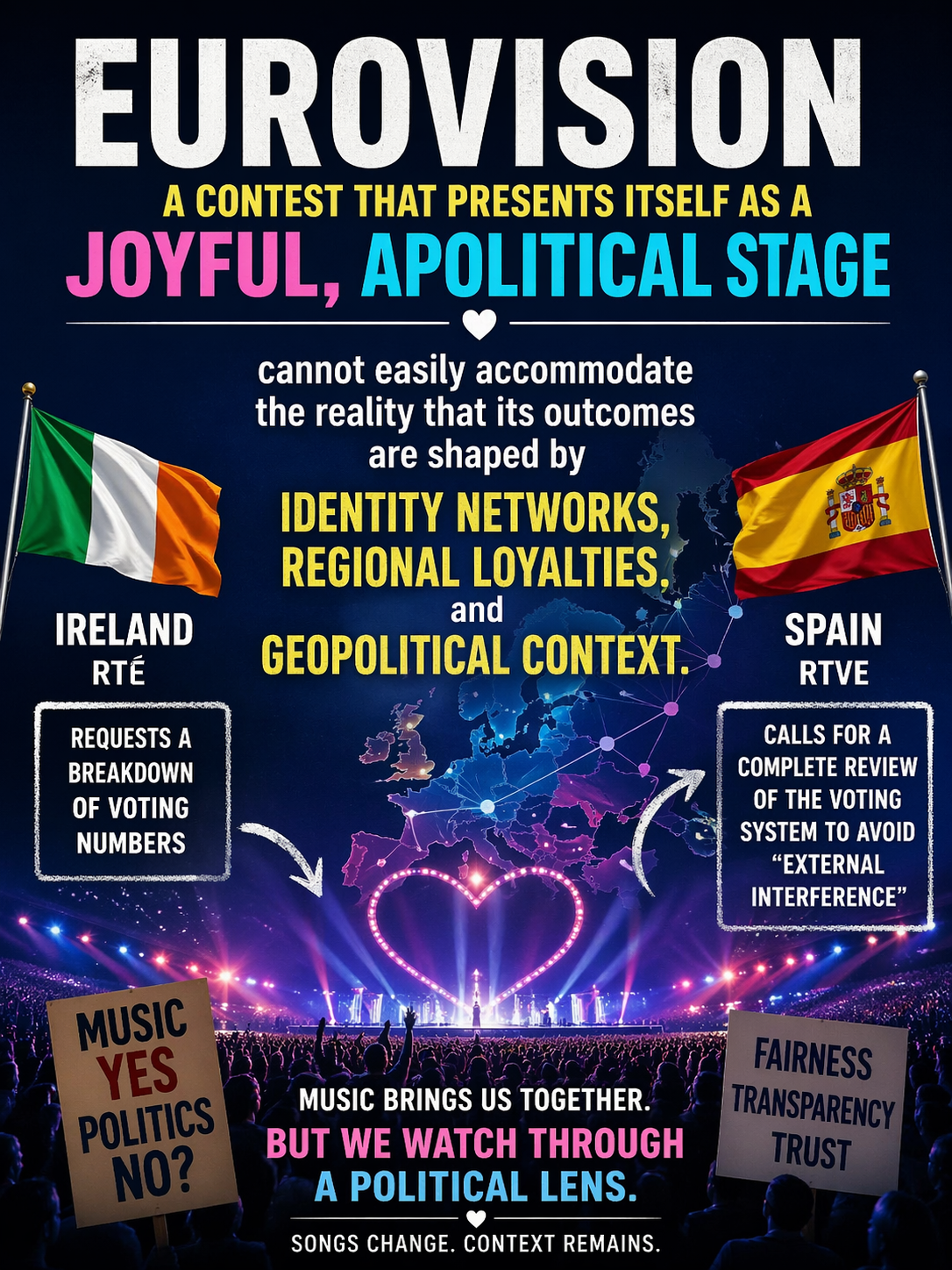
- The core issue is whether Eurovision—run by the European Broadcasting Union—should be “apolitical” or apply political/ethical standards.
- Critics argue there’s a double standard compared to Russia’s ban after the Russian invasion of Ukraine.
- Supporters of Israel’s inclusion say Eurovision is a non-political cultural event and should remain open.
- Participation depends on national public broadcasters, not governments directly. However, in practice, broadcasters are often state-linked or politically influenced. This creates the “soft political” nature of Eurovision decisions (e.g., suspensions, eligibility disputes).
However, the EBU’s position has always been that it is an association of broadcasters, not governments. Kan TV (in Israel) has the right to take part. Kan is editorially independent in theory, and Eurovision membership is meant to reflect broadcasting systems, not foreign policy approval.
Once the EBU starts excluding broadcasters for political reasons, they run the risk of turning a cultural contest into a shifting enforcement mechanism for international disputes. This is something the EBU has historically tried to avoid, even under intense pressure.
Calls for Israel’s exclusion from Eurovision have at various times been politically motivated, often coinciding with broader campaigns to isolate Israel from international cultural and sporting institutions. The EBU has explicitly maintained that Eurovision is a non-political event and that membership rights cannot be suspended on the basis of foreign policy disputes or lobbying campaigns by non-member states.(5)
Sources:
- Campaign groups No Music for Genocide and BDS call for boycott unless the European Broadcasting Union kicks Israeli broadcaster KAN out of the contest https://www.independent.co.uk/arts-entertainment/eurovision/eurovision-2026-boycott-letter-israel-palestine-b2961658.html
- Controversies of the Eurovision Song Contest
https://en.wikipedia.org/wiki/Controversies_of_the_Eurovision_Song_Contest - Is Music Haram?
https://islamqa.info/en/answers/5000/is-music-haram#evidence-of-prohibition-of-music-and-singing-in-the-quran-and-sunnah - How Jew-hate is becoming the norm in the music industry
https://www.thejc.com/life/how-jew-hate-is-becoming-the-norm-in-the-music-industry-cx8poype -
Israel participates in Eurovision through EBU membership, not geography, making it a legitimate and long-standing competitor despite lying outside continental Europe https://hasbara.co.il/resources/israel-eurovision-song-contest/israel-s-geographical-eligibility-and-ebu-membership-explained
Behind the scenes and even the losses, from all of Israel’s years at the Eurovision Song Contest https://www.kan.org.il/content/archive1/archivemusic/p-670963/
Telegraph columnist Jake Wallis Simons reacts to the campaign to ban Israel from Eurovision — and to boycott singer Yuval Raphael https://x.com/GBNEWS/status/1920832376529186864