
When Religion Becomes an Idol
Parashat Re’eh and the most sophisticated form of idolatry.
When we hear the word idolatry, most of us picture an ancient world of carved statues, pagan temples, and forgotten rituals. It belongs, we assume, to the same distant universe as chariots, desert wanderings, and long-extinct civilizations. We read the Torah’s warnings against Baal and Asherah as fascinating history rather than a living moral challenge, convinced that idolatry is one biblical commandment that has little to say to people living in the twenty-first century. That confidence, however, may be our greatest mistake. Idolatry has never disappeared; it has simply changed its form. Today, we rarely bow before statues, but we still bow before money, power, success, ideology, status, and even our own certainty. Every generation creates its own golden calves. The only thing that changes is what they are made of.
The Bible’s golden calves have given way to modern ones. Today we rarely bow before statues, but we willingly bow before other masters. We sacrifice our health, our families, and sometimes even our integrity on the altar of success. We measure our worth by careers, followers, profits, or public approval. We become servants of productivity, prisoners of our calendars, worshippers of endless growth, convinced that if only we earn a little more, achieve a little more, or win one more argument, we will finally find peace.

The object has changed. The impulse has not. Perhaps the simplest definition of idolatry is this: whenever something finite occupies the place that belongs only to the Infinite. Money is not evil, but money becomes an idol when profit matters more than people. Patriotism is not evil, but it becomes idolatry when love for one’s own people requires hatred of someone else’s. Even justice can become an idol when our desire to be right becomes stronger than our willingness to remain compassionate. Every generation creates its own golden calves, and they are often far more respectable than the ones described in the Book of Exodus. It is precisely here that Parashat Re’eh surprises us. Just before launching into one of the Torah’s strongest condemnations of idolatry, Moses offers what seems like an unrelated command:
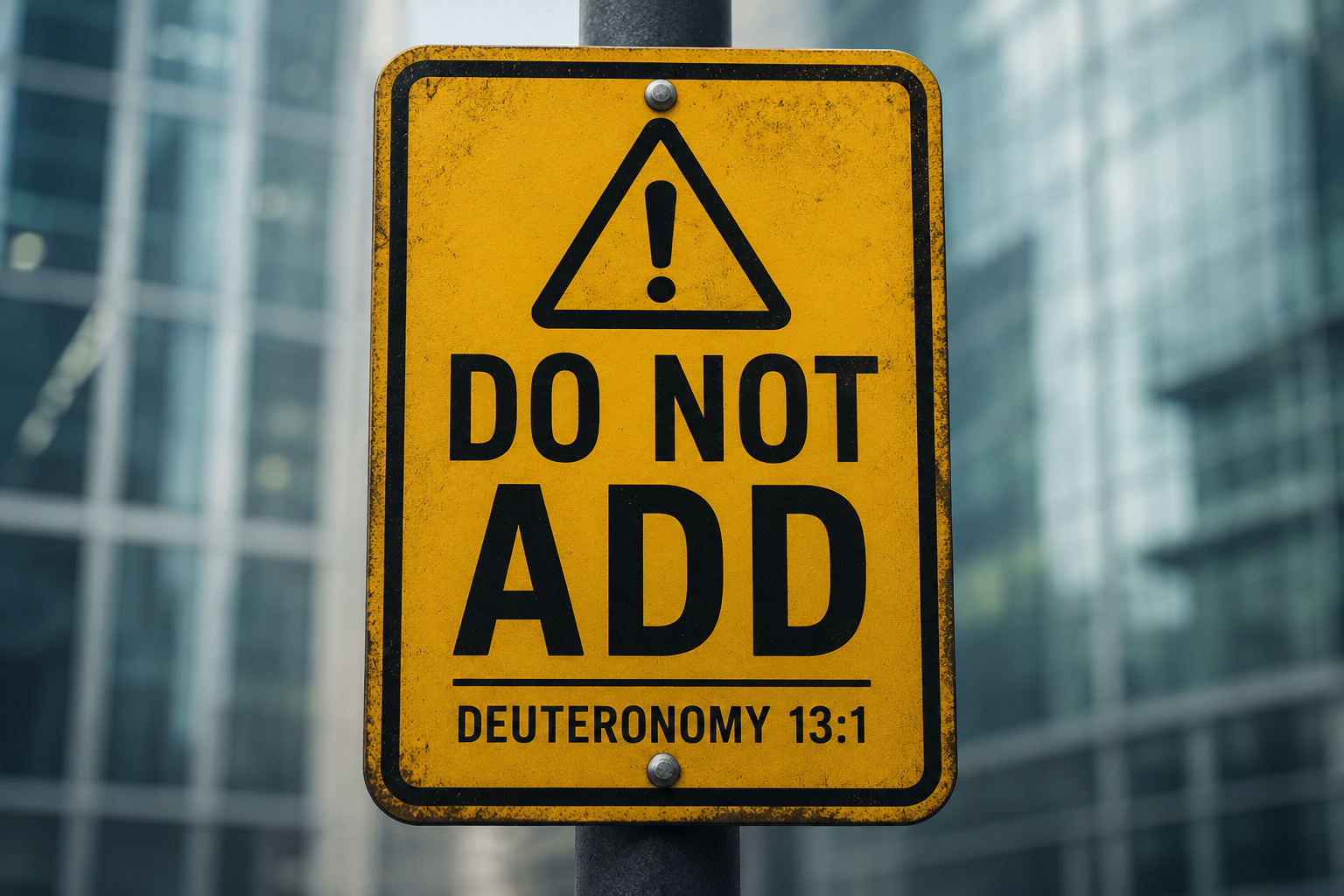
“Everything that I command you, you shall observe to do; you shall neither add to it nor take away from it.” (Deuteronomy 13:1)
The second half is easy to understand. Do not diminish the Torah. But the first half is deeply unsettling. Do not add?
How can that be? Jewish history is, in many ways, the story of interpretation. The Mishnah, the Talmud, rabbinic literature, legal codes, customs, responsa, centuries of discussion and debate, all are, in one sense, additions. They transformed a written text into a living civilization.
The Talmud itself celebrates this human partnership. In the famous story of The Oven of Akhnai, even a heavenly voice cannot settle a legal dispute. The sages respond with one of Judaism’s boldest declarations: “It is not in heaven.” Once the Torah has been given, responsibility belongs to human beings. We are expected to interpret, to wrestle, to argue, and to shape Jewish life in every generation. I cherish that tradition. As a liberal rabbi, I believe Judaism survives precisely because it is alive rather than frozen. Revelation did not end at Sinai; every generation is called to continue the conversation. Yet partnership is not ownership. The Torah’s warning, “Do not add,” is not a rejection of interpretation. It is a warning against forgetting the difference between God’s voice and our own.
Every institution begins with a noble purpose. Over time it develops rules to protect that purpose. Eventually, however, something subtle happens: the rules themselves become sacred. In organizational psychology this phenomenon is known as goal displacement– the moment when the system gradually forgets the mission it was created to serve and begins serving itself instead. Religions are not immune.
The commandments were meant to bring human beings closer to holiness, compassion, justice, and dignity. Halakhah* was meant to guide that journey. But whenever preserving the system becomes more important than preserving the human being, we should have the courage to ask whether we are still serving God or whether we have begun serving religion itself. This, I believe, is the most sophisticated form of idolatry. Not replacing God with another god, but replacing God with our own religious structures. Not worshipping a statue, but worshipping certainty. Not abandoning faith, but confusing our interpretations with revelation itself.
The tragedy is not that Judaism developed. Judaism has always developed. The tragedy begins when we stop distinguishing between Torah and tradition, between eternal values and historical responses, between the voice of Sinai and the fences we later built around it. Ironically, this concern appears in the very section devoted to idolatry. The Torah does not merely forbid serving other gods. It also warns: “Do not inquire about their gods, saying, ‘How did these nations worship their gods? I too will do likewise.'” (Deuteronomy 12:30). The question is not only whom we worship, but how we worship.
A religious system that forgets human dignity, silences moral conscience, excludes women’s voices, or places legal perfection above human suffering may still speak the language of holiness. Yet it risks becoming precisely what the Torah warns against: a human creation demanding absolute devotion. Faith should always point beyond itself. An idol always points back to itself.
Parashat Re’eh reminds us that the opposite of idolatry is not religion. The opposite of idolatry is the humility to remember what religion is for. Every generation must identify its own golden calves, especially the respectable ones, and ask whether they still lead us toward God or whether they have quietly taken God’s place.
That question may be the most urgent religious challenge of our time.
May we have the wisdom to recognize the golden calves of our own generation, the humility to distinguish between God and the structures we build in God’s name, and the courage to ensure that our religion always leads us toward greater compassion, justice, and human dignity.
Shabbat Shalom!
*The Hebrew word Halakhah derives from the root halakh (“to walk”). Its very name suggests movement, growth, and an ongoing journey rather than immobility. Jewish law was never intended to be static, but to accompany a living people as they continue to walk through history.