CEO of Time to Stand Up for Israel
When Remembrance Is Hijacked and Truth Is Twisted
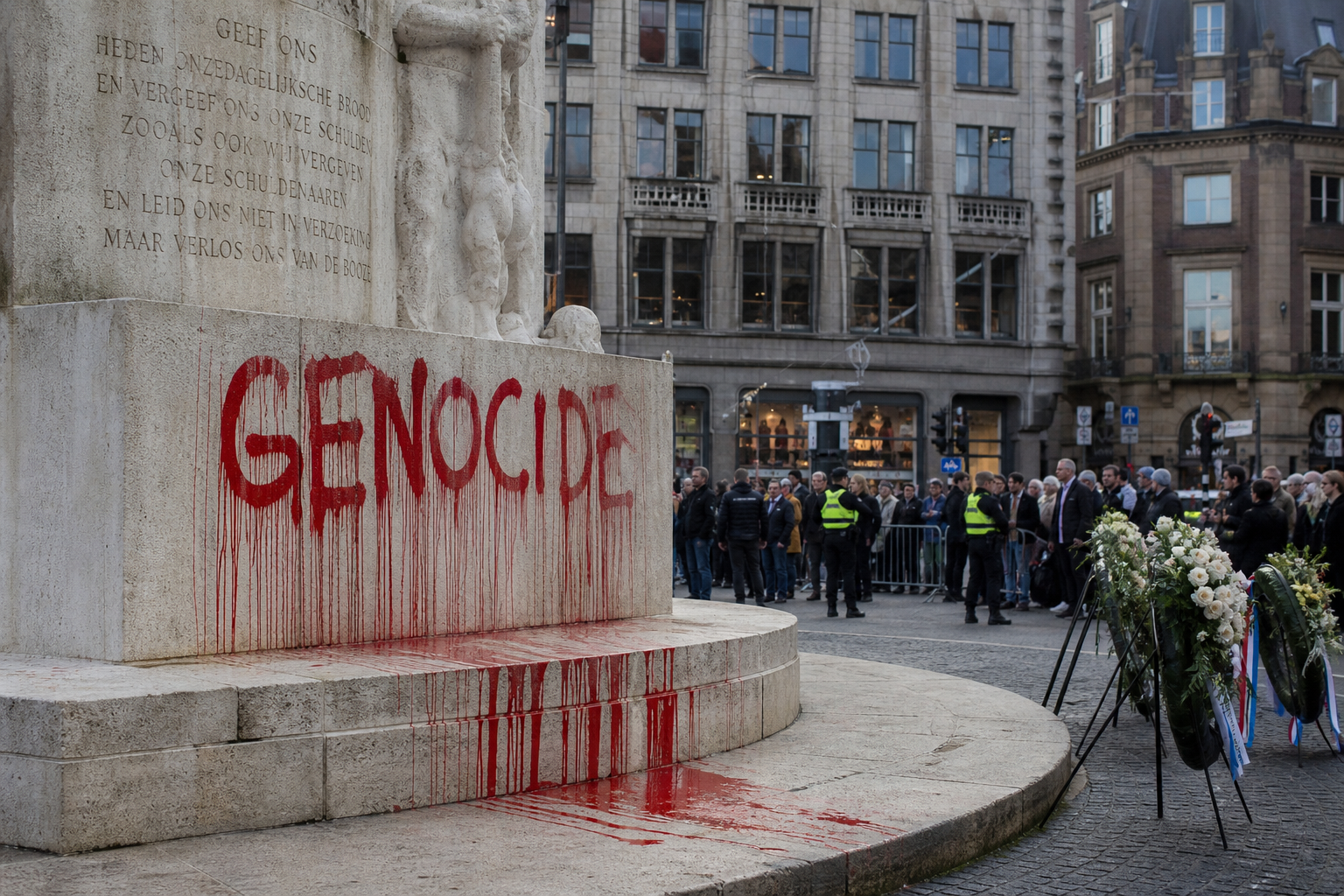
Photo credits: Sabine Sterk (AI)
There is something profoundly wrong when a nation gathers to remember the victims of World War II and the horrors of the Holocaust, and that moment is turned into a political battleground. The defacing of the national monument on Dam Square with red paint and the word “Genocide” was not protest. It was desecration. It was a deliberate act aimed at hijacking memory and weaponizing it against the very people whose suffering is being remembered.
This is not an isolated incident. It is part of a broader and deeply troubling trend across Europe, and yes, in the Netherlands as well. The boundaries between legitimate criticism of Israel and outright hostility toward Jews have eroded to the point where they are often indistinguishable. What is presented as activism increasingly carries the tone and substance of intimidation.
Leadership plays a decisive role in shaping this climate. When public figures, like Professor Jan Pronk, elevate one-sided narratives, when they normalize language that paints Israel as uniquely evil, and when they fail to draw clear lines against harassment, they create an environment where these acts become not only possible but predictable. Femke Halsema has repeatedly emphasized freedom of speech, yet that principle rings hollow when it is not matched with the responsibility to protect citizens from targeted hostility. Freedom of speech cannot mean freedom to intimidate Holocaust survivors on their way to remembrance events. It cannot mean turning public spaces into arenas of fear for Jews.
The same pattern is visible in how incidents are framed. When violence or intimidation occurs against Israelis or Jews, it is explained away, justified, or even blamed on the victims. After tensions surrounding supporters of Maccabi Tel Aviv, the narrative quickly shifted to what they might have done to provoke hostility. This inversion of responsibility is not just dishonest. It is dangerous. It sends a message that aggression can be excused if the target is Israeli or Jewish.
At the core of this problem is the relentless campaign to delegitimize Israel. Israel is not treated like any other nation. It is singled out, judged by standards that are not applied elsewhere, and accused in ways that ignore the reality it faces. Israel is surrounded by actors who openly call for its destruction. It deals with terrorism, rocket fire, and constant security threats. Yet in the global conversation, these realities are minimized or ignored entirely.
Instead, Israel is reduced to a caricature. A narrative is constructed in which it is always the aggressor, always at fault, always guilty. This narrative is not only false, it is corrosive. It fuels hostility far beyond the borders of the Middle East. It seeps into European streets, universities, and institutions, shaping how people think and act.
Social media has amplified this to an unprecedented level. Platforms that should enable open discussion are flooded with content that crosses the line into blatant antisemitism and even Hitler glorification. The kind of rhetoric that once would have been universally condemned is now tolerated, sometimes even celebrated. Those who challenge it risk being silenced, reported, or pushed out of the conversation entirely.
At the same time, there is a troubling dynamic within Israel itself. It is a democracy, and like any democracy, it has internal debates and political divisions. That is normal. But there is a difference between internal criticism and publicly undermining the country at a time when it is under intense global scrutiny and pressure. Disagreement should not become a tool that others use to delegitimize the very existence of the state.
Israel is the only Jewish homeland. That is not a political slogan. It is a historical and existential reality. For thousands of years, Jews were a people without a state, subject to persecution, exile, and ultimately genocide. The existence of Israel is the answer to that history. It is the guarantee that Jews will never again be completely at the mercy of others.
That is why the stakes are so high. When Israel is attacked not just militarily but morally, when its right to defend itself is questioned, when its very legitimacy is challenged, it is not just a political issue. It is an existential one.
The situation in the Netherlands reflects a broader European struggle. Societies are grappling with identity, integration, and the limits of tolerance. It is not helpful to reduce this to simplistic claims about entire populations, but it is equally unhelpful to ignore the real tensions that exist. Europe is slowly changing into an Islamic stronghold, that is the unfortunate truth. Pretending everything is fine while antisemitism rises is not a solution. It is denial.
What is needed is clarity. Clarity that antisemitism in any form is unacceptable. Clarity that Israel has the same right to exist and defend itself as any other nation. Clarity that remembrance of the Holocaust cannot be twisted into a weapon against Jews today.
There is still hope, but it requires action. Those who understand what is at stake must speak out, even when it is uncomfortable. They must challenge false narratives, expose double standards, and refuse to accept intimidation as normal.
Israel has always stood as a symbol of resilience in a hostile environment. That has not changed. What has changed is the willingness of others to recognize that reality honestly.
The question is not whether the world will become easier. It will not. The question is whether those who value truth and justice are willing to stand firm in the face of distortion and pressure.
Because if remembrance can be defaced, if truth can be twisted, and if hatred can be excused, then silence is no longer neutral. It becomes part of the problem.
Related Topics