


Stephen J Stern PhD
When some Christians made Common Cause with Fascism Against Communism
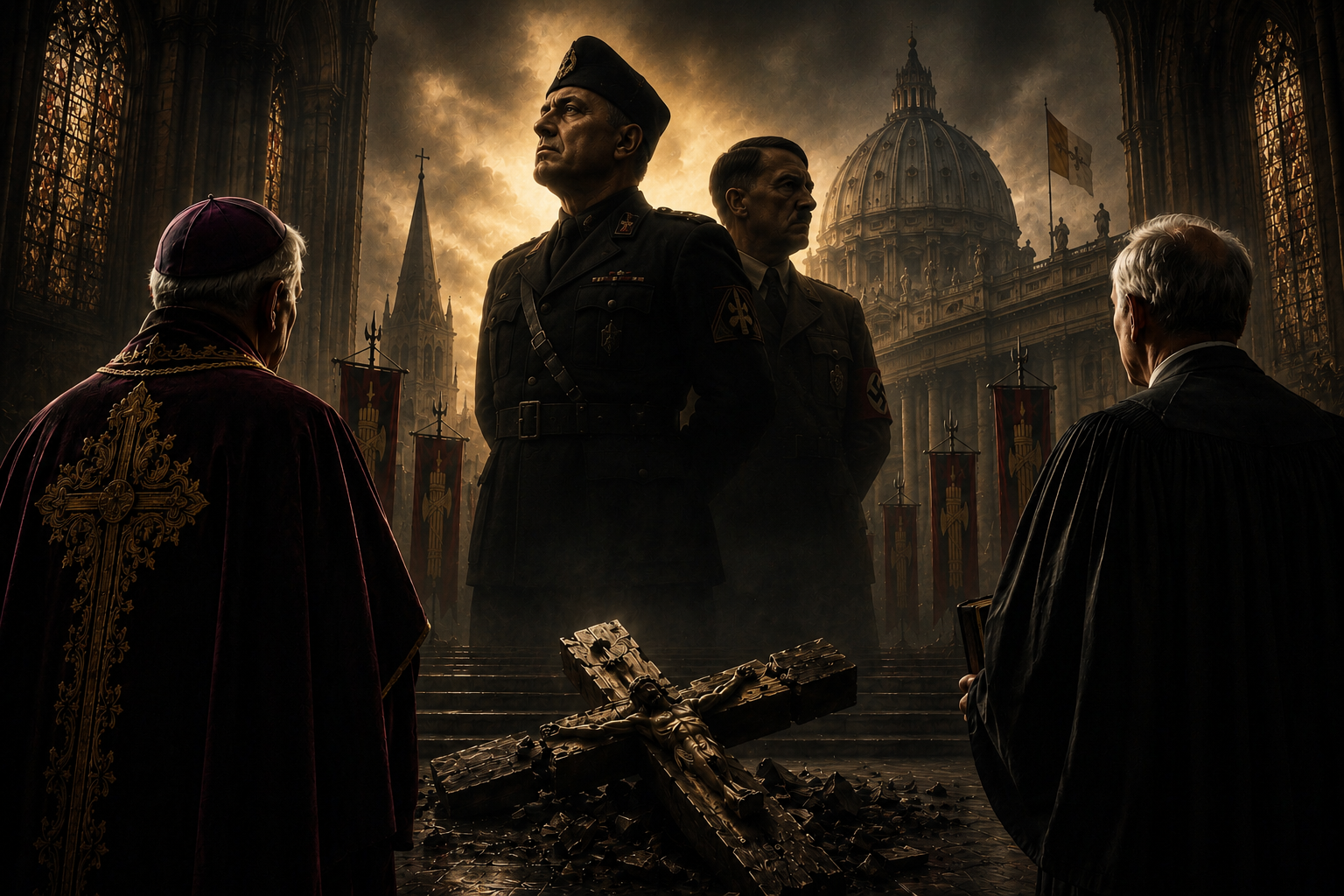
AI image created by author.
This piece builds on my recent piece on Édouard Drumont and Nick Fuentes by exploring Christianity’s complex relationship with fascism.
It is easy to forget that there was a time when some Christian leaders regarded fascism not as the enemy of Christianity, but as its political ally. That history may not seem as distant today as it once did.
In the years between the two world wars, fascism promised something Italian church leaders desperately needed. It presented itself as the great enemy of communism, militant secularism, liberal individualism, and the moral fragmentation of modern Europe. Many Christian leaders judged fascism less by what it was than by what they believed it would do. It would defeat communism, strengthen the family, revive national purpose, and return Christianity to the center of public life.
Pulitzer Prize-winning historian, David Kertzer, The Pope and Mussolini, shows Pope Pius XI viewed Mussolini as more than a political ally. Fiercely anti-communist, he believed fascism would halt the advance of communism while reversing years of liberal anticlericalism in Italy. https://www.davidkertzer.com/
The Lateran Accords of 1929 vindicated his hope, restoring Vatican sovereignty, returning Catholicism to a privileged place in Italian public life, and offering the promise of rebuilding a Catholic social order. Pius XI wasn’t seeking only accommodation with the fascist Italian state but pursuing a political order in which Catholicism would shape the nation.
The same pattern appeared in Spain. Francisco Franco cast his uprising as a defense of Christian civilization against communism. The Russian Revolution had convinced many Christians that communism posed an existential threat to both the Church and Christian civilization. Opposition to communism became so urgent that large numbers of Christians accepted, defended, and supported authoritarianism. For many, the overriding desire to defeat communism made that alliance necessary.
That anti-communism shaped Pius XI’s approach to Nazi Germany. Hitler also presented Nazism as communism’s great enemy, triggering Vatican hopes that accommodating the Nazis would preserve both the Church and Christian civilization. But Pius XI misjudged Hitler’s ambitions. Unlike Mussolini, Hitler did not seek some coexistence with Christianity but its complete subordination. Pius XI died before those ambitions became unmistakable in occupied Poland, where the Nazis imprisoned and slaughtered thousands of Catholic clergy while systematically attacking the Church’s institutions.
Mussolini never intended to become the political instrument of the papacy. He expected the Church to legitimize the Fascist state while staying out of his way. Hitler went further. The Nazis looked to dominate Christianity, bringing churches, schools, clergy, and religious organizations under Nazi authority. By the end of his pontificate in 1939, Pius XI understood that he had miscalculated Hitler and the Nazi movement.
The “Jewish question” exposed another difference with Nazism. Pius XI objected to Nazi racial ideology because it challenged Catholic theology. If Jewishness were biological, baptism could not transform a Jew into a Christian. Catholic universalism depended on conversion. Nazi racial theory denied that. However, Pius XI was not rejecting the Church’s tradition of Jew-hatred. Christianity had spent almost two thousand years portraying Jews as murderers of Christ, morally dangerous, spiritually blind, and resistant to Christian truth. Pius XI’s disagreement with Nazism centered on race, not on hostility toward Jewish people.
Pius XII inherited a continent on the edge of catastrophe.
That distinction between Nazi racial antisemitism and Christianity’s older Jew-hating tradition explains Father Charles Coughlin, the 1930s American “Radio Priest” who broadcast from the Shrine of the Little Flower in Royal Oak, Michigan. At his peak, Father Coughlin’s weekly radio show reached tens of millions of Americans, making him one of the most influential voices in the United States. He began by championing economic reform, but turned toward conspiratorial attacks on Jews, communism, finance, and liberal democracy while sympathizing with aspects of European fascism.
Father Coughlin was portrayed as a rogue priest going way beyond Catholic teaching. The historical record is less reassuring. His message was strengthened by ideas within respected sectors of Catholic thought. Kertzer’s research shows that influential Catholic publications of the 1930s continued defending restrictions on Jews while rejecting only the biological assumptions of Nazi racism. Father Coughlin popularized these ideas. He did not invent them. Nor was he alone.
Henry Ford’s national newspaper, The Dearborn Independent, spent the 1920s serializing the Jew-hating conspiracy that Jews run the world from The Protocols of the Elders of Zion, regularly publishing “The International Jew” to millions of Americans and showing that European Jew-hatred found powerful advocates in the United States before Father Coughlin reached a mass audience.
The “blood libel” reveals how deeply those traditions endured. The accusation that Jews murdered Christian children to drain their blood for ritual purposes was repeatedly disproved, yet the Church would not unequivocally repudiate it. Kertzer shows in The Popes Against the Jews: The Vatican’s Role in the Rise of Modern Anti-Semitism that the problem extended well into the twentieth century. The Vatican continued to circulate the belief that Jews needed Christian blood for Passover rituals instead of declaring the accusation a fabrication. Papal reluctance was historically consequential. It meant that one of Christianity’s oldest Jew-hating conspiracies survived into the modern age.
Fascists did not need to invent the image of the Jew as a hidden menace living within Christian society. They inherited a religious tradition that had already cast Jews as dangerous outsiders, reshaping that inheritance into the language of race, nation, and biological destiny.
Catholicism was not alone. Protestantism confronted many of the same temptations. As Richard Steigmann-Gall controversially argues in the Holy Reich, German Christians believed National Socialism fulfilled Christianity’s mission within the German nation. They embraced racial nationalism while seeking to purge Christianity of its Jewish roots, all the while celebrating Hitler as their providential leader. The Confessing Church resisted Nazi domination of Protestant institutions, but that resistance centered mainly on preserving the church’s independence from state control, not on defending German and European Jews.
Within the Confessing Church, though, a small minority pushed further. Dietrich Bonhoeffer argued from the start that the church’s silence on the Jewish question was itself a betrayal of the gospel, and was eventually executed for repeatedly saying things like that against Hitler in public. Martin Niemöller, though slower to extend his concern beyond baptized Jewish converts, became one of the regime’s most prominent clerical prisoners. They remained the exception. Most of the Confessing Church’s energy went toward institutional self-preservation. The bravery of Bonhoeffer and the few who stood with him still shames that broader silence.
The story did not end in Germany. As John Hellwege’s doctoral research suggests, American Lutherans struggled to make sense of Hitler’s rise, and they did not speak with one voice. Some initially viewed National Socialism favorably, judging it against the backdrop of the Depression and their fear of communism, while others were uneasy from the start. That ambivalence narrowed. By 1940, American Lutheran opinion joined in opposition to the Nazis, as it became clear that Hitler wasn’t interested in coexisting with Christianity, but in subordinating it.
Taken together, these episodes tell a larger story. Fascism did not enter a Christian vacuum. It entered a Christian world already shaped by fierce anti-communism, suspicion of liberal modernity, and inherited hate toward Jews. Many Christians believed authoritarian politics would renew Christian civilization, judging it by what it would produce rather than by the nature of the movement itself. They were wrong.
Mussolini and Hitler accepted Christian support only so long as it strengthened their regimes. Neither intended to build a Christian civilization. Both intended to subordinate Christianity to the state. The tragedy was not simply that many Italian and German Christians miscalculated fascism. It was that they believed they could use authoritarian power to renew Christianity, while fascism believed it could use Christianity to consolidate authoritarian power. In the end, only one side understood the bargain.