When Synagogues Burn…..
Before the arguments begin, before the explanations arrive, before the debates over language and intent, it is worth confronting a simple and disturbing fact.
Synagogues are burning.
Over the past fifteen months, Jewish houses of worship have been targeted by arson or attempted arson across the globe.
- Oct 17: El Hamma, Tunisia
- Oct 18: Berlin, Germany
- Nov 8: Montreal, Canada
- Nov 18: Yerevan, Armenia
- Nov 19: Lakewood, United States
- Feb 28: Sfax, Tunisia
- April 5: Oldenburg, Germany
- April 10: Moscow, Russia
- May 1: Warsaw, Poland
- May 17: Rouen, France
- May 30: Vancouver, Canada
- Aug 24: La Grande-Motte, France
- Dec 6: Melbourne, Australia
- Dec 18: Montreal, Canada
- Dec 30: Mykolaiv, Ukraine
- Jan 11: Sydney, Australia
- July 4: Melbourne, Australia
- January 10: Mississippi, United States
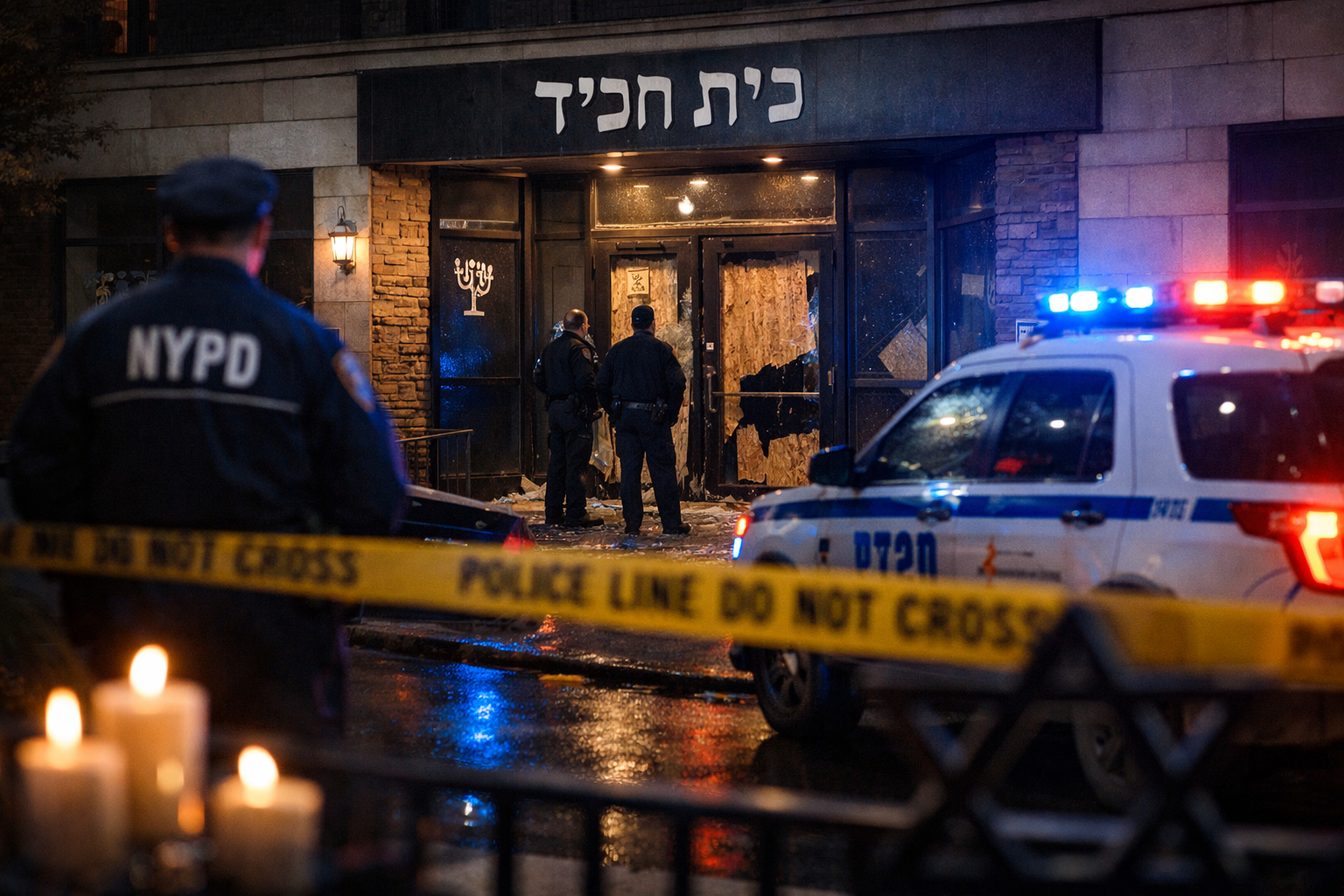
Closer to home, in Brooklyn, a car was intentionally driven into a Chabad center multiple times, turning an automobile into a weapon against a Jewish institution in one of the most Jewish cities in the world. This was not rhetoric. It was not vandalism. It was physical force directed at a place of Jewish life. The message did not require interpretation.
Different continents. Different political systems. Different cultures. One constant. Jewish institutions targeted because they are Jewish.
These are not isolated incidents, and they are not the work of a single organization or ideology. But they are unmistakably the product of a climate in which Jewish spaces have once again become legitimate targets. Antisemitism today does not always arrive with crude symbols or explicit declarations. It arrives with justification.
Just days earlier, the world marked January 27, Holocaust Remembrance Day. The occasion invites solemn reflection and rare moral consensus. Nazis are safely confined to history. The villains are unambiguous. The lessons appear settled.
That consensus is also its weakness.
As commentators such as Melanie Phillips have warned, the danger today is not Holocaust denial so much as Holocaust distortion. We remember the catastrophe, but in a way that trains us to recognize antisemitism only when it resembles the past. If antisemitism looks like 1939, we know how to name it. If it looks anything like the last two years, we debate definitions while synagogues burn.
For decades, Western societies have reassured themselves that antisemitism is primarily a right wing pathology, a relic of fascism associated with neo Nazis and fringe extremists. That belief is comforting. It is also incomplete.
While antisemitism on the right never disappeared, antisemitism on the left adapted. It learned new language, adopted new moral frameworks, and embedded itself in institutions that shape culture, education, and legitimacy. The name of that adaptation is antizionism.
After World War II, explicit antisemitism became socially disqualifying in much of the West. Hatred did not vanish. It evolved. In the Soviet system, antisemitism was recoded as hostility to Zionism. Jews were no longer portrayed as racially inferior but as politically criminal. Zionism was reframed not as a national liberation movement, but as a form of racism, imperialism, and conspiracy.
Israel became the collective Jew among nations, uniquely illegitimate, uniquely dangerous, uniquely undeserving of sovereignty.
This distinction matters. Criticism of Israeli policy is political speech. Denial of Jewish self determination is something else entirely. No other people are told that their national movement is immoral by definition.
This ideological shift did not spread organically. It was refined and legitimized within elite institutions, particularly academia. A revealing discussion on the podcast Call Me Back between its host Dan Senor and sociologist Shaul Kelner helps clarify how this occurred. Kelner explains how Zionism, once broadly understood as Jewish self determination, was gradually reclassified within academic discourse as a form of settler colonialism. Once placed in that category, the moral verdict became automatic. No policy debate was required. The conclusion was embedded in the premise.
Zionism ceased to be a political position and became a moral offense.
What distinguishes this form of antisemitism from earlier versions is not its impact, but its respectability. It is abstract rather than visceral. Theoretical rather than explicit. It borrows the language of power, oppression, and justice, and because it speaks that language fluently, it often escapes scrutiny from those trained to look for antisemitism elsewhere, as well as from students eager to situate themselves on the “morally correct” side of history.
The connection between these ideas and the attacks on synagogues is not one of instruction, but of permission. No academic text calls for arson. But ideas shape moral boundaries. When Zionism is defined as a uniquely illegitimate form of power, and Jewish collective identity is framed as inherently oppressive, the moral firewall that once protected Jewish institutions erodes. Violence no longer registers as antisemitism, but as misdirected protest. In that environment, synagogues cease to be seen as houses of worship and begin to be rationalized as political symbols. That is how theory becomes practice without ever issuing an order.
None of this unfolds in a vacuum. The war in Gaza is devastating, and the images circulating daily through mainstream and social media shape perception far beyond their immediate context. Israeli policy matters. The tone and conduct of its leadership matter. The confrontational and often self serving posture of Benjamin Netanyahu has deepened alienation among many younger Jews and hardened hostile impressions among non Jews. When these images and narratives circulate within an intellectual framework that already defines Zionism as immoral, they do not merely inform opinion. They supply emotional confirmation. Together, they help transform abstract hostility toward Israel into moral permission to target Jewish spaces elsewhere.
This shift is no longer confined to seminar rooms. It has moved into electoral politics and civic power. One prominent example is Zohran Mamdani, elected and inaugurated earlier this year. His rise symbolizes the translation of academic antizionism into political language and activist legitimacy. In this framework, Zionism is treated not as a response to Jewish vulnerability or historical dispossession, but as a moral offense that cannot be redeemed by policy change or compromise. Israel, in this telling, does not err. It exists wrongly.
The significance of this development is heightened by where it occurred. New York City is home to one of the largest Jewish populations in the world, shaped by Holocaust memory, immigrant experience, and the founding of Israel. That a candidate whose worldview treats Zionism as illegitimate could win citywide office in such a place is not a footnote. It is a signal. It reflects a generational shift in which lived memory has faded and ideological frameworks increasingly substitute for historical literacy.
This lineage is not incidental. Mamdani’s political roots in the orbit of the Democratic Socialists of America reflect a broader continuity between contemporary antizionism and older Soviet style frameworks that rebranded antisemitism as anti imperialism. In both cases, Jewish self determination is not treated as one national movement among many, but as a uniquely illegitimate form of power. The language has changed. The conclusion has not.
Ideas, however, require infrastructure. Universities, activist networks, and cultural institutions do not operate on moral passion alone. They require funding. Funding shapes ecosystems. It is not incidental that some of the most aggressively antizionist spaces in the West have benefited from substantial foreign funding from states with a strategic interest in delegitimizing Israel, including Qatar. This is not a claim of secret control or conspiracy. It is a recognition that money amplifies frameworks already in motion.
Academic frameworks do not remain confined to campus. They migrate into NGOs, media narratives, activist training programs, and public consciousness. By the time they reach the street, they no longer sound radical. They sound obvious. This is how synagogues become targets of protest rather than objects of protection. The fires listed above are not disconnected from the ideas that preceded them. They are downstream.
Holocaust remembrance remains essential. But remembrance without translation risks becoming ritual rather than warning. If we only recognize antisemitism when it wears the symbols of the past, we will miss it when it presents itself as moral analysis, academic consensus, or social justice rhetoric.
Never Again was never meant to be a museum slogan. It was meant to be a diagnostic tool.
When synagogues are burning across the world, theory is no longer an abstraction. It is already shaping behavior.
Ignoring that fact does not make the fires go out.