
Where Objectivity Meets Reality
When terror gets a state and democracy doesn’t
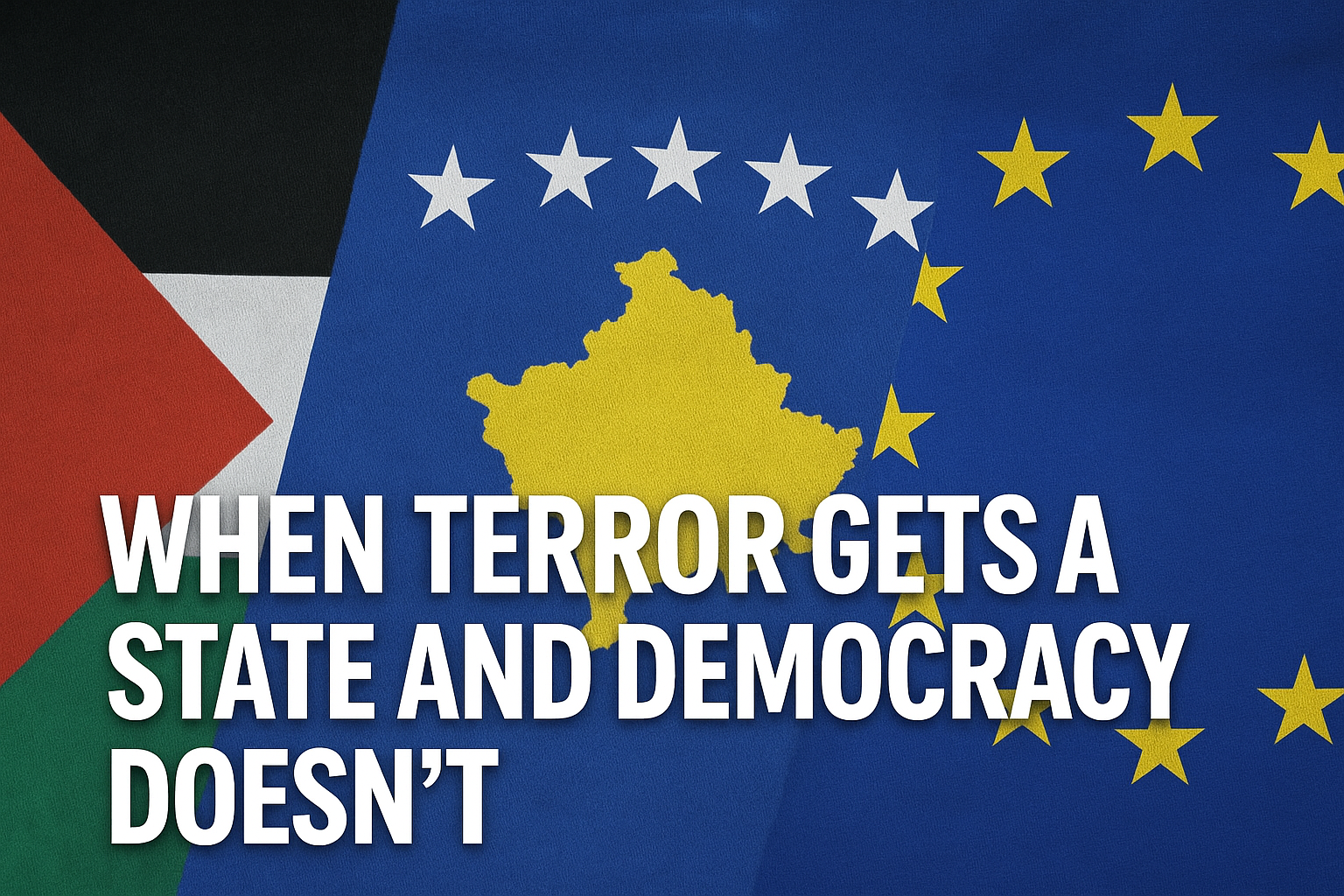
(AI-generated)
The world’s hypocrisy: why Kosovo deserves what Palestine never will
When Spanish Prime Minister Pedro Sánchez passionately defends the “right” of Palestinians to their own state, he does so with the moral conviction of a man standing on the right side of history. Or so he believes.
Yet while he waves the flag of Palestinian sovereignty, Sánchez and his European colleagues continue to deny the same right to Kosovo — a small Balkan democracy that has fulfilled every criterion of statehood but remains punished for existing outside the ideological comfort zone of Europe’s political class.
It is a revealing contradiction. The West claims to defend international law, stability, and self-determination, yet its own behavior shows that these values are applied selectively. A “state” born of terrorism and division enjoys the sympathy of European elites, while a real, functioning democracy is left in diplomatic limbo.
A state that isn’t one: Palestine
More than seventy years after the creation of Israel, “Palestine” still lacks all basic attributes of sovereignty.
It has no defined borders, no unified government, no functioning economy, and no control over its own security.
The West Bank and Gaza Strip are politically, ideologically, and administratively separate entities — ruled by rival factions that often kill more of each other than they do of Israelis.
By any legal standard — the Montevideo Convention of 1933 being the classic — Palestine fails the test of statehood.
It cannot guarantee order, defend its territory, or conduct stable foreign relations.
What it can do is wage war, incite hatred, and glorify violence.
And yet, across the world, it is celebrated as a legitimate “state,” welcomed into UN agencies, and showered with diplomatic recognition.
Why?
Because Palestine is not a state; it is an idea — one sustained by ideological solidarity and oil diplomacy.
Arab and Muslim nations long ago turned the Palestinian cause into the moral currency of the Middle East.
In the wake of the oil crises of the 1970s, the world learned the cost of opposing that narrative.
For Western governments dependent on Gulf energy, supporting “Palestinian statehood” became the safest, cheapest gesture of virtue signaling in foreign policy.
A state that isn’t recognized: Kosovo
Kosovo, by contrast, is everything Palestine is not.
Since declaring independence from Serbia in 2008, it has built a multi-party democracy, a functioning parliament, a professional police force, and an independent judiciary.
It uses the euro, maintains stable borders, and has been recognized by over one hundred countries.
It is no utopia — few young democracies are — but it is undeniably a state.
The irony is brutal: according to international law, Kosovo meets the criteria that Palestine fails, yet the latter enjoys a seat at nearly every diplomatic table while the former remains excluded from the United Nations.
Why?
Because Kosovo has no oil, no ideology, and no geopolitical value to the great powers.
Its independence offends Serbia, and through Serbia it offends Russia — and anything that offends Russia automatically triggers Chinese resistance at the UN Security Council.
Even within the European Union, five members — Spain, Slovakia, Cyprus, Greece, and Romania — refuse to recognize Kosovo, fearful of encouraging their own separatists.
The result is paralysis: a European democracy held hostage by the anxieties of its supposed allies.
Europe’s moral acrobatics
This contradiction exposes Europe’s moral gymnastics.
Leaders like Sánchez champion “self-determination” for Palestinians while denying it to Kosovars.
They condemn Israeli airstrikes against a terror movement but stay silent when Belgrade undermines Pristina’s sovereignty.
They call Hamas “a partner for peace” but treat Kosovo as a diplomatic inconvenience.
The pattern is clear: principles only matter when they cost nothing.
Supporting Palestine is cheap politics — it flatters the Arab world, poses no risk, and feeds a sense of moral superiority.
Supporting Kosovo, on the other hand, means confronting Serbia and, by extension, Russia.
And that requires courage — something in short supply among Europe’s self-proclaimed defenders of justice.
The uncomfortable truth
The broader lesson is that international recognition is not earned by meeting legal or moral standards.
It is bought with power, ideology, or oil.
Palestine has two of those three; Kosovo has none.
That is why one flies the flag at the UN while the other waits outside the door.
It also explains why Europe’s moral rhetoric rings hollow in Jerusalem, Kyiv, or Pristina.
A world order that rewards victimhood and punishes responsibility cannot expect credibility.
Kosovo, for all its flaws, chose democracy, reform, and coexistence.
It did not export terror or glorify death.
It did not turn grievance into ideology.
And for that, it has been forgotten.
If the world rewarded responsibility instead of rhetoric, Kosovo would already sit in the UN — and Hamas would be in The Hague.
Related Topics