
When the CEO Disagrees with the Board | From Torah to the C-Suite
Parashat Va’etchanan
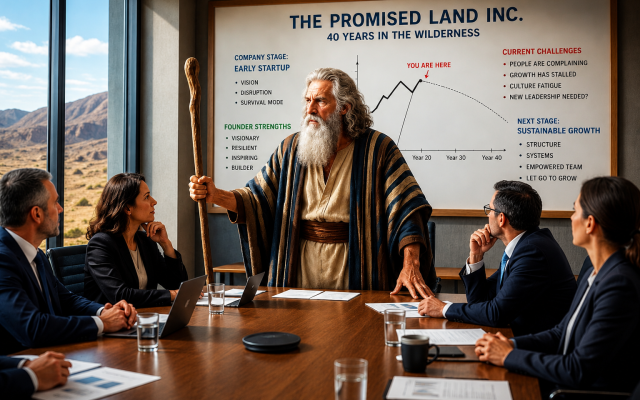
Imagine this. You’re the CEO. You’ve led your organization through crisis after crisis: geopolitical turmoil, supply shortages, employee unrest, and even a forty-year wilderness detour. You’ve built a strong team, cultivated a compelling vision, and led under relentless pressure. Then one day, the Board tells you: “Thank you for your extraordinary service. You won’t be leading us into the next chapter.” That is precisely where we find Moses in this week’s parashah.
A Leadership Case Study
In Deuteronomy 3, Moses makes one final appeal. He asks God to allow him to cross the Jordan and enter the Promised Land:
I pleaded with the Lord at that time, saying: ‘O Lord God, You have begun to show Your servant Your greatness and Your mighty hand… Please let me cross and see the good land… (Deut. 3:23–25)
Let’s be honest- this is a masterful C-suite negotiation. Moses begins by acknowledging God’s greatness, reconnects with the larger vision, and only then presents his request. But the Board- in this case, the ultimate Chair, is unmoved.
“Enough! Do not speak to Me again about this matter.” (Deut. 3:26)
The decision is final. Meeting adjourned.
Disagreeing Without Undermining
Leadership literature consistently reminds us that disagreeing with someone more powerful is an essential executive skill, one that demands emotional intelligence, respect, preparation, and impeccable timing. Harvard leadership scholar Ronald Heifetz argues that mature leaders know how to challenge authority during the decision-making process while preserving trust in the institution once a decision has been reached. Moses embodies precisely that kind of leadership. He approaches God with humility, expresses unwavering loyalty, and chooses a moment of relationship rather than confrontation to make his case. In doing so, he models one of the highest forms of executive maturity: the ability to disagree without undermining authority. Leadership is not merely about speaking truth to power. It is about knowing how, when, and why to do so.
The Real Challenge Begins: Executive Communication
Here Moses becomes more than a prophet. He becomes a masterclass in organizational communication. Because now he faces what may be every leader’s hardest assignment: To communicate a decision he personally opposed, and inspire others to embrace it. This is no longer the Moses confronting Pharaoh. This is a leader standing before the people he loves, delivering heartbreaking news while preserving hope, confidence, and purpose. And he does far more than comply. He inspires. He reframes. He leads. Knowing he will never enter the land himself, Moses gives Israel the Shema, renews the covenant, and articulates a national vision that will outlive him.
Harvard Business Review Meets Deuteronomy
Modern management theory would likely applaud Moses. Harvard Business Review has repeatedly emphasized that leaders must communicate strategic decisions authentically even when those decisions are not their preferred outcome. Likewise, change-management pioneer John Kotter argues that vision must be communicated simply, repeatedly, and passionately. That is exactly what Moses does. He distills an entire national mission into one unforgettable sentence:
Hear, O Israel: The Lord is our God, the Lord is One.” (Deut. 6:4)
Long before organizations coined the term mission statement, Moses condensed a people’s identity into a single sentence that could be remembered, repeated, and lived. This is culture-building. Moses is no longer simply leading a journey. He is embedding a mission into the soul of a nation.
From the Bible to the Boardroom
Having spent years in executive leadership before entering the rabbinate, I have come to believe that the Bible is far more than a spiritual guide. It is one of history’s greatest leadership textbooks. From Moses to Deborah, from Joseph to Ruth, our tradition is filled with leaders navigating competing stakeholders, ethical dilemmas, organizational change, succession planning, and visionary leadership.
A Final Word
If you are a leader, in business, education, or community- Moses remains one of history’s greatest leadership mentors. You will not always win the argument. But you will always have the opportunity to shape the story. To build culture. To communicate vision. And perhaps most importantly, to help others cross the river, even when you know you will not be crossing it with them.
Shabbat Shalom,
Rabbi Adi Romem
Founder, Voluntherapy | Educator | Former Capital Markets Executive
 Inspired by the lecture series: Biblical CEOs: Leadership Lessons from the Ancients for Today’s World. Biblical narratives through the lenses of organizational psychology, leadership theory, and contemporary management challenges.