
Bridging faith. Defending truth. Confronting hate
When the Counter-Witness Became Sovereign: Activation of Islamic Antisemitism
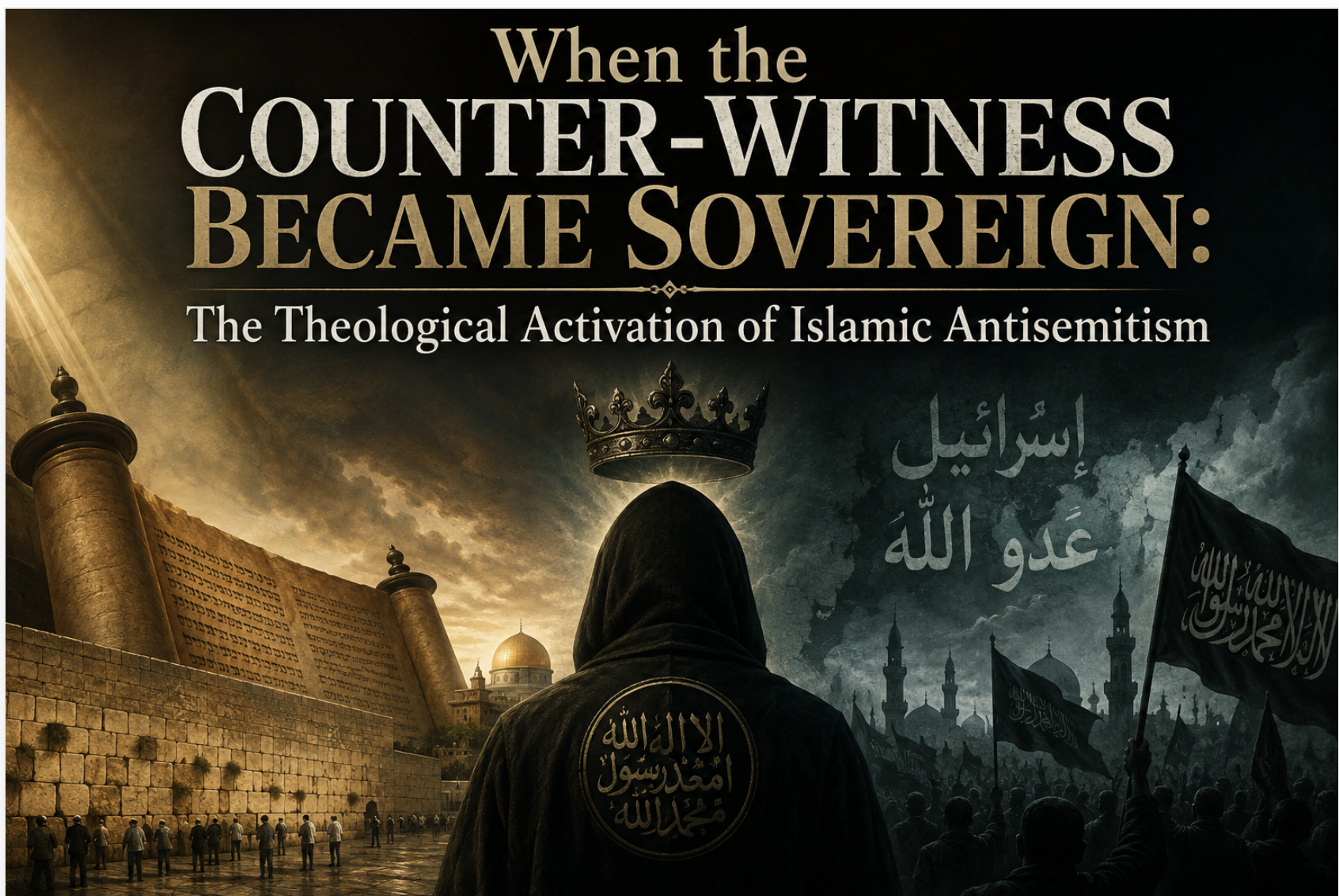
Image created from Google Gemini by Tim Orr
There is one aspect of Muslim-Jewish relations history that stands out as odd but which is one of the keys to modern Islamic antisemitism. On one hand, if Islamic antisemitism is simply rooted in Islam’s foundational texts then we have to ask why Jew-hatred has not been politically central to Muslim history during all fourteen centuries since Muhammad? On the other hand, if modern Islamic antisemitism was simply a European import to Islam then we have to explain why modern Muslim antisemitic movements were so eager to reactivate Islamic accusations against Jews for supposedly attempting to harm Muslims. Of course Islamic sources do clearly teach anti-Jewish ideas (most notably Qur’an, Hadith, and sira), but after Muhammad’s death there was not a thirteen-century crescendo of Jew-hatred in Muslim politics.
Jews faced discrimination, humiliation, periodic persecution and violence from Muslim rulers across the centuries, but it was only in modern times that Muslims systematically organized their political life with Jews as the enemy. Neither of the typical explanations seems adequate on its own. One explanation sees modern Islamic antisemitism as just a continuation of seventh century anti-Jewish Islam while another suggests that antisemitism was foreign to Islamic civilization and only arrived through Christian Europe, colonialism, and modern racial ideology. Both views capture part of what has happened over the centuries, but neither view can explain how older Islamic theological claims about Jews (which were never new) acquired such force in Muslim discourse against Jews at the exact moment when their political status changed so dramatically.
The key issue, therefore, is not whether anti-Jewish ideas have existed within Islamic history. The key issue is: when, how, and why did those ideas become politically exigent? Muslims have not always made Jews their political enemy because the position occupied by “the Jew” has changed. For centuries Muslims were politically dominant over Jews. Modernity made them equals, Zionism made them politically independent of Muslims and Israel made Jews sovereign over many Muslims. Then, in 1948 and especially in 1967, Jews went from political subordinates to victors.
Modern Jewish sovereignty did not just create a geopolitical crisis for Muslims. In certain restorationist Islamic perspectives it also created something like a crisis of theological explanation, or a problem of theodicy. Theodicy does not simply refer to trying to explain suffering in light of God’s goodness. Instead it also refers to what can happen when a community experiences history in ways that appear to contradict what should happen if divine truth is on its side and if God favors believers and orders things the right way. In short: if Muslims had come to see Islamic political supremacy as fitting the truth and finality of Islam, what was Jews’ surprising sovereignty to say about divine will?
The Jew as Counter-Witness
In order to appreciate the significance of this development, we need to rewind back to square one. Jews whom Muhammad encountered in Medina found themselves in a unique theological situation since Islam inherited its self-understanding from Israel’s revelatory narrative. Muhammad presented himself as more than the founder of another Arabian religion. The message he brought, as recounted in the Qur’an, placed him within the revelation history of Abraham, Moses and the biblical prophets. Jews accordingly had scriptures and traditions that were claimed by the Islamic scripture as its own prototype.
This meant that Jewish rejection functioned differently than pagan rejection. Learned Jews could answer “yes” to Abraham, Moses, covenant, revelation and prophecy then deny Muhammad’s place in that lineage. The Jew was not simply stating “I do not believe you.” He could logically say, “The revelation history you use does not support your conclusion.” Jewish rejection was then able to become counter witness.
Islamic theology would later supply this obstinacy with an explanation. Rather than allowing Jewish disbelief to endanger Muhammad’s prophethood, Jewish rejection could become synonymous with Jewish spiritual depravity. Qur’anic charges of kitmān (concealment), taḥrīf (distortion/alteration), naqḍ al-mīthāq (breaking the covenant), kufr (disbelief), takdhīb al- rusul (denying the messengers), and ʿiṣyān (disobedience/rebellion) reframed Jewish denial of Islam’s claims as condemnation of those denying it. Jewish rejection could therefore be explained by Islamic scripture.
The point is not to suggest that every remark about Jews in Islam is polemical in nature or that Muslim- Jewish relations can be seen purely through theological lenses. Here we are simply pointing out that because of revelation history, Jewish rejection was different. Jews were tied to revelation history that Islam proclaimed to be continuing. Their rejection was a form of internal criticism.
The Contained Counter-Witness
After early Islam, that theological discord was articulated within a different political context. Jews were religious minorities, to be sure, but typically subjects dwelling under Muslim rule as protected, subordinate communities. The dhimma institution had legal, fiscal, administrative and political roles to play. It also applied to Christians and other communities. But its effect was to embed Jewish religious difference within an openly hierarchical political system.
The counter-witness thus persisted, but he was politically constrained. The subordinate Jew could be hated, mocked, or disadvantaged without being seen as a wholesale political menace. Hate and fear are not the same. An inferior population can be tolerated as an object of contempt precisely because it is not seen as a threat to the social order.
This is why polemic texts could be read across the centuries without always inspiring the same political fervor. Books aren’t self-inflammable. It is the interaction of historical forces that makes certain inherited concepts politically relevant. A negative theological repertoire can be latent in one political context and volatile in another.
From Equality to Sovereignty
Modernity brought an end to the older hierarchy. Nineteenth-century reform movements, Europeanism, nationalism and changing notions of citizenship increasingly undercut established orders of confessional privilege. Jews and Christians who had formerly been second-class sought out new rationales upon which to base demands for greater legal and political recognition. The older notion of counter-witness hadn’t changed his theology, but the world around him was changing.
Islamic antisemitism soon incorporated European ideas. Racial theories, the Protocols of the Elders of Zion, fantasies of Jewish world conspiracy and later Nazi models of race provided further points of explanation. Modern Islamic anti-Semitism was thus a contradictory discourse. Islamic tradition furnished charges of Jewish rejection of Islam, treachery, covenant-breaking, and distortion. European antisemitism contributed conspiracy explanation, racialization, and ideas about occult Jewish power.
Zionism would introduce yet another element. It recast “the Jew” not merely as an individual recipient of emancipation, but as a collective seeking self-rule. Anti-Zionism cannot be taken simply as antisemitism. Palestinians and neighboring Arabs had real national and territorial stakes in opposing a rival nationalist movement. Zionism, however, also changed “the Jews” symbolic valence in particular Islamic imaginations. A people that had long existed beneath Muslim structures of political authority was now asserting its right to political independence.
Israel actualized that assertion. Jewish sovereignty became a political fact on the ground in 1948. The formerly subordinate had become not just equal, but dominant. He now had a state and an army, and had won the war meant to prevent that state from existing in the first place. The theological counter-witness had become sovereign.
1967 and the Crisis of Explanation
If 1948 engendered the contradiction, 1967 deepened it into crisis. Israel’searly triumph in the Six-Day War was no ordinary military victory. Israeli troops defeated Egypt, Jordan, and Syria incredibly quickly while simultaneously occupying East Jerusalem and lands of unmatched political and religious symbolism. The Jewish state had not just endured. It had soundly defeated the Arab armies that surrounded it.
Who had won mattered. Muslims had suffered humiliating defeats at the hands of European Christians for centuries before the founding of Israel. But European Christian empires were traditionally perceived as great civilizational adversaries. Defeat by Jews carried with it another level of humiliation because Jews had traditionally been subordinates within Muslim political orders. The shock was therefore not simply, “We were defeated.” In many Muslim conceptions the deeper shock was, “We were defeated by them.”
Such a distinction opened the door for theological explanation. Among secular Arab nationalists, 1967 might be interpreted as military defeat and the failures of nationalism, military modernization, and pan-Arab governance. Among Muslims looking toward religion for answers, defeat could be reinterpreted as proof that Muslims had turned away from Islam and that Allah had therefore withdrawn His support. The solution was not going to be found in secularism but piety.
Old charges against Jews could also be revived to help explain the capabilities of their victorious adversary. The Jew was not simply the counter-witness of the seventh century or the subservient minority of the classical Islamic order. He had been made sovereign. Old accusations of Jewish treachery, trickery, covenant-breaking, and hostility towards prophets now became newly activated when paired with European conspiracy theories about Jewish power.
The result was something both medieval and modern. Islamic antisemitism synthesized ancient theology with imported conspiracy, combined political humiliation with a need to assign blame for military defeat.
A Theory of Activation
Which may help you understand why contemporary Islamic anti-Semitism is not simply exaggerated prejudice. Anti-Semitism becomes a theory of history. How do you explain political fragmentation? Military defeat? Western meddling? Corruption? Secularization? Palestine’s loss? Anti-Semitism has answers. It externalizes causation. The Jew, Zionism, or some imagined international Jewish conspiracy provides an imputed occult cause that explains why things are happening.
It also allows one to preserve ideological innocence. If “the community” has the truth on its side and continues to lose battles and wars the gap needs explanation. You can question yourself. You can call for political change. Or, antisemitism lets you off more easily: the community hasn’t failed because it might be wrong, but because it faces an enemy more deceitful and powerful than previous generations have encountered.
Put this way, we can see this historical process unfold in stages. The Jew is initially a theological counter-witness: he possesses previous revelation but rejects Muhammad. Muslim superiority transforms him into a domesticated counter-witness: he can dissent on religious matters but cannot hope for political power. Modernity levels the playing field. Zionism liberates him. Israel gives him strength. At some point after 1948 and particularly after 1967, he figures as a theodic threat in certain revivalist Islamic imaginations.
Obviously not all Muslims conceive of Jews or Israel in this fashion. Neither is Palestine terra nullius, Zionist conquest a mirage, or Muslim reaction to Zionism monolithic. My point concerns processes of activation. Traditions contain many texts and permit many possible readings. Events determine which readings become politically activated.
Antisemitism’s emergence as a political force in the Islamic world cannot therefore be explained by listing hostile Qur’anic verses. Neither can we explain it by showing how European antisemitic texts made their way into the Middle East. Proxies identify resources but not historical activations. For that we need to understand why certain ingredients became_active_ at certain times.
Modern Islamic antisemitism became possible because the theological counter-witness was rendered equal, then sovereign, then victorious.
And when Jewish victory became a theological problem, Islamic antisemitism provided the politics needed to address it.
Sources
Cohen, Mark R. Under Crescent and Cross: The Jews in the Middle Ages. Princeton, NJ: Princeton University Press, 1994.
Durie, Mark. The Qur’an and Its Biblical Reflexes: Investigations into the Genesis of a Religion. Lanham, MD: Lexington Books, 2018.
Herf, Jeffrey. Nazi Propaganda for the Arab World. New Haven, CT: Yale University Press, 2009.
Lewis, Bernard. Semites and Anti-Semites: An Inquiry into Conflict and Prejudice. New York: W. W. Norton, 1986.
Qutb, Sayyid. In the Shade of the Qur’an. Vol. 1, Surahs 1–2. Translated and edited by M. A. Salahi and A. A. Shamis. Leicester: Islamic Foundation, 1999.
Wistrich, Robert S. A Lethal Obsession: Anti-Semitism from Antiquity to the Global Jihad. New York: Random House, 2010.
Related Topics
Related Posts