


When the Father Does Not Come, Part I
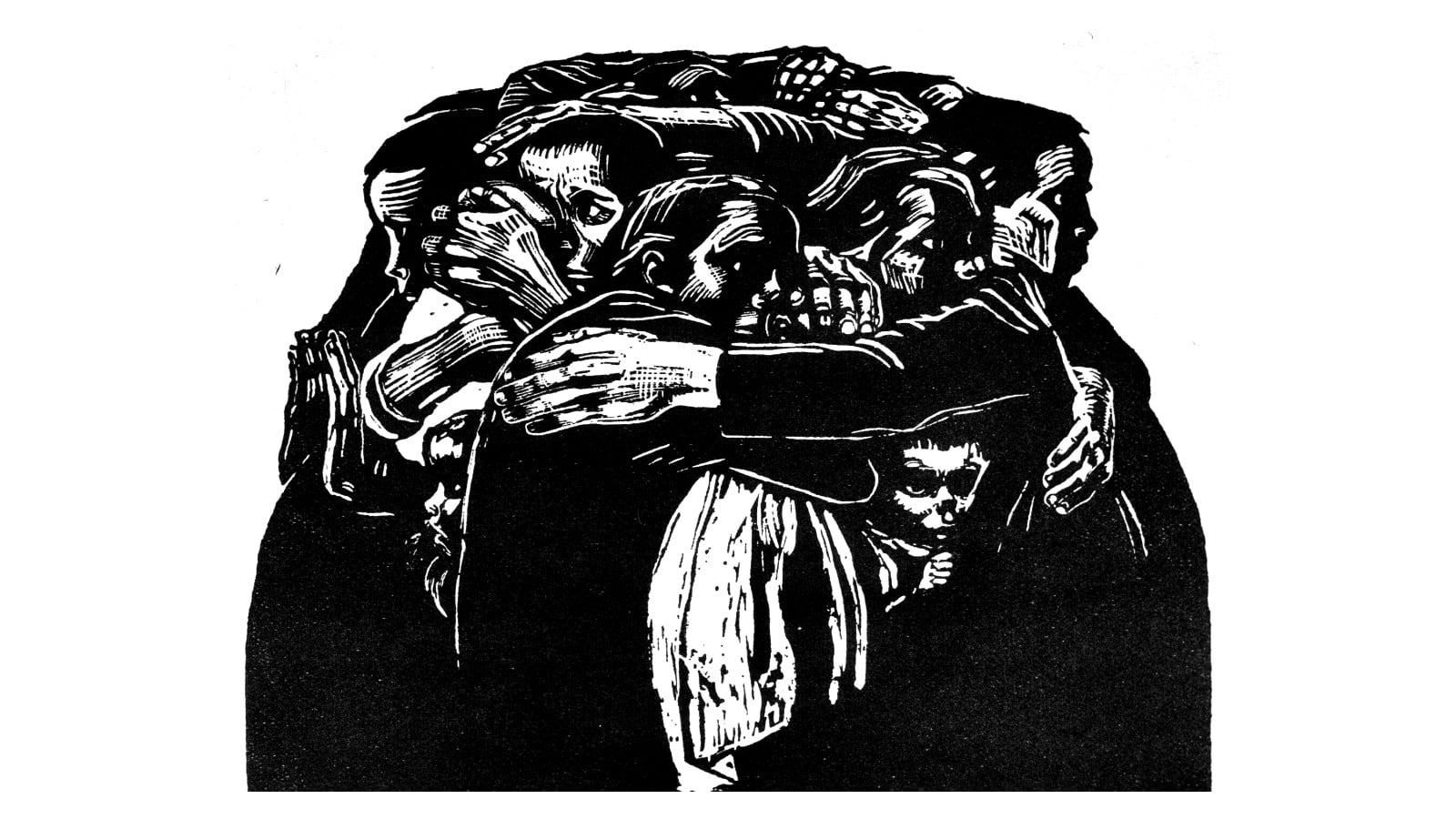
Survival, Shame, Revenge, and the Theology of Divine Absence
“You learn to lie. To the living, to the dead, to the devil himself.”
Betty
The Good Liar (2019) appears to be a thriller about an elderly confidence man and his mark. Its final reversal discloses a different subject: a woman who was raped as a girl in wartime Germany, whose father was executed on her rapist’s denunciation, whose mother and sisters died, and who, sixty-six years later, constructs the judgment that neither family, state, history nor heaven supplied.
This essay reads the film as a parable/mashal of survival when no one comes. It argues that Lili’s deception belongs to a recognized rabbinic category, the lie told upward by the endangered, and that her shame, her guilt toward the dead, and her revenge are theological injuries as well as psychological ones. The absent father of the film opens onto the biblical fathers who fail violated daughters (Jacob with Dinah, David with Tamar) and onto the liturgical Father and King whose face is hidden.
Through hester panim, the Scroll of Esther, Job, Lamentations, the Akedah, the Shekhinah in exile, and the unreconciled voices of Rubenstein, Fackenheim, Wiesel and Levinas, the essay proposes that Lili’s revenge is a human performance of the divine din that history withheld: a counterfeit eschatology that can expose but cannot restore. The conclusion is anti-theodic.
The film neither proves God present nor explains God’s absence. It shows a survivor whose continued life exceeds both her violator and her vengeance, and it leaves the clinician with one obligation: to be the witness who arrives late and believes.
I. The Wound That Asks to Be Believed
There are wounds that ask to be healed, and there are wounds that first ask to be believed. A long clinical life teaches the difference slowly, and usually by failure: the patient who was offered treatment when what she needed was a hearing does not always come back.
The Good Liar, directed by Bill Condon from Jeffrey Hatcher’s screenplay of Nicholas Searle’s novel [1,2], is ostensibly a film about deception. Roy Courtnay is a professional confidence man; Betty McLeish appears to be his latest mark; identities are invented, histories concealed, money moved, loyalties feigned. Beneath the machinery of the thriller lies a darker drama. The decisive lie of the film is not a false name or a fraudulent account. It is the lie that the moral world is dependable: that innocence will be defended, that fathers will protect their children, that societies will punish cruelty, that history will expose wrongdoing, and that God, or whatever now occupies the place God once held, will eventually intervene.
The girl who becomes Betty learns otherwise. No father comes. No judge comes. No God descends. She is left with a terrible possibility: if justice is to enter history at all, she may have to manufacture it herself.
My thesis is that the film, whatever its makers intended, works as a parable/mashal of that possibility, and that its three psychological themes (shame, survivor guilt, revenge) are also theological injuries. The survivor asks more than “Why did this happen to me?” She asks, “Why was I left alone inside it?” That second question is addressed to someone, and the tradition I work in has spent two and a half millennia on the problem of an addressee who does not answer.
Two matters of method need stating. First, I read the film as I have read other works of popular narrative: as a mashal whose nimshal is not supplied by its author and must be argued for [3-5]. A parable does not have to be great art to do its work, and I make no large claim for this one as cinema.
Second, the vocabulary I bring is borrowed, and the borrowing must be declared. The film does not present the Schröder family as Jewish. Lili’s catastrophe unfolds inside the perpetrator nation: a father denounced as a traitor and executed by his own state, a mother’s suicide, sisters killed by a bomb in the last weeks of the war, and then the occupation.
The language of hester panim, of Rubenstein and Fackenheim and Wiesel, was forged by and for the Jewish victims of the same regime. It is not hers, and nothing in what follows should be read as conscripting her into the Shoah. My warrant is narrower. David Blumenthal built a theology of protest by listening, in one frame, to survivors of the Holocaust and to adult survivors of childhood abuse, and he found that the two groups put the same question to God in the same grammatical mood [6]. I claim that congruence of question, and no equivalence of event. Samuel Sandmel’s old warning against parallelomania applies to theologians as much as to philologists [7]: a resemblance is a place to begin thinking and proves nothing by itself.
The essay proceeds from the film to the survivor’s education in deceit, then to shame and to guilt toward the dead, then to the father who does not come and the hidden face behind him. Its central sections ask whether Lili’s revenge can be understood as the human performance of a divine judgment that was withheld, and what such a performance can and cannot accomplish. It ends in the consulting room, where this question usually arrives without a film attached.
II. The Film and Its Reversal
The film is set in London in 2009. Roy Courtnay (Ian McKellen), an elderly and accomplished swindler, meets Betty McLeish (Helen Mirren), a recently widowed woman with savings of more than two million pounds, through an online dating service. He feigns a bad knee to gain a room in her house and persuades her to pool their money in a joint offshore account that he intends to empty. In a parallel plot Roy and his partner Vincent defraud a group of investors. When a hired accomplice asks for a larger share, Roy has the man’s hand broken. When one of the defrauded investors, Bryn, tracks him down, Roy stabs him in an Underground station and pushes him under a train. The audience is thus taught to fear for Betty, and to discount the suspicions of her apparent grandson Stephen [1].
On a holiday in Berlin, Stephen brings them to a flat and discloses what he has found in Soviet records: the real Roy Courtnay, a British officer, died there in 1948. The man who has carried his name ever since is Hans Taub, the officer’s German interpreter. Roy admits it. Betty appears to accept his account and to forgive him.
The money is transferred. Roy leaves, discovers that the keypad controlling the account is missing, and returns to find the house stripped bare and Betty waiting. She is Lili Schröder. In 1943 Hans was her English tutor. At their last lesson, after he had tried to kiss one of her sisters, he raped her. Her parents dismissed him over the attempted kiss. He then denounced her father to the authorities as a traitor, and her father was executed. Her mother killed herself. Her sisters died in a bomb blast two weeks before Hitler’s death. After the war Lili suffered at the hands of the occupying Russians, and it was then, she tells him, that she learned to lie well to live. Eventually she reached England.
She has known who he is throughout. Stephen is the partner of her real grandson, Michael. That Roy is Hans was confirmed by a DNA test on a strand of his hair, kept in a locket from her girlhood. Vincent has been turned. She empties the joint account, leaving him only enough to repay the men he cheated. He locks the door and attacks her; she fights him off. Two of his victims arrive. He refuses to repay them and is beaten. Weeks later he lies in a hospital bed after a stroke, unable to speak or move. The last scenes show Lili among her extended family [1].
Several critics found this reversal arbitrary: a grave historical motive attached to a light entertainment, with almost nothing in the first two acts to prepare it [8]. As a judgment on the craft that may be fair. As a description of how such a past behaves, the unpreparedness is exact. Judith Herman’s account of trauma begins from the observation that atrocity is the thing a community arranges not to know, and that it returns without invitation and out of sequence [9]. For sixty-six years nothing in Betty’s surface prepared anyone for Lili. The film cons its audience in the same way that she cons Roy, and for a related reason: the genre, like the society around her, had no place prepared for what she had to say.
Three details of the plot will carry weight in what follows. The father did act, but against the lesser offense. The proof of identity was a relic of the body, the only document in the story that could not be forged. And the avenger left the means of restitution on the table and did not herself strike the blows that ended him.
III. The Education of the Survivor
The literature of trauma has taught us to distrust the language of “overcoming.” Extreme violation does not happen and then recede into autobiography. It reorganizes experience, so that the past stays contemporaneous with the present [9]. Jean Améry, writing of his torture, located the loss precisely: with the first blow a person loses trust in the world, the unreflective expectation that others will respect the boundary of one’s body and that help will come if they do not, and that trust is not regained [10]. The violated child has learned something the protected child has not. She has learned that the door can open, that the trusted person can become dangerous, that the adult world can fail, and that an appeal can go unanswered.
What changes most deeply is the function of speech. A child ordinarily learns that language establishes relationship. “I am frightened” summons a parent. “He hurt me” brings intervention. When testimony does not protect, speech stops revealing the self and starts sheltering it. One learns what to disclose and what to conceal, whom to trust, and which version of oneself is safest in which room. Sándor Ferenczi described this as a confusion of tongues. The overwhelmed child, unable to resist, takes the adult’s reality inside herself and learns to speak the adult’s language, at the cost of her own [11].
The film gives Ferenczi’s phrase a literal turn that I have not seen remarked. Hans Taub was Lili’s English tutor. He was in her parents’ house to teach her a tongue. She completed the course. Betty McLeish’s flawless English is the language he was hired to give her, and it is in that language, sixty-six years on, that she undoes him. Both are Germans living inside English names. He stole his from a dead officer. She built hers out of what he left her.
None of this makes falsehood morally neutral. It makes the ethics of falsehood inseparable from power. Roy lies downward: he manufactures trust to violate it. Lili lies upward, as people do who have lived under forces stronger than themselves. Rabbinic tradition knows this distinction and is uneasy with it in exactly the right way. Scripture phrases the prohibition of falsehood uniquely as a command of distance: “Keep far from a false matter” (Exodus 23:7). Yet the midwives lie to Pharaoh about the Hebrew births, and the next verse says that God dealt well with them (Exodus 1:19-20). The Talmud permits one to alter the truth for the sake of peace and notes that God edits Sarah’s words before repeating them to Abraham (Yevamot 65b).
Two passages come closer still. When Jacob meets Rachel, he tells her he is her father’s “brother in deceit.” She asks whether the righteous are permitted to deal in deceit. He answers with the verse that David will later sing: with the pure You show Yourself pure, and with the crooked You show Yourself wily (Megillah 13b, citing 2 Samuel 22:27). And of Yael, who received Sisera with milk and a blanket and then drove a tent peg through his temple, Rav Nachman bar Yitzchak says that a transgression committed for its own sake is greater than a commandment performed for an ulterior one (Nazir 23b).
The tradition therefore has a category for Lili’s lie, and its name is instructive: aveirah lishmah. The lie is called great, and it is still called a transgression. This is the correct grammar. Her deception has nothing of purity in it and nothing of mere corruption. I would call it the intelligence of the endangered. Nor does the tradition let Jacob off. I have written elsewhere about the disguise in his blind father’s tent and its long bill [12]. The midrash has Leah answer him on the morning after her substitution with his own deed: did your father not call you Esau, and did you not answer him? (Bereshit Rabbah 70:19).
The asymmetry between Roy and Lili is real. He lies to create vulnerability; she lies because she has known it. But Jacob’s phrase is a confession of kinship, and the confession applies here. “I am his brother in deceit” means that the opponent has chosen the terrain and that I have learned to fight on it. The perpetrator helped to educate the person capable of defeating him. Violence leaves methods behind it as well as memories, and this is one of the longest shadows abuse casts: one may defeat the abuser and still find his syntax in the strategy that did it.
Part I of a five-part series. Notes and references appear at the end of Part V.