

When the Father Does Not Come, Part III
Survival, Shame, Revenge, and the Theology of Divine Absence
VII. Hester Panim and the Scroll of Esther
Jewish tradition has a name for this experience: hester panim, the hiding of the divine face. The phrase is dangerous, and its danger lies in its source. In Deuteronomy the hiding is a punishment. The people will stray, evils will find them, they will say that these evils have come because God is not in their midst, and God answers: “I will surely hide My face on that day, because of all the evil they have done” (Deuteronomy 31:17-18). Applied to a girl in her teens, or to a million and a half murdered children, that causal clause is an obscenity.
Post-Holocaust Jewish thought kept the phrase and cut the clause. Martin Buber spoke of an eclipse of God: something has come between, and the light is not thereby extinguished [24]. Eliezer Berkovits made the hiding the price of human freedom, the space in which people can act well or monstrously [25]. To my ear that is already an explanation, and so already too much. Rabbi Joseph Soloveitchik refused the question “why” altogether and asked instead what the sufferer is now commanded to do [26]. What survives these revisions is a phrase that names without explaining. God’s face is not visible. That statement leaves the reason unsaid. I have worked with the phrase on this condition in earlier studies of concealment and of the question Israel asked at Massah, “Is the Lord among us or not?” [27,28]. The hidden God offers no solution to the wound. Hester panim is the wound’s name.
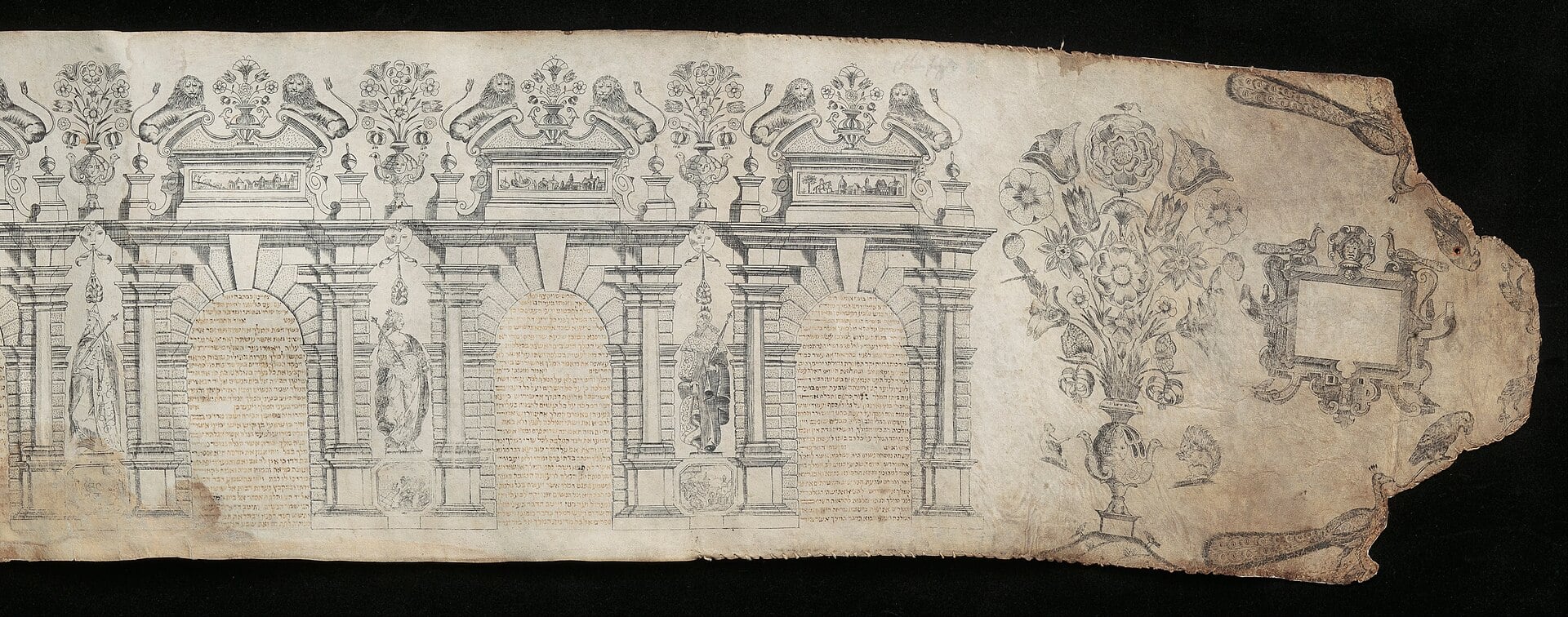
The Talmud ties the phrase to a book. “Where is Esther found in the Torah?” it asks, and answers with a pun on her name and the verse just cited: ve-anochi haster astir, I will surely hide (Chullin 139b). The Scroll of Esther is the canonical narrative of the hidden face. God’s name never appears in it. I want to propose that it is also the nearest scriptural pattern for the film, and that reading the two together sharpens both.
Esther “had neither father nor mother” (Esther 2:7). She is an orphan, and the verb the text uses for her entry into the palace is passive: she “was taken” (2:8). The tradition does not linger over what happens to a girl taken into a king’s harem for a night, and the text does not hide it. She conceals her people and her kindred on her guardian’s instruction (2:10). Her weapon is hospitality. Twice she invites her enemy to a banquet of wine, and at the second, at the moment of his greatest ease, she names him: “the adversary and enemy is this wicked Haman” (7:6). The book’s own word for what follows is reversal, ve-nahafoch hu (9:1). Haman falls upon her couch to plead and is taken for an assailant (7:8), so that he is condemned for the one crime he was not at that moment committing.
Lili is orphaned by her enemy. She conceals her name. She receives him at her table and in her spare room and waits. She discloses herself when he believes his triumph complete, in a house she has emptied for the purpose. The con film and the Purim story share a structure. The predator is destroyed through his own confidence by a woman he took for furniture. The film is a Purim story with the carnival removed.
Two features of the Megillah keep the comparison honest. The first is Mordecai’s sentence to Esther when she hesitates: “if you keep silent now, relief and deliverance will arise for the Jews from another place, and you and your father’s house will perish” (4:14). This is the hidden-God book’s single gesture toward providence, and it arrives as a demand on a human being. In a world of the hidden face, providence is an assignment. The second is the ending. Chapter 9 is a chapter of killing, and the narrator insists three times that the avengers “did not lay their hand on the spoil” (9:10, 15, 16). The Megillah knows that vengeance and profit must not be allowed to resemble each other. Lili takes the money. In a con film money is the only language the parties share, and the film does not say what she does with it. I note the discrepancy and do not resolve it.
In Baum’s parable (The Wizard of Oz), which I have read elsewhere as a midrash on divine concealment, there is at least a man behind the curtain [4]. In Esther no one is behind the curtain at all, or no one who will speak. What is left on the stage is a woman deciding what to do.
VIII. Three Voices That Do Not Agree
Three post-Holocaust positions bear directly on Lili’s situation. They cannot be harmonized, and I will not try.
Richard Rubenstein carried the problem furthest. If God governs history, then Auschwitz falls within the divine intention, and Rubenstein judged that conclusion intolerable. He gave up the God of history and kept the moral intelligibility of the victims [29]. The film is no exercise in Jewish theology, but Lili behaves as though Rubenstein were right about history. No providence arrives. No tribunal convicts Hans. History shows no mechanism by which his crime returns upon him. So she builds one. Her revenge is anti-theodicy in action. She refuses to say that what happened served a purpose, and she refuses to let time convert atrocity into mystery. Her deed says: this happened; you did it; you escaped; I remember; and history will now answer, because I will force it to.
Emil Fackenheim heard something different in the same silence. He did not claim to explain Auschwitz and insisted that it ruptured every earlier system of explanation. But he heard a commanding voice in survival itself: the Jew is forbidden to hand Hitler a posthumous victory, and continued Jewish life, memory and stubbornness are acts of resistance [30]. Later he gave the idea a name from the Kabbalah. A tikkun, a mending, was performed during the destruction by those who resisted it, and it is therefore possible afterward, though it can only ever be partial [31]. Read through Fackenheim, Lili’s great act is the sixty-six years, and the trap in the emptied house counts for less. I return to this at the end.
Wiesel stands between them. His protest approaches blasphemy without abandoning address [20]. In The Trial of God, he stages the case directly. The setting is the eve of Purim, 1649, in the village of Shamgorod, after a pogrom. Three itinerant players and the innkeeper Berish convene a court to try God for what was done there. Berish, who insists on prosecuting, is a father whose daughter was violated in the pogrom. No one will take the defense. At last, a stranger volunteers, argues God’s justice with great eloquence, and is revealed in the final moments as Satan [32]. I know of no more compact statement of where theodicy stands after catastrophe. The defense of God against the testimony of the victims is the devil’s brief.
Irving Greenberg turned this into a working rule: no statement, theological or otherwise, should be made that would not be credible in the presence of the burning children [33]. Zachary Braiterman later gave the stance its technical name. Anti-theodicy is the refusal to justify, explain or accept as meaningful the relation between God and suffering, and he showed that it has deep roots in the classical sources, which are far less pious about divine justice than their reputation suggests [34]. My own attempts at an anti-theodicy of the Shoah, and at its clinical application, belong to this line [35,36].
A fourth voice belongs here, and it differs from the other three in kind. Elliot Wolfson does not write as a theologian of the Holocaust, and I do not enlist him as one. His work on apophasis nevertheless reaches beneath the ground the other three share. Rubenstein, Fackenheim and Wiesel disagree about what to do with a God who was expected and did not come. Wolfson asks what the expectation was made of. In Giving Beyond the Gift, he shows that the twentieth-century Jewish philosophers most alert to the pitfalls of scriptural theism (Cohen, Buber, Rosenzweig, Levinas) still, in differing degrees, personified transcendence, even as they tried to purge their descriptions of God by negation. He argues that the logic of apophasis, allowed to run its full course, would go past every such figure to what he calls an apophasis of apophasis. It rests on an absolute nothingness, which he distinguishes from the nothingness of an absolute, and it does not signify an unknowable One. The metaphor of the gift then yields to an unconditional givenness in which the distinction between giver and given collapses [37].
If I read him rightly, the bearing on this essay is direct, and it falls first on the previous section. A hidden face is the nothingness of an absolute: someone is there and is not seen. Wolfson’s distinction asks whether even that much can be said. The Father who did not come would then be an image, and some part of the wound would belong to the image. The survivor would have a second labor beside her protest, which is to mourn the figure itself. Her sixty-six years, which I called a gift and an accusation, would be neither. They would be given, with no giver to thank and none to indict. Wolfson does not pretend that this comes without cost. Of Derrida and Wyschogrod, who carried the removal of images from God furthest, he grants that the move puts the life of devotional piety in serious doubt. I do not set his voice against the others, and I do not try to answer it. This essay goes on speaking of a Father because that is the grammar in which the injured child speaks. I owe to Wolfson the knowledge that it is a grammar, and that it is to be held with an open hand.
Rubenstein concluded that the providential God could no longer be believed. Fackenheim heard a commandment where Rubenstein heard nothing. Wiesel stayed in the courtroom. Wolfson asks what we pictured when we looked toward the bench. Their disagreement is the landscape after catastrophe and needs no repair. One survivor loses God, another curses God, another clings, another finds God only in other people, and another cannot bear the word at all. The theologian’s task is to refuse to silence any of them. Lili, who is given no religious vocabulary by the film, enacts the first three positions. Like Rubenstein she waits for nothing from history. Like Fackenheim she has made a life. And like Wiesel she convenes a court. Whether the fourth voice describes her more truly than any of them, I leave open. By the film’s account she asks nothing of heaven at all.
IX. Din Without a Judge
I come to the proposal on which this essay turns. Lili’s revenge is a human attempt to perform the divine din, the judgment, that history withheld.
The midrash teaches that the world could not have been created by judgment alone. God saw that it would not stand and joined to the attribute of judgment the attribute of mercy, like a king who pours hot and cold water together into a fragile cup so that it neither cracks nor contracts (Bereshit Rabbah 12:15).
The teaching is usually cited for its tenderness. Its other half is as important. A world of mercy alone would not stand either. Judgment is one of the two pillars, and a world from which it has vanished is no gentler for the loss. It becomes the world the Targum puts in Cain’s mouth as he rises against his brother: there is no judgment and no judge (Targum Jonathan on Genesis 4:8). For sixty-six years the evidence available to Lili supported Cain.*
Scripture does not treat the desire for vengeance as pathology. “God of vengeance, O Lord, God of vengeance, shine forth” (Psalm 94:1). The verb is hofia, appear. Vengeance is asked for as a mode of divine appearing, the exact contrary of the hidden face. The Talmud observes that the word vengeance in this verse stands between two divine names and concludes, with visible unease, that in its proper place vengeance is a great thing (Berakhot 33a). The Torah reserves it: “Vengeance is Mine, and recompense” (Deuteronomy 32:35). A reservation, however, presumes that the one who holds the right will exercise it. When the right is left unexercised, the question of who holds the claim reopens.
In one domain the Torah itself answers. The nearest kinsman of a murdered person is the go’el ha-dam, the redeemer of blood (Numbers 35). This is Job’s word. The law does not abolish the avenger. It fences him, with cities of refuge, with the requirement of witnesses, and with the distinction between the murderer and the one who killed by mischance. Lili is the go’elet ha-dam of her father, and Hans, who killed by deliberate denunciation, would find no city of refuge open to him.
The two biblical precedents for avenging a violated sister are warnings. Dinah’s brothers answer Shechem “with guile” (Genesis 34:13), turn the sign of the covenant into a weapon, and kill every male in the town. Jacob curses their anger on his deathbed (49:7). Yet the chapter gives them the last word, and it is a question no one answers: “Shall he deal with our sister as with a harlot?” (34:31). Absalom waits two full years, prepares a feast, and has Amnon struck down when his heart is merry with wine (2 Samuel 13:23-29). The avenger then becomes a usurper and dies at war with his father. In both stories, vengeance taken outside the law exceeds its occasion.
Measured against these, Lili’s judgment is remarkable for its proportion. The Mishnah states the principle: “by the measure with which a person measures, it is measured to him” (Sotah 1:7). Hans lived by manufacturing trust, and manufactured trust undoes him. He took the savings of others, and his are taken. He took a dead man’s name, and she takes it back from him by naming who he is. Finally, the man whose whole instrument was his tongue ends without speech.
Three restraints separate her from Simeon and Levi. She does not kill. She leaves in the account what he owes the men he defrauded, so that the door of restitution, which in Jewish law is the door of repentance, stands open, and it is Hans who refuses to go through it. The blows that fell him come from his own victims and, in the stroke, from his own body. She raises her hand only to free herself from his.
In the idiom of the Kabbalah, her din has not been cut loose from mercy. Gershom Scholem showed that for the Zohar the root of evil is precisely judgment severed from its counterweight, which hardens into an independent domain, the sitra achra [39]. The balance of mercy and judgment has been a recurring concern of mine on the theology of healing [40]. The rabbis also knew the opposite failure: whoever is merciful to the cruel will end by being cruel to the merciful (Kohelet Rabbah 7:16). Hans is no penitent. Within the film’s own present, he has a man maimed and kills another. Had Lili forgiven him in that emptied house, the next Bryn would have paid for her magnanimity. Reconciliation between victim and perpetrator, about which I have written elsewhere, presupposes a perpetrator who turns [41]. This one does not.
The proposal has a cost, and Jewish law states it. A witness may not become a judge in the same case (Rosh Hashanah 26a). And the Mishnah warns: do not judge alone, for none may judge alone but One (Pirkei Avot 4:8). Lili is victim, witness, investigator, prosecutor and judge. She has help in the investigation, but the sentence is hers alone. This is the exact sense in which she occupies the divine seat. And the Mishnah, read from her side of it, becomes an accusation: there is One who may judge alone, and for sixty-six years He did not.
* I have examined the post-Holocaust form of this dialectic between divine judgment and divine absence elsewhere [38].
Part III of a five-part series. Notes and references appear at the end of Part V.