


When the Father Does Not Come, Part IV
Survival, Shame, Revenge, and the Theology of Divine Absence
X. Counterfeit Eschatology
Religious traditions commonly postpone perfect justice. The wicked may flourish now, but there will be a judgment, and history is not the final court. Eschatology spares the believer the need to see every account settled in his own lifetime. When confidence in a final justice collapses, revenge becomes an improvised eschatology. The avenger tries to make the last judgment occur inside history.
Lili’s plan has this character, and its center is revelation more than punishment. She does not only take Roy’s money. She unveils him. Hans Taub, who has lived for six decades inside a stolen name, is made to face the past he believed he had outrun. The structure is apocalyptic in the oldest sense of apokalypsis, an uncovering. You are not who you claim to be, and neither am I. The masks come off, memory enters the room, and the dead are called as witnesses.
It is counterfeit because the human avenger cannot do what eschatological hope promises. She cannot raise her father. She cannot restore her mother or save her sisters, and she cannot become the girl she was before the last lesson. Punishment moves forward and trauma reaches back, and the two never meet. Hannah Arendt called this the predicament of irreversibility. Human beings cannot undo what has been done. Forgiveness and punishment are the only two means we have of bringing to an end something that would otherwise go on without limit, and they share a boundary: people cannot forgive what they cannot punish, and they cannot punish what has turned out to be unforgivable [42].
Améry is the necessary witness on the other side. In his essay on resentments, he refuses the consolation that time heals, and calls that healing a moral scandal. He defends his resentment as a protest against the natural drift by which what was done slides into what merely happened. And he states precisely what he wants. The criminal’s suffering is beside the point. He wants the criminal brought to the point where he too wishes that the deed had never been, so that for one moment perpetrator and victim stand on the same side of it [10]. By that standard Lili’s apocalypse fails at the decisive point, through no fault of hers. Hans hears everything, and his response is to lock the door and attack her. The revelation is made to a man who will not receive it.
What of forgiveness? Simon Wiesenthal’s silence at the bedside of the dying SS man still marks the limit: no one may forgive on behalf of the murdered [43]. Vladimir Jankélévitch put it more harshly: where pardon has never been asked for, the question of granting it does not arise [44]. Jewish law agrees. For wrongs between one person and another, the Day of Atonement does not atone until the offender has appeased the one he wronged (Mishnah Yoma 8:9), and the dead cannot be appeased. Forgiveness demanded of victims as a religious duty, for the comfort of bystanders, is the perpetrator’s last privilege. Jeffrie Murphy has argued that a measure of resentment is what self-respect looks like in a person who has been wronged, and that a victim who feels none has accepted the offender’s estimate of her worth [45].
Yet revenge cannot carry the whole weight either. Herman’s late study of what survivors themselves mean by justice is sobering for anyone who assumes that they want blood. Most of the women and men she interviewed wanted acknowledgment. They wanted the truth established, the community to take their side, and the burden of shame returned to the person who earned it. Punishment mattered to them far less [46]. This suggests that what Lili most needed from the emptied house was a sentence said aloud in his hearing: you did this, and I am the one who knows it. The ruin of Hans mattered less than that. Revenge can do certain morally intelligible things. It reverses power, and it sends shame back along the path by which it came. It cannot, by itself, heal, because healing requires a self no longer organized around the abuser. Hatred has nothing of submission in it, yet it can remain a form of attachment. The opposite of domination is freedom, and revenge does not supply it.
A superficial reading would say that Lili risks becoming what she hates. I think that moral equivalence here is an evasion. She does not become Hans. The disturbing point is the one reached earlier: Hans has helped to determine the form her justice takes. Healing, if it comes, must mean more than victory over him. It must mean that he ceases to be the author of any part of her.
XI. God After the Father
What theology is left when the father does not come? The tradition offers at least three places to stand, and each has a danger.
The first is Lamentations. In the five poems of Eichah God never speaks. The book is all address and no reply. Its first chapter personifies the ruined city as a violated woman: the adversary has spread his hand over all her precious things (Lamentations 1:10), and the refrain, which returns in one form or another five times in that chapter, is ein menachem lah, there is none to comfort her. The phrase is the sister of Deuteronomy’s ein moshia lah. The poet goes as far as to say that the Lord has become like an enemy (2:5), and the book ends on a question so bleak that the synagogue repeats the verse before it in order not to finish there (5:20-22). By canonizing this book, the tradition has licensed, as Scripture, the speech of a violated woman to a God who does not answer. The survivor who can say only “You were not there” is quoting.
The second is the Akedah, and it is the harder case, because it looks like the opposite of our story. There the father is present, and it is his hand that holds the knife. What the Akedah offers to those who love it is that someone does come: the voice calls from heaven at the last instant and calls twice. Shalom Spiegel showed what happened to that comfort in the Rhineland during the Crusades. Jews who had watched their children die wrote liturgical poems in which Isaac is actually slaughtered, and his ashes lie upon the altar, because the biblical story, with its timely angel, no longer described the world they lived in [47]. Lili’s story is that medieval Akedah. No voice calls and no ram is caught in the thicket. To read her story with theirs is to see that the tradition has been here before and did not respond by defending the angel’s punctuality.
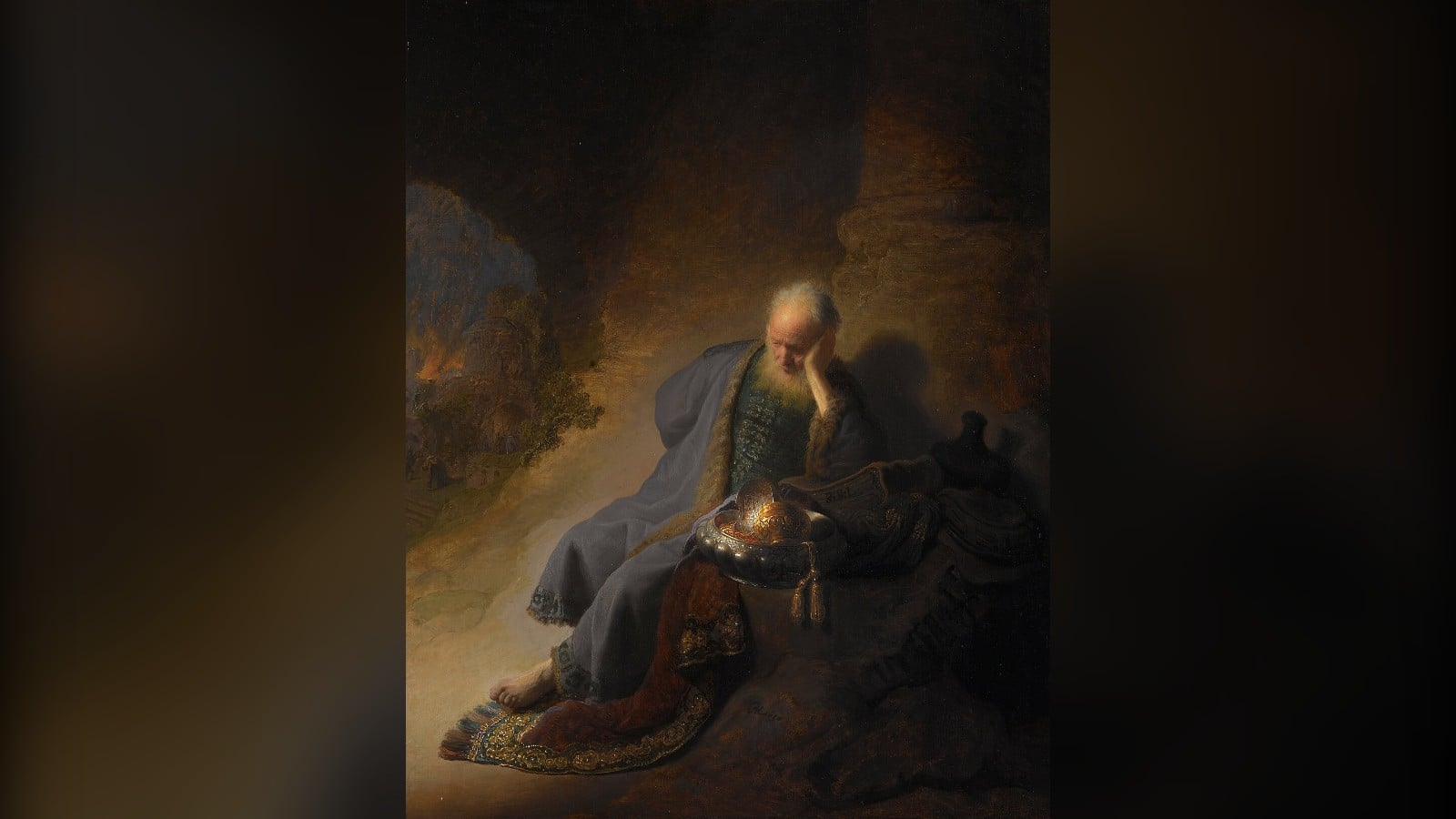
The third is the Shekhinah. Wherever Israel was exiled, the rabbis say, the divine presence went into exile with them (Megillah 29a). God weeps in the inner chambers, in a place called mistarim, the hidden places (Chagigah 5b, on Jeremiah 13:17). In the Warsaw ghetto in 1942, Rabbi Kalonymus Kalman Shapira, the Piaseczner Rebbe, returned to that passage. God’s weeping is hidden, he taught, because it is without limit, and the world could not survive hearing it. The one who presses through into the inner chamber weeps there together with God [48,49].† Hans Jonas reached a neighboring conclusion by philosophical means: after Auschwitz we may keep God’s goodness and God’s intelligibility only by surrendering God’s power, and must think of a God who suffers, becomes and cares, and who could not intervene [50]. I have traced this figure of the suffering and darkened Shekhinah from the midrash to the present in two earlier studies [51,52].
Here I must apply to myself a caution I formulated for the bedside. A suffering God can become one more consolation administered to the victim. “God wept with you,” said to a girl who was raped in her parents’ house, relocates her suffering into a cosmic drama, and this is theodicy by another route. In an essay, I proposed three rules for theological speech in the presence of suffering. The third is that the divine name may be predicated neither of the event nor even of the human response to it. It may be used only, if at all, of the interval between the cry and our incapacity to answer it [53]. By that rule God is not to be in the denunciation, as though it served a plan. Nor is God to be located in the revenge, as though Lili were heaven’s instrument, nor even in her survival, as though it justified what preceded it. If the Name belongs anywhere in her story, it belongs in the moment the Torah itself isolates: the girl cried out, and there was none to save her. It belongs, that is, to the protest that this should not have been.
Levinas found the same place by way of a short story. Commenting on the fictional testament of Yossel Rakover, who dies in the Warsaw ghetto still addressing God, he describes an adult faith under an empty heaven, one that loves the Torah more than God. The commandment to do justice survives the hiding of the one who commanded it, and may be the only form in which, for a time, that one can be met [54]. What “Father” can mean after this, I do not know. Perhaps, for a time, nothing. Here the fourth voice of Wolfson has its practical force: an image may have to be unsaid before anything can be said in its place. Perhaps the paternal image must be laid down for a generation in favor of others the tradition also owns: the fellow mourner, the hidden one, the exile, the voice that demands justice and cannot yet deliver it.
XII. Where Were We?
Emmanuel Levinas gives the most ethically stringent direction. After the twentieth century, he argued, the attempt to justify another person’s suffering is itself the source of immorality. Suffering in the other is useless, for nothing, and no scheme can redeem it. It takes on meaning only as my suffering over the suffering of the other, and this meaning takes the form of a summons [55]. This reverses the direction of the question. Theodicy looks upward, and ethics looks across. In place of “Why did God allow this?” comes “What does this person’s suffering demand of me?”
Applied to Lili, this forbids us to look for a divine purpose behind what happened to her and directs us to another line of questioning. Did anyone hear her? Did anyone believe the violated child, protect the endangered family, remember the dead, or refuse the perpetrator’s version of events? Did anyone stand beside the survivor before revenge became the only form of justice she could imagine?
The film’s answer, which it gives almost in passing, is a list of human absences. A state had made denunciation a civic act, and a young man’s word against a father was enough. An army of liberation became, for a girl without a family, a further assault. A ruined continent allowed a Hans to become a Roy by a change of papers. And for sixty years no one in a peaceful country had reason to look behind an Englishman’s name. Divine absence is in large part a human indictment. People invoke the silence of God after they have taken part in a human silence. The father is removed, the neighbor says nothing, the institution protects itself, the witness looks away, the community doubts the victim, and then theology is asked to explain the result. I have written about one recent instance of that sequence and about our own share in it [56]. Levinas refuses the sequence. For him responsibility comes before explanation.
Dori Laub, a psychiatrist and himself a child survivor, described the Holocaust as an event without a witness. The victims were so enclosed that no one inside could step outside to testify, and the world outside declined to look. Testimony, he argued, comes into existence only when a listener is found, and until then the event has in a sense not finished happening [57]. Lili’s rape had no witness. The denunciation of her father had many, and none of them objected.
This corrects a tempting first reading of the film, which is that Lili acts alone. She does not, quite. Stephen, her grandson’s partner, traces Roy’s history, produces the Soviet records, plays the suspicious grandson, and turns Vincent. Michael, her grandson, is party to it. The witnesses do finally arrive. They come two generations late, from among the grandchildren, and they come the only way that counts, by doing the work. Belief, in this sense, is labor. A hearer who believes takes on some of the cost of the truth. This is the film’s one image of a community functioning as it should, and it is easy to miss, because the film is busy with the duel.
It bears on how we speak of resilience. To say that Lili “took back her power” is true and insufficient. Why did she have to take it back alone, and wait until she was old? Therapeutic culture celebrates agency, and rightly. There is nonetheless a cruelty hidden in the demand for resilience. We praise the survivor for being strong because others failed to protect her, and we admire the architecture she built from wreckage and forget to ask why she was left standing in ruins. Resilience is admirable, and it must never serve as an alibi for abandonment. The survivor who becomes her own providence exposes the failure of every lesser providence around her. Braiterman’s anti-theodicy has this human corollary [34]: the refusal to justify God’s absence obliges us to stop justifying our own.
† The English reader has those sermons in the translation of Rabbi J. Hershy Worch [48].
Part IV of a five-part series. Notes and references appear at the end of Part V.