


When the Flag Falls Silent
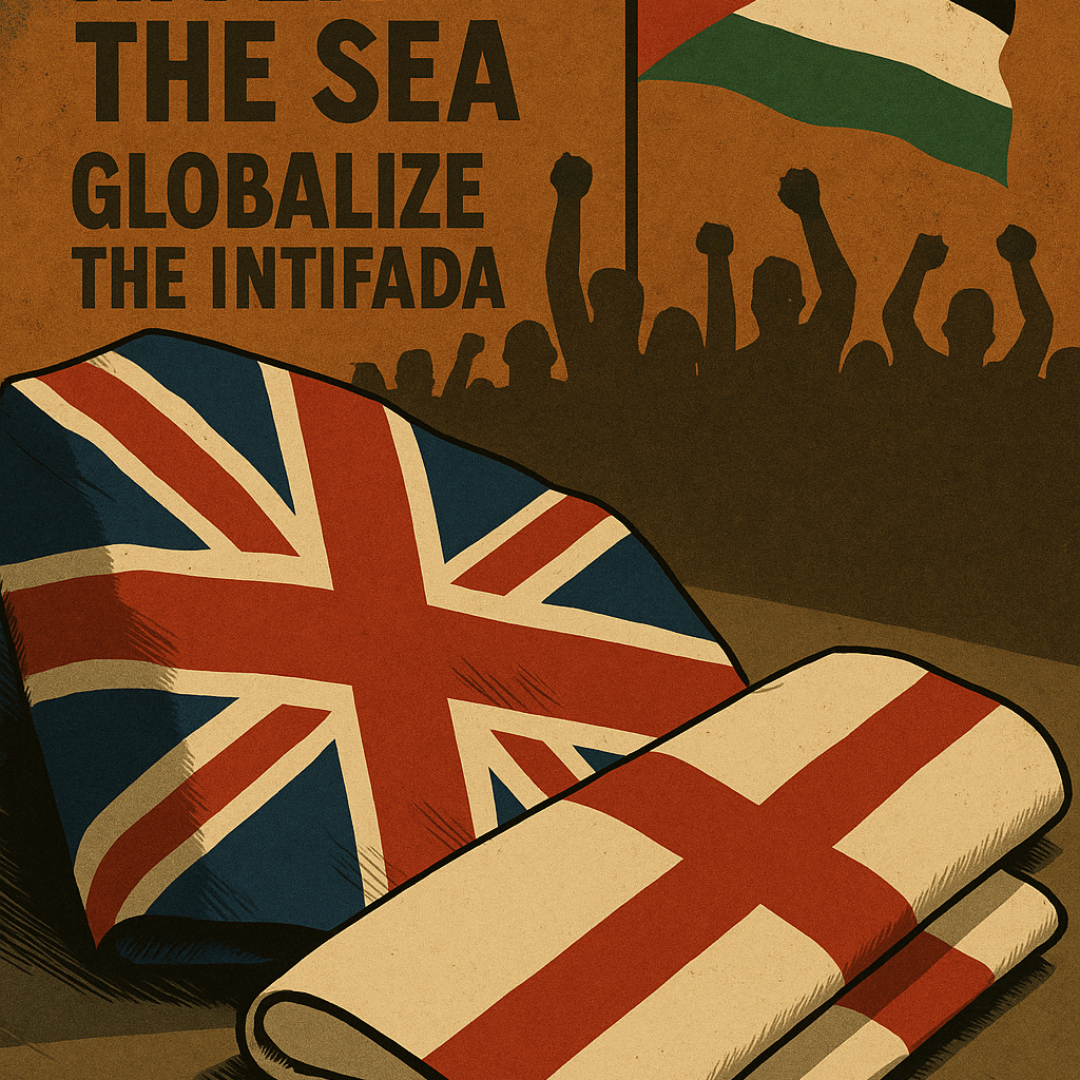
There are moments in the life of a nation so absurd, so unthinkable, that were they not observed with one’s own eyes, one might suspect the hand of Swift or Orwell at play. That a council in England should declare the cross of St. George too “provocative” to fly; that the Union Jack should be hidden from sight, as though guilty of some unnamed misdemeanor. It is the stuff of satire, of sketches performed before a winking audience, not of sober public policy. And yet here it is, decreed with the earnest face of officialdom: our own emblems of history and belonging treated as dangerous contraband.
Meanwhile, the streets below those stripped flagpoles are festooned in green, black, red, and white. The Palestinian flag, a symbol now so ubiquitous in Britain that one might think it part of our municipal décor, waves proudly from bridges, from campuses, from every other demonstration where the air is thick with slogans. “From the river to the sea,” they chant, “globalize the intifada.” No bureaucrat scribbles a memo against such words. No council speaks of “provocation.”
And here we arrive at the crux: it is not neutrality at all. It is the quiet absorption of our public space into the cause of Hamas. For what else can we call it when the movement’s banners are unchallenged, its chants unimpeded, its narrative woven into the fabric of protest — while the Union Jack and the cross of St. George are told to slink away like unwelcome guests?
How British, how exquisitely British, to imagine that this is done in the name of tolerance! In permitting one flag, we have not expanded freedom, but narrowed it. In making space for imported rage, we have made less space for ourselves. And the proof is in the absurd spectacle of a land embarrassed by its own emblems.
It should be a simple thing, this business of flags. A flag is an emblem of identity — sometimes of faith, sometimes of sovereignty, sometimes of shared history. It can be waved in pride, lowered in mourning, carried in triumph, or draped in grief. To suggest that one flag is to be banished while another may flutter freely is to suggest that some identities deserve a place in the public square and others do not. That is not tolerance. It is discrimination in its most decorative form.
And here, Jews have felt the blade first. The Israeli flag, with its blue Star of David, has long been subject to vilification. To carry it in public is to invite fury; to display it is to risk vandalism. Its presence is almost never defended as a right, but nearly always interrogated as a provocation. And once that principle is conceded — that some flags are too offensive to fly — the contagion spreads. Soon it is the turn of the Union Jack and St. George’s cross.
Thus, by indulging the radicalism of Hamas’s narrative — hatred of Jews dressed up as hatred of their symbols — Britain has invited intolerance to seep into its own bloodstream. It does not remain politely confined to Golders Green or Stamford Hill. It seeps outward, slowly, like dye in water. Today it demands that Jews lower their banner. Tomorrow it insists the English do the same.
This is the lesson we are too polite to state plainly: you cannot accommodate intolerance without diminishing yourself. You cannot silence one flag without imperilling your own. For a society that allows Hamas’s chants to dominate its streets while apologising for its own symbols is a society that has forgotten the simple business of belonging.
Let us imagine, for a moment, a reversal: the crescent atop a mosque is smeared in paint, and the vandals explain that they object to Saudi foreign policy. Who would nod and say, “Well, perhaps we should examine the context”? The very suggestion would be met with outrage, and rightly so. Symbols matter. They are not easily disentangled from the people they represent. Yet somehow Jews are expected to accept precisely this logic — and now Britons too are being asked to accept it, as their own flags are hidden in shame.
The banishing of the Union Jack and St. George’s cross is not an eccentric local policy. It is a warning. It tells us what happens when a society pretends that hatred is just another opinion, that bigotry is merely political critique. It tells us what happens when Hamas’s rhetoric is permitted to colonize our squares and streets: the civic fabric begins to fray, and in the end, no one’s identity is safe from erasure.
This is not, then, a Jewish issue alone, nor an Israeli one. It is the most British of questions: whether we will continue to fly our own flags without apology, or whether we will allow a borrowed intolerance to dictate which emblems may remain in the sunlight.
Let us be plain. To strip our flagpoles of their rightful colors is not to keep the peace. It is to surrender it. And if the British public does not recognize this as the thin edge of the wedge, they may one day find themselves standing in a square without any banner left to fly at all.