
When the hallowed turns hollowed
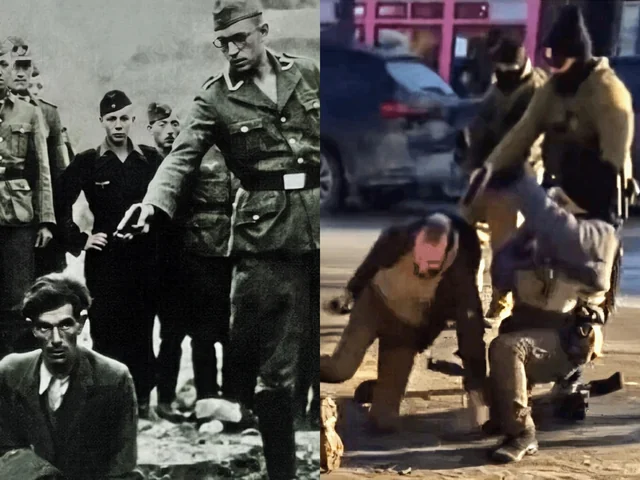
On January 25, and ironically two days before the International Holocaust Day of Remembrance, Tim Walz stood at a press conference and decided to go for a travesty of a blunder to add to his already extensive repertoire: an evocation of the specific story of Anne Frank to promote a personal political agenda.
His particularly pathetic performance successfully put a glaring spotlight for many on a problem that has already been growing for quite some time, and one that has allowed it to manifest publicly in a government official.
It’s a swastika in a political sticker on a pole, out in the open, placed intentionally for all to see. An occurrence by no means unique, as one can easily pass by at least three of them any given day.
It’s the inevitable label of “Nazi” issued to many, Jews included, for simply having the gall to know and defend basic realities in the world.
And it’s the corrupted confidence to post the nauseatingly false equivalence of Alex Pretti with The Last Jew in Vinnitsa.
How did we get to a point where evoking symbols loaded with death has become vernacular? How did we get to a point where such macabre mockery is not only second nature, but seen as righteous?
Everyone already knows about classic Holocaust denial from the right and the modern Holocaust inversion of the left.
But there’s another phenomenon taking place that is potentially worse, as it has crept into and become normalized in mainstream society, not simply spewed from the fringes. This is the gradual and grave dilution of the Holocaust through universalism: an insidious process of belittlement, with harm that is far from anything little.
Let’s jump right in and state the should-be obvious:
There is never an appropriate time to call someone a Nazi unless one is an actual Nazi. To do so is egregiously wrongful in both facts and morals, ensuring a dual disservice to both past and present, as careless belittlement dilutes meaning and reality.
Yet the grotesque glossing-over and perversion of Holocaust rhetoric has become alarmingly endemic, through a skyrocketing in accepted hyperbole that has transformed the most serious human offenses into political barbs. The rotten cherry on top is that Jews are by no means immune to participating in this sloppy behavior either, making such historical manipulation even more grotesque.
As a result, a Nazi has diminished into a label for anyone who dares to disagree with the perpetually offended. So Immigration and Customs Enforcement becomes the literal Gestapo. Illegal immigrants are now in the same situation as Jews in the 1930s. Detention facilities or mishandled land are analogous with concentration camps. Legal war or regulations are resultingly genocide. “Never again” is hashtagged and plastered onto any cause du jour.
With this pervasive overuse and abuse, it isn’t too difficult to understand how drawing swastikas in public has become acceptable.
Yet none of this is acceptable or comparable. Someone who holds a different set of beliefs or political registration does not a Nazi make. A pompous politician or United States president is not equivalent to Hitler, no matter how much one dislikes him. Deporting noncitizens is not in the same universe as rounding up Jewish citizens. Detention facilities are not for the deliberate extermination of their inhabitants. Retaliation against terrorist aggressors will never be in the realm of a genocide…and though it should never even need to be acknowledged, neither is revoking access to puberty blockers.
Ironically, those so against the sin of appropriation are seemingly A-OK with co-opting Jewish history for their own desires. But if one’s personal cause has merit, it should be able to stand by itself, not sloppily propped up by another. Disrespecting a nearly unmatchable horror of history brings no respect to anything else…especially not the individual attempting such moral fraud.
So why is it that the Holocaust does not receive the absolute respect it deserves?
The societal failure of universalizing the Holocaust has essentially proven that Holocaust education has not been universally successful…assuming it has been bothered to be attempted at all. For too many that even experienced any education, it appears to have only been a memorization of when and who, while crucial takeaways of why and how have been lost. Stark truths of depth of hate and enormity of destruction have either not been properly conveyed or sufficiently ingrained, so hard realities have waned into soft metaphors.
The objective reality of the NSDAP is watered down to a subjective concept of personally-abhorred politics. Naturally, a Holocaust widens to perceived injustice against any vague group, versus the industrialized extermination of a very specific one. Anne Frank is mercilessly tokenized to a generic darling of victimhood and quoted for emotional effect without real respect to the circumstances being referenced. The oft parroted, “it didn’t start with gas chambers,” factual yet diminutive, tends to only serve to demonstrate a serious lack of understanding for how and why it did truly start, frequently becoming simply a vehicle to lead into a completely inappropriate analogy. And with the consistent equalization of other demographics slaughtered by Hitler’s regime, it’s been far too easy to lapse into an egalitarian fantasy of targeting that no longer centers Jews in their own genocide. All sadly proving that any shallow homage afforded is often covering a deep lacking in genuine respect to the subject.
But it isn’t just that education has seemingly failed. It was an inevitability of a society providing it whose standards have as well. When crimes of humanity become colloquial, we’ve got a real problem. It is truly the exposure of the depth of human narcissism and entitlement to cheapen one of the worst events in history by weaponizing it for political grievances.
Given second-to-none Jewish determination and success at rising above the victimization thrust upon us, Jewish trauma of the past is all too often viewed as acceptable to passively diminish or actively exploit in the present.
On one hand, Jewish-specific things tend to be expected to share their uniqueness and importance with other movements and groups and not allow significance for themselves alone. One only needs to look at the Blue Square campaign to see this in action, which once a campaign strictly for fighting Jew hate soon became one that included fighting all hate. Or that fascinating pattern of how often antisemitism just cannot be uttered without “Islamophobia” in the same breath. Why wouldn’t Jews be expected to not only accept sharing their targeted trauma, but to move out of the way entirely?
And with hallowed-turned-hollowed definitions as up for grabs as integrity, it only makes sense that others would actively steal such trauma to manipulate for their own movements and agendas, as it’s infinitely easier to push such irrationality and immorality when stretching and warping reality has already become standard practice.
But this historical and moral vandalism shouldn’t just register as absolutely offensive: it should be acknowledged as darkly reckless as well.
Such fast and loose cosplay isn’t just thoroughly degrading to what the Nazis’ victims actually lived through and died from. When sacrosanct events are allowed to be diminished from their essential singularity, not only is permission given for continued disrespect of the past, but the bar is dangerously lowered for the future.
If any person can be a Nazi, a Nazi now means nothing. If anything can be the beginning of a Holocaust, or the Holocaust itself, the actual Holocaust fades into nothing. So do its unique lessons. And that might be the real point.
Toleration for the continued misuse of language will lead to the abuse of what it represents for other purposes until society simply has no use for it any longer.
Stripping the core from the historical event also strips its promised assurances. Guilt can be minimized along with safeguards. And when past and present antisemitism don’t have to be taken more seriously than a metaphor, future repetition of its crimes becomes more than one.
But the Holocaust will never be a metaphor for anything else. It was a horror of horrors singular in itself, deliberate in its destruction, and ages in the making. So much in society is up for discussion, but this cannot be without losing more than we can afford of our grip on both reality and humanity. As survivors fade and we are left with words for memory, the world must honor its promise to never forget the desecration it once allowed by not allowing any further desecration of them.
- 2016 US presidential elections
- Abuse
- Activism
- American Jewry
- Anti-Zionism
- antisemitic violence
- Antisemitism
- Ashkenazic Jews
- Donald Trump
- Gaza
- Gaza Strip
- genocide
- Holocaust Denial
- Holocaust Revisionism
- Palestinians
- Social Media
- The Holocaust
- US Midterm Elections
- US Politics
- US Presidential Elections 2016
- US Presidential Elections 2024
- Zionism