
When the yellow ribbons start to fade
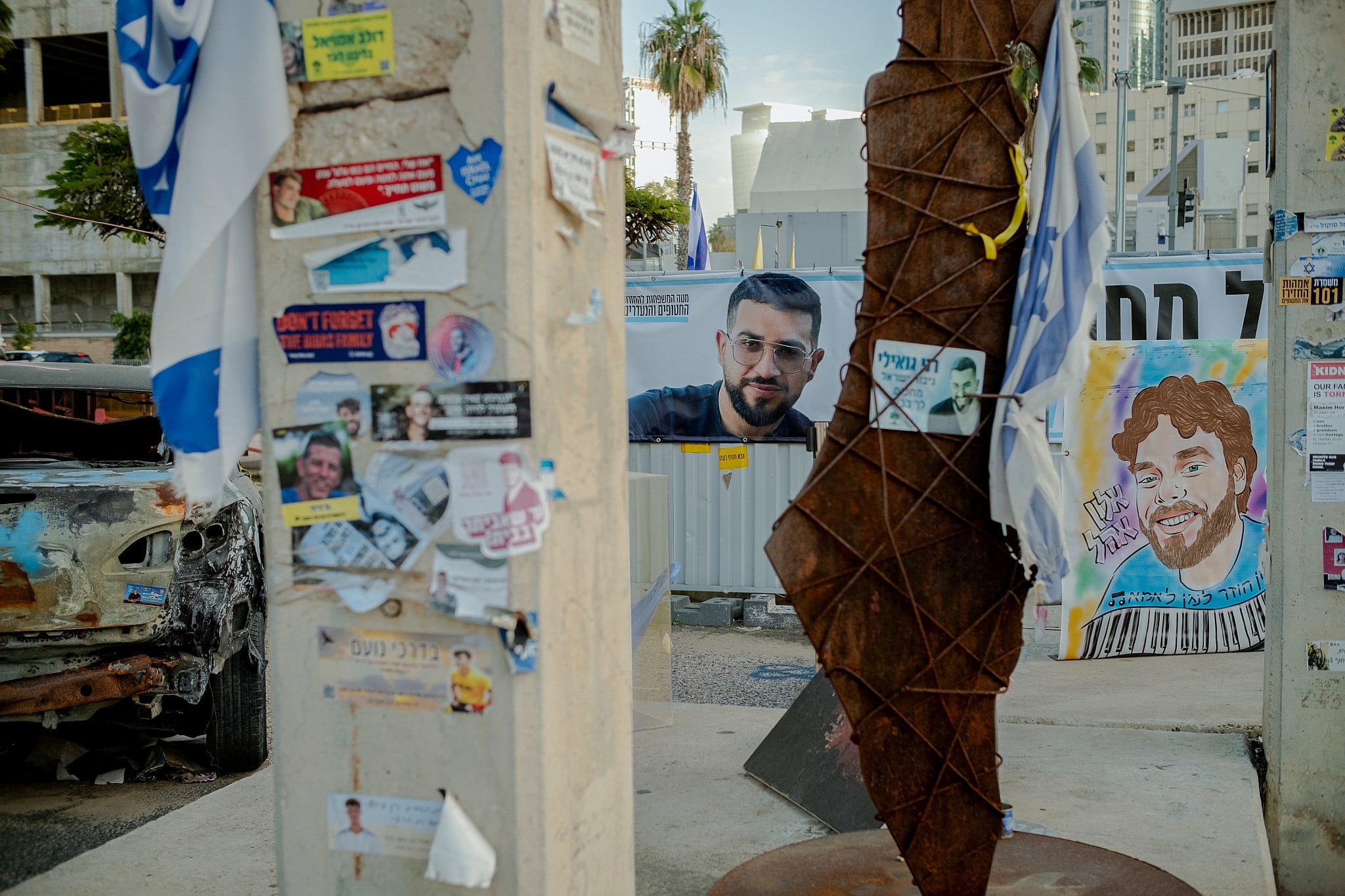
The return of the last hostage’s body marks a moment that is both deeply human and profoundly symbolic. It is a moment of closure in the most literal sense: the final name crossed off the list, the last absence accounted for. But beyond the personal grief, this moment marks a collective transition that deserves careful attention.
For the first time since October 7, Israeli society is no longer living with an open-ended register of the missing. The long season of waiting for news, for proof of life, for final confirmation, has come to an end. With it, a certain symbolic economy that sustained public life during the months of uncertainty also begins to shift. But as the symbols begin to fade, a harder question emerges: what framework exists to carry forward what they held?
Throughout the crisis, visual symbols played a central role in holding the catastrophe within the public sphere. Yellow ribbons, hostage pins, empty chairs, and portraits of the abducted functioned as more than gestures of solidarity. They were tools of what might be called symbolic holding: a way of carrying an ongoing disaster in everyday life without allowing it to dissolve into abstraction or statistics. These symbols made absence visible. They created a shared language that did not require agreement on policy or ideology in order to express a minimal moral commitment: these people are missing, and we are not done with them.
Such uses of visual symbols in times of crisis are not unique to Israel. The white headscarves of the Mothers of Plaza de Mayo in Argentina, the yellow ribbons worn in the United States during the Iran hostage crisis, and the posters of the missing after September 11 all served similar functions. They refused closure. They suspended normal time. They insisted that a wound remain visible until it could be properly named.
The return of the last hostage’s body changes this condition fundamentally. For the first time, the catastrophe can be narrated as a completed episode rather than an open one. And with that possibility comes a crucial question: what comes after?
Yet something else is happening. Even as the hostage chapter closes, the public language remains mobilized. The discourse shifts seamlessly from “bring them home” to “how do we disarm Hamas”—from one urgent demand to another, with no pause for the questions that fall between. But a society kept in permanent emergency mode cannot stop to ask what happened to it. It can defend itself while also asking how its defenses failed. It can look forward while also looking back. The refusal to do so is not a sign of strength. It is a sign that something essential is being avoided.
There is a tendency to frame the demand for a commission of inquiry as a political attack, a settling of scores, a distraction from urgent security needs. This framing misses something essential: accountability is not separate from healing. It is a precondition for it. A society that has experienced collective trauma needs someone to say: this happened, I was responsible, we will ensure it does not happen again. Without this, grief has no address. The wound remains open even after the symbols fade. A political leadership that takes responsibility does not weaken itself. It rebuilds the covenant between those who govern and those who are governed.
The danger, therefore, is not that Israeli society will forget. It is that it will be asked to move on without being allowed to know. A society asked to move on without knowing does not become resilient. It normalizes the absence of responsibility at the heart of democratic life. What exactly do we need to know? The questions are concrete and urgent. But without an independent institutional framework, they cannot be turned into public knowledge.
Israel has faced catastrophic failures before. After the Yom Kippur War, the Agranat Commission was established within weeks. Golda Meir resigned, even though the commission did not demand it. She understood that political responsibility follows national disaster. What has changed is not only the scale of the failure, but the erosion of the norm that once made responsibility self-evident. Fifty years later, there is no state commission of inquiry, no resignation, no framework for accountability.
Some will argue that the comparison to 1973 is unfair: that war ended within weeks, while this one has lasted two years. But the question of what enabled October 7 does not depend on when the war ends. The failure occurred on a single day. A phased inquiry is both possible and desirable: begin collecting testimony while memory is fresh; investigate failures unrelated to current combat; complete broader discussions when timing permits. The refusal to investigate independently is a political choice renewed daily, not a verdict of fate.
The symbols did their work. They held the wound open long enough for us to face it. What they cannot do, and what only democratic institutions can do, is explain why the wound occurred in the first place. Israeli society does not need permission to grieve. But it does need a framework to heal. The last hostage has come home. The question is whether the truth will be allowed to follow.