
The Third Story
Featured Post
When the miracle fades: A grown-up’s guide to Hanukkah
How a holiday celebrating the miracle of a small jug of oil from over 2,000 years ago can actually be meaningful right now
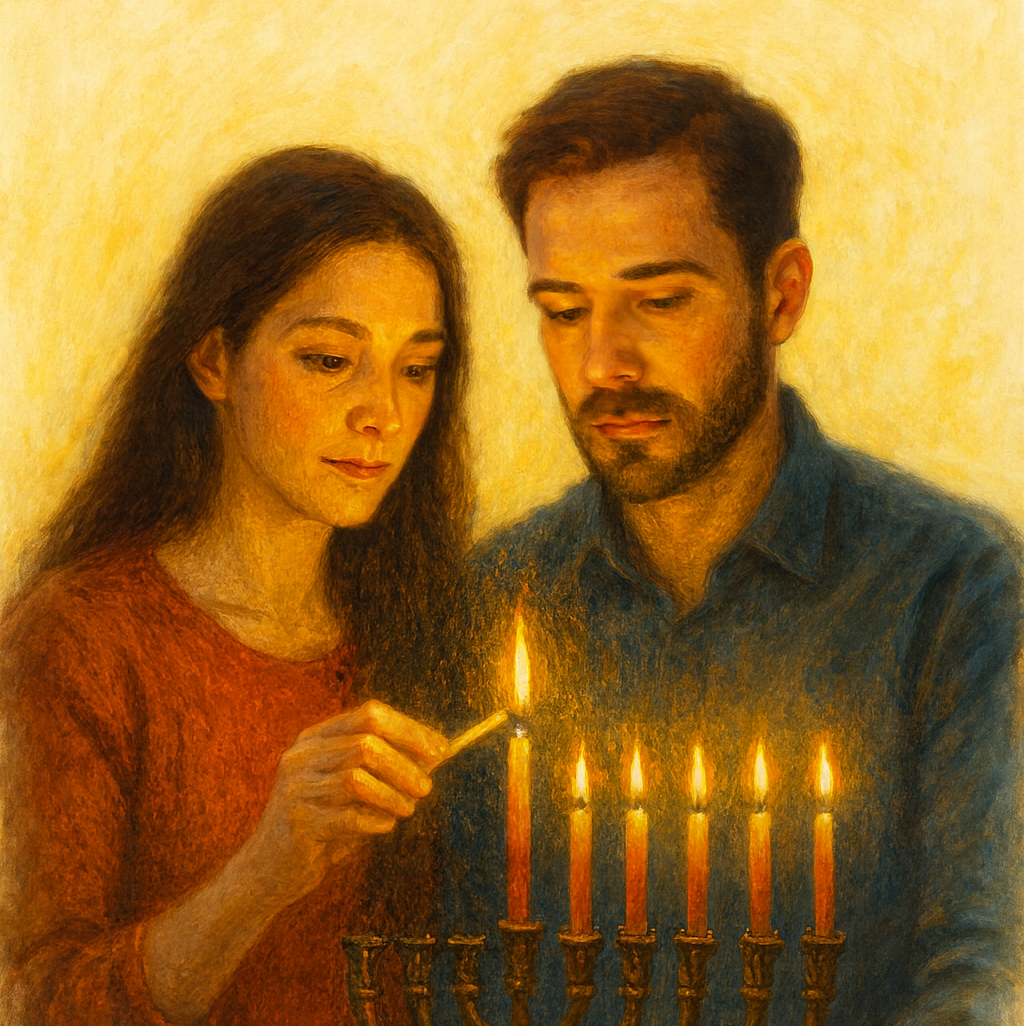
Created by CHatGBT AI. 12.2.25
The annual rhythm of eight nights of candles, latkes, doughnuts, gifts and dreidels is here again. But for me, this year is different. The lighting of our modest menorah is going to feel less like a cozy tradition and more like a defiant declaration against a world currently steeped in darkness.
We find ourselves today in a moment of profound crisis. Just look around: the aggression of the Iranian regime and its proxies, the intellectual warfare being waged in places like the United Nations and certain Western universities, the troubling statements by public figures like New York mayor-elect Zohran Mamdani — all of these add to the relentless pressure bearing down on the Jewish collective worldwide.
How can a holiday celebrating the miracle of a small jug of oil over 2,000 years ago possibly be at all meaningful right now?
To find a genuine, adult meaning capable of sustaining us through this fire, we need to move past the simple Hanukkah story of our youth and embrace what the French philosopher Paul Ricœur called the “Second Naiveté.”
Let me break down what that really means for us.
- The First Naiveté: Our Simple Childhood Miracle
This is the Hanukkah we all grew up with. It is defined by simply accepting the narrative without asking tough questions.
The story felt pure and powerful: a clear miracle where one tiny cruse of oil burned for eight full nights. It was a black-and-white battle between the good Maccabees and the evil Syrian-Greeks. The meaning was immediate, and we believed it all, no questions asked. It was the beautiful, simple faith of a child.
Here’s the thing: That stage was wonderful, but that simple innocence cannot survive once it runs up against the real world.
- The Desert of Criticism: The Adult Crash
For any thinking Jewish adult, that simple faith inevitably shatters when we start looking deeper. This is Ricœur’s “Desert of Criticism,” and it is a stage marked by doubt and disappointment.
Our adult knowledge forces us to face the hard facts: the revolt was complex — a civil war as much as a fight against foreign rule. The Maccabees were heroes? That heroic stature was short-lived, and they and their leaders eventually succumbed to the temptations of power. And the famed oil miracle? Historians tell us it was probably a later rabbinic addition. We also cannot ignore that the holiday has become a commercialized substitute for what it once was, stripped of its original, serious significance.
If we get stuck here, we are left with an intellectual pile of rubble — a hollow shell of a holiday, observed only out of habit. We know too much to believe like a child, but we have not found a way to believe meaningfully.
- The Second Naiveté: The Light We Choose
The Second Naiveté is the mature way forward. It’s the conscious choice to embrace the holiday’s symbolic power, even after we have taken the story apart. We accept the historical critiques, yet we choose to transcend them.
This mature perspective means accepting that the real truth of Hanukkah lies in its call for dedication (“Hanukkah” means dedication). We choose to see the miracle not as a data point, but as a powerful statement about the enduring resilience of Jewish identity. We choose to renew our inner commitment—our practice, our values, and the unique mission the Maccabees fought to preserve.
This chosen commitment is infinitely stronger than the simple faith we lost. It is a belief forged by experience, struggle, and intellectual honesty. It is the light that survives the storm of criticism.
The Fierce Defiance of Re-Commitment
This Hanukkah, the lights we adults kindle must be seen through the hard-won clarity of the Second Naiveté.
We know the world is complex. We understand how critics try to use history to deny our legitimacy. But this moment demands that we reject the luxury of just being academic and embrace the fierce, unbreakable simplicity of the light.
We stand in a world where terror is committed and deafening lies are screamed out by hostile states, and where even global institutions — meant to be impartial — are weaponized to cast moral shadows over our homeland’s right to self-defense and our very existence. Against all of that, our commitment to a basic truth becomes the most powerful force we possess: light endures, dedication matters, good triumphs over evil.
We need to be able to tell the simple story once more, not because we are ignorant, but because we are post-critical and absolutely certain of the moral rightness of our existence.
We’re not kids waiting for a magic show; we light the menorah as adults who choose the miracle. This is our second naiveté: an eternally renewed commitment that sees the ideological darkness not as a reason to despair, but as the perfect backdrop for our defiant truth. That light burns because we choose it, knowing the complexity of the world — a brilliant, unyielding flame of commitment, standing tall against everything trying to dim it.
Related Topics
Related Posts