

When the Shofar Becomes a Shelter
Here’s a riddle for you: What does a shofar and sukkah have in common?
The answer is a handbreadth.
Stay with me on this because it will end with a hug.
By Jewish law, the minimum size of a kosher shofar is a Halachic “tefach”, (an extended handbreadth) which is approx. 3.5 inches long. The reason for this is that when you hold the shofar in your fist, you should be able to see the horn on either side of your hand.
A sukkah as well has its minimum size to be kosher. Two complete walls do not form an enclosed space. But once you add just a little bit of a third wall, at least a tefach wide, you have now built enough wall for your Sukkah to be defined as a proper enclosure.
The same minimum handbreadth measurement is required to make both the Shofar we hear, and the Sukkah we enter, considered kosher.
There is another beautiful connection. The customary one hundred shofar blasts on Rosh Hashanah include sixty long Tekiah blasts, twenty broken Shvarim blasts, and twenty short Teruah blasts. The covering of a sukkah is called “Schach”. Its Hebrew letters are samech, chaf, chaf, which contain theg numerical value of sixty, twenty, and twenty.
Isn’t it amazing how the 100 sounds of the shofar (60+20+20) add up in the same pattern as the letters of the roof above our heads.
So here is what got me excited during the Yom Kippur services. As we were praying, I read the verse from Isaiah: “My hand founded the earth, and My right hand spread out the heavens.” (Isaiah 48:13)
I had just been learning a discourse in the Alter Rebbe’s Likkutei Torah with my brother, our amazingly talented cantor. It explains that Rosh Hashanah and Sukkos are two parts of one spiritual journey. They each play similar, yet different roles in revealing G-d’s presence in our world.
The Hebrew word for “spread out,” tipchah, shares its root with tefach, a handbreadth. That small measure the size of our hand points toward something far greater.
Of course, G-d does not have physical hands. The metaphor is only so we can begin to understand how He relates to us. Hence the famous imagery from King Solomon’s Song of Songs that describes the current Holiday season: “His left hand is under my head, and His right hand embraces me.” (Song of Songs 2:6)
Chassidus connects the left hand of discipline with the awe of Rosh Hashanah and Yom Kippur. We hear the shofar, crown G-d as King, examine our lives, and stand before Him with awe and reverence praying for good.
Then comes Sukkot, when “His right hand embraces me.” The right hand is the side of kindness and connection. It is the hand metaphorically used to illustrate how our relationship has become one of intimacy and love.
It is easy to understand why the shofar speaks to so many Jews. Even someone who rarely comes to synagogue makes a point of hearing it on Rosh Hashanah. When the room falls quiet and the Shofar sounds, something inside us recognizes that this moment matters.
Imagine if you were suddenly brought before a king or ruler, you would not need a long introduction to sense his greatness. You would automatically straighten up and pay attention. Reverence and awe usually do not need an introduction.
Now imagine being welcomed into the home of someone who loves you. He invites you over for dinner and to hang out after for some drinks. Often no introduction is needed because you are already close friends.
When you enter the palace, you are conscious of the King’s power. But when the King opens his arms and welcomes you home as his child, you suddenly know something much more: He wants you near him. Now, you are conscious of His love for you.
On Rosh Hashanah, we stand before the King in awe. On Sukkos, the King invites us to sit with Him and make ourselves at home.
And yet it is this very act of closeness and intimacy that causes many Jews to miss the unbelievable energy of the Sukkah.
After all, the sukkah lacks the fanfare and pomp that makes High Holidays so intense. The Sukkah seems spiritually secondary. It looks like an outdoor picnic area, with an added possibility of likely rain.
After a full day of prayer on Yom Kippur, could sitting down to a dinner under the stars really take us somewhere deeper? Are these really two parts of one spiritual journey?
Chassidus says yes. We spent the Days of Awe becoming aware of G-d’s presence. The Sukkah now invites us to come close enough to live in the shade of His Protection.
That is a much more personal invitation.
You can stand before a king without knowing him. But you cannot feel at home in someone’s embrace unless you sense that they want you there.
Rosh Hashanah teaches us to accept G-d as King. Yom Kippur helps us clear away what has come between us. Sukkot invites us to enjoy being with Him. To feel His love. They are all part of the same journey.
From the outside, a sukkah looks like a temporary structure put up for one week. But from inside its embracing walls and sheltering Schach is a different story. The story of a loving Father in Heaven who wants to spend quality time together with you.
It’s the story of an ordinary meal becoming a Mitzvah.
Which, as the Rebbe explains, is why this mitzvah surrounds our entire body. Every part of our identity and personality. Even our quirks. G-d embraces us as we are.
This is what makes the sukkah so powerful. It does not demand that we remain in the intense mood of the Days of Awe. It lets us bring the holiness we discovered last week into ordinary life.
G-d, whose greatness made us tremble at the sound of the shofar, also makes room for us to sit close to Him. Yes, while we pass the food across the table and listen to a child sing.
So both the shofar and the sukkah are at least a “tefach” long. Both bring G-d into our consciousness.
The difference is that the Shofar asks, “Do you recognize Me as your King?” The Sukkah asks, “Will you come and sit with Me?”
And the hundred Shofar blasts have not faded away. They are now waiting for us right above our table in the Hebrew letters of the “Schach”. The sound that awakened us has now become the shelter that holds us.
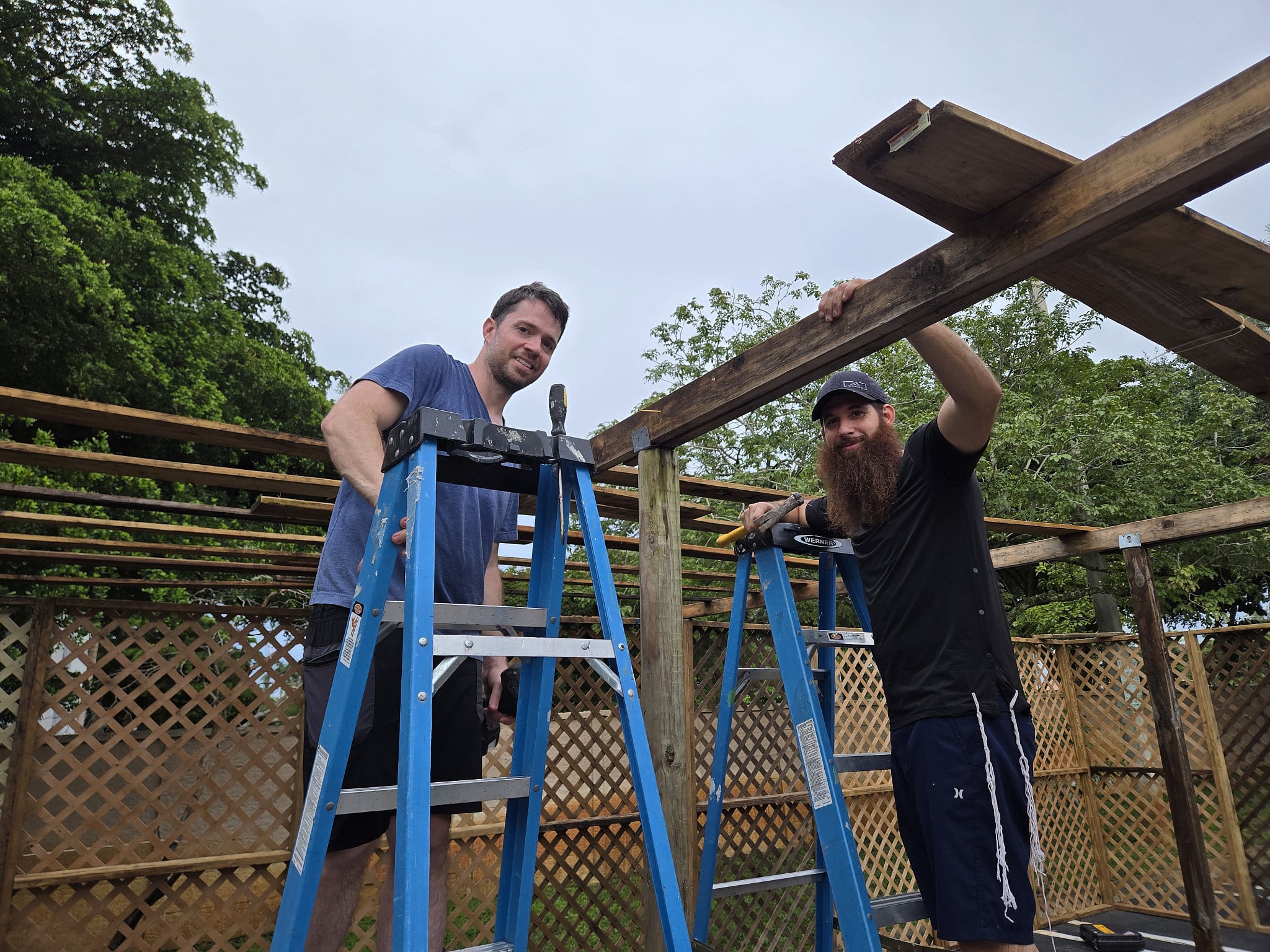
So whether you heard the shofar this Rosh Hashanah or missed it, I want to invite you into our massive Shul sukkah. It holds over 100 people and it’s open around the clock. You are welcome to come make a blessing on our Lulav and Esrog any day next week. And if you want to bring food, or just sit and spend some time together with G-d, come. You will find a table waiting for you.
And you will also find the G-d you crowned on Rosh Hashanah waiting to give you a hug.
Happy Sukkos & Good Shabbos!
Rabbi Yankie & Chana Denburg