


Where history exposes power and moral failure
When Tradition Wants the Road
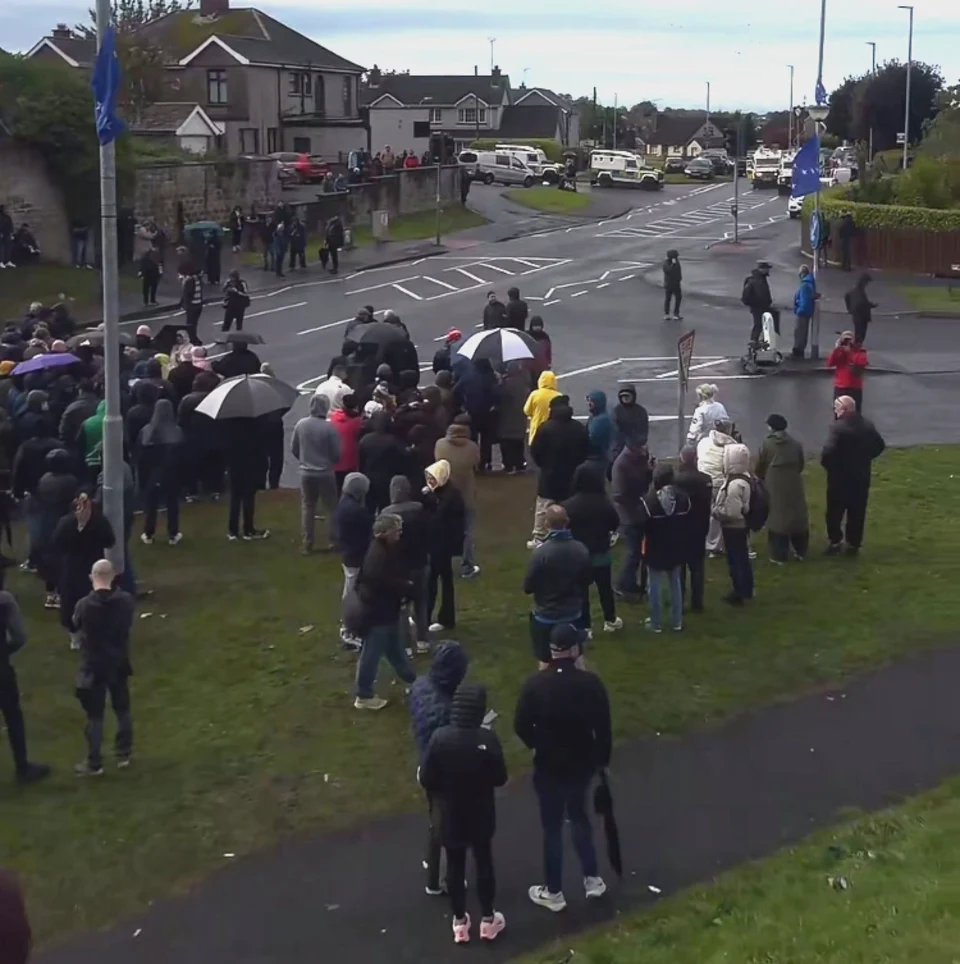
Protesters on Garvaghy Road, Portadown, September 27, 2026. (Irelandfinalboss/Wikimedia Commons, CC BY 4.0)
On Sunday, September 27, thirty-five Orangemen were supposed to leave Drumcree Parish Church in Portadown and walk back through Garvaghy Road. The Parades Commission had authorized the procession with restrictions: thirty-five participants, one Portadown District banner, no band on Garvaghy Road, no accompanying supporters.
Around a thousand people were already blocking the road.
Breandán Mac Cionnaith of the Garvaghy Road Residents Coalition told residents to pick broken glass from the pavement. If police removed them, he did not want anybody dragged through it.
Anyone coming fresh to Drumcree in 2026 could misunderstand this as an argument about competing rights: the Orange Order obtained legal permission to march; residents objected; police found themselves between them. That description manages to be factually correct while explaining almost nothing.
I studied, researched, and wrote about The Troubles extensively as part of my Irish Studies education at Notre Dame and later as part of my training in modern European history at the University of Edinburgh. The Orange Order is a Protestant fraternal organization founded in County Armagh in 1795 and named for William of Orange. Its lodges, banners, sashes, marches and commemorations have passed through Protestant and unionist families for generations. Its most famous historical reference is William’s victory over the Catholic James II at the Battle of the Boyne in 1690.
Its history in Portadown also includes Catholics being beaten, threatened, driven from streets, confined behind police lines and murdered amid the violence surrounding its demand to march.
That history begins early. After a Battle of the Boyne sermon at Drumcree Church in 1795, Orangemen attacked Catholics, smashed houses and killed two people. In 1835, Protestant magistrate William Hancock complained that Orangemen deliberately went out of their way to pass a Catholic chapel while insulting residents. Violence attended Drumcree processions repeatedly during the nineteenth and early twentieth centuries. After partition, the Northern Irish state overwhelmingly favored Protestant and unionist parades. Between 1922 and 1950, almost one hundred parades and meetings were prohibited under the Special Powers Act; nearly all were nationalist or republican. The Public Order Act of 1951 then gave special treatment to “traditional” parades.
None of this made Catholics or nationalists innocent of violence: Sinn Féin was politically involved in organizing resistance around contentious marches, the PIRA remained an armed participant in the wider conflict, and nationalist rioting repeatedly accompanied Drumcree. Those facts belong in the history without converting the Orange Order, loyalist paramilitaries, Catholic residents, Sinn Féin and the PIRA into interchangeable actors with interchangeable conduct.
As readers of my published work will know, I have written extensively against collective culpability: the actions of radicals, governments or armed organizations do not make an entire population answerable for them, much less legitimate punishment of that population at scale.
In any case, Catholics in Portadown knew perfectly well whose traditions the state had spent decades protecting.
In 1972 British troops and riot police bulldozed Catholic residents’ barricades before 1,200 Orangemen marched through Obins Street. Masked and uniformed members of the UDA lined the route. In 1985 residents complained of being effectively confined to their homes while Orange marches passed. They described drummers intensifying their playing outside the Catholic parochial house and alleged that marchers and supporters urinated against its walls. Police forcibly removed hundreds of residents protesting on Obins Street that year.
The dispute eventually moved to Garvaghy Road. By 1993, a survey found 95 percent of its residents opposed Orange marches through their neighborhood.
In 1995, residents sat in the road. Roughly 10,000 Orangemen and supporters gathered at Drumcree. Loyalists blocked roads elsewhere in Northern Ireland. Ian Paisley told the crowd that they would “die if necessary rather than surrender.” A compromise allowed the march through. Paisley and David Trimble walked at its head and raised their joined hands afterward. At a subsequent Spirit of Drumcree meeting, a speaker announced to applause, “I’m a sectarian bigot and proud of it.”
In 1996 the RUC prohibited the return march. Thousands of Orangemen and loyalists mobilized. Loyalists erected roadblocks across Northern Ireland, attacked police and intimidated Catholics. The UVF murdered Catholic taxi driver Michael McGoldrick; security and loyalist sources linked his killing to Billy Wright and described it as a warning over Drumcree. After five days the Chief Constable reversed the ban. Armored police vehicles entered Garvaghy Road. Police batoned residents from the street and confined them behind lines while approximately 1,200 Orangemen marched through.
In 1997 loyalist paramilitaries threatened to kill Catholics if the march was stopped. At 3:30 in the morning, 1,500 police and soldiers entered the Catholic district in armored vehicles. Residents were forced from Garvaghy Road. Some could not reach their church, so priests celebrated Mass outdoors in front of soldiers and armored personnel carriers. One resident recalled being ordered inside his house and told he could not even remain in his own front garden.
The Orange Order marched through at noon. The Parades Commission prohibited the procession in 1998. Loyalist violence spread. Catholic churches and homes were attacked. On July 12, Richard, Mark and Jason Quinn, aged ten, nine and eight, died when their Ballymoney home was petrol-bombed. Their mother was Catholic. RUC Chief Constable Ronnie Flanagan called their deaths “brutal sectarian murders” and linked them to the violence surrounding Drumcree.
The Orange Order has not marched down the Garvaghy Road since 1997. Twenty-eight years later, Mac Cionnaith was picking glass from the road because residents believed police might remove them for another Orange march.
The 2026 legal determination does not erase any of this. The Orange Order obtained permission through the legal process. The residents’ blockade is unlawful. Those are facts. So is Chief Constable Jon Boutcher’s refusal thus far to clear the road by force because of the serious injuries and potentially catastrophic disorder that could follow. Enforcement would require police to enter the same community that remembers police physically removing its residents so Orangemen could march through. Calling the Garvaghy Road a “traditional route” cannot settle that history. The tradition includes what happened to the people living along it.
As a historian and writer, I see the same historical category error in arguments about the West Bank, particularly since October 7.
Jewish history there is ancient and extensively documented. Hebron, Shiloh and the Judean hills contain material evidence of Jewish life extending back thousands of years. Attempts to erase that history are historically indefensible, and attempts to sever Jews completely from the history of the land have repeatedly supplied antisemitic narratives.
The West Bank of 2026 contains another chronology, too.
Israel captured it from Jordan in 1967. Israeli civilian settlements followed. Over the next half-century settlements expanded, roads were built, land was expropriated, military security arrangements developed around Israeli communities, and Palestinians encountered an increasingly elaborate system governing construction, movement and access to agricultural land. Unauthorized outposts became another method of establishing Israeli civilian presence, particularly from the 1990s onward; some were subsequently legalized by Israeli governments.
Palestinian olive groves sit directly inside this history. An olive tree can produce for generations. Families inherit groves. They prune them, harvest them and press the fruit into oil. The crop provides annual income. Losing mature trees can therefore mean losing this year’s harvest, future harvests and work accumulated over decades.
Settlers have attacked Palestinian farmers and olive groves for years. Trees have been cut, burned and uprooted. Crops and equipment have been stolen or destroyed. Farmers have been prevented from reaching land near settlements and outposts or permitted access only during restricted periods coordinated with Israeli authorities.
The scale and severity of these attacks has increased sharply as of late. During the 2025 olive harvest, the UN documented about 150 settler attacks affecting 77 Palestinian villages and towns, approximately 140 Palestinians injured and more than 4,200 trees and saplings damaged. October 2025 produced the highest monthly number of settler attacks causing casualties or property damage recorded by OCHA since it began keeping those figures in 2006. Some attacks are seen occurring on video.
During the first eight months of this year, OCHA recorded more than 1,600 settler attacks causing Palestinian casualties or property damage across 275 communities, an average of 6.7 attacks per day. More than 4,000 Palestinians had been displaced across the West Bank by September through demolitions, evictions, settler attacks and related restrictions on access. More than 60 percent of that displacement followed settler attacks and related access restrictions.
The 2026 olive harvest has now begun. On October 3, attacks were reported against Palestinian olive pickers in Abu Dis, Awarta and near Beita. Olive trees were burned. Farmers were driven from groves. Video evidence supports these reports, and in the videos, IDF soldiers do not intervene.
On September 29, 2026, the Tubasi family attempted to return to two houses in Jalud that settlers had previously seized. Israeli soldiers escorted them. More than one hundred settlers arrived, and roads were blocked. The houses were set on fire. Three Israeli soldiers were injured. The army eventually evacuated the Palestinian family instead of completing its return. Prime Minister Benjamin Netanyahu condemned the violence and called for legal action. Two settlers were arrested.
October 7 did not create the settlements, the outposts, the agricultural-access restrictions or the practice of attacking Palestinians during the harvest. OCHA and Palestinian human-rights organizations documented settler attacks on olive farmers years before the current war.
An Orange march through Garvaghy Road cannot be detached from what happened there in 1795, 1972, 1985, 1996, 1997 and 1998. Nor does Portadown exist outside the larger history of the Troubles: Bloody Sunday, the republican and loyalist campaigns of violence, Omagh, the peace process and the Good Friday Agreement all belong to the political world in which this road acquired its present meaning. Twenty-eight years without an Orange march through Garvaghy Road are themselves part of that history.
The resemblance between what is happening now in Portadown and what is happening in the West Bank is uncanny and analytically important. It does not depend upon pretending that Northern Ireland and Israel-Palestine are the same conflict, or that Orangemen, Jews, Palestinians and Catholics occupy equivalent historical positions. The comparison lies in the use of an authentic historical connection to a place as authority over the people who live there now.
Jewish antiquity in Israel survives this historical argument perfectly well. An excavation at Shiloh does not become less Jewish because a Palestinian farmer owns an olive grove nearby. Jewish history does not require somebody to burn his trees in order to prove itself. There is nothing antisemitic about insisting that attacks on Palestinian residents in the West Bank stop and that Israeli security forces protect Palestinians when settlers attack them.
The Orange Order’s history is equally real. Orangemen have marched in Portadown for more than two centuries, but the existence of that history does not require a Catholic resident of Garvaghy Road to surrender the street outside her house to prove that the tradition exists. Catholic residents’ right to live in a post-Good Friday Agreement Northern Ireland without deliberate sectarian intimidation does not diminish Protestant identity, Protestant theology or the history of the Orange tradition.
The olive tree makes the collision between different periods of history unusually tangible. Archaeology can establish Jewish habitation at Shiloh in antiquity, and the historical record can trace Jewish connections to the land across centuries of exile, migration, persecution and return. A Palestinian farmer can tell you who planted the particular tree standing in his family’s grove. His father and grandfather may have harvested it. He intended to harvest it this October. These histories can occupy the same landscape without one functioning as an eraser for the other.
If somebody burns that tree, the fire does not resolve whose history belongs there. It tells us who had the power to burn the tree.