
When Truth Descends into the Pit
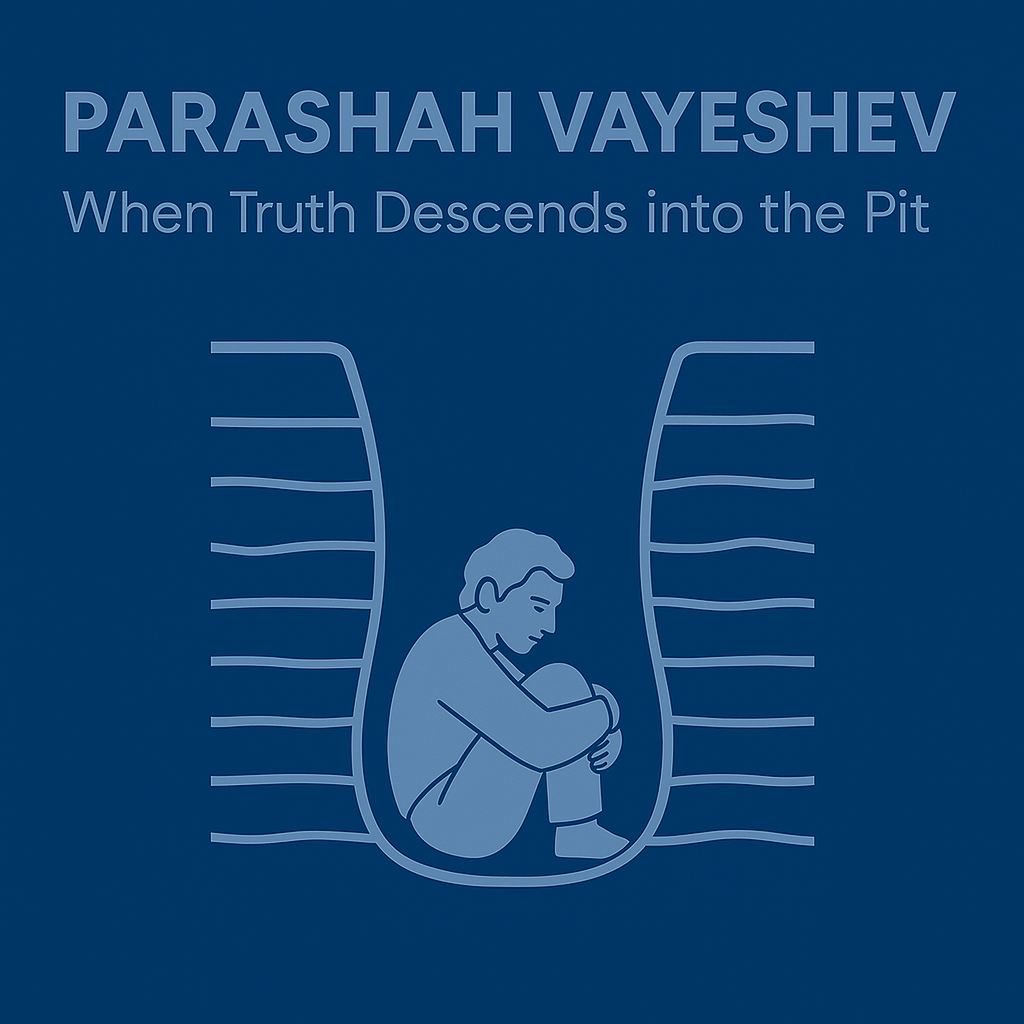
Parashah Vayeshev — When Truth Descends into the Pit
The Impossible Rest
Yaakov returns wounded yet in peace. He has settled accounts with Esav, buried idols beneath the oak of Shechem, raised altars. It seems he has finally reached the rest denied to him his entire life. But the Torah opens with a deceptive word: Vayeshev — “And Yaakov settled.”
In the language of the Torah, settling is never rest: it is a warning. The silence before a storm that comes to claim ancient debts. What Yaakov lived as deception — the tunic used to steal a blessing, the preferences that fracture families — his sons will relive as jealousy, blood, and silence.
What is not healed returns in disguise.
A story does not close: it is inherited.
The Dream Without a Vessel
Yosef wears the ketonet passim, the multicoloured tunic that marks him out without his noticing. He is the son of Rachel, the beloved one, and that alone is enough to make him a foreigner in his own home.
Then he dreams.
“Vayajalom Yosef ḥalom…” — And Yosef dreamed a dream.
He sees sheaves bowing, celestial bodies bending down. The dreams are true, but Yosef is not yet a vessel. He speaks without measure, shines without care, wounds without intention. The light he carries is real… but blinding.
His brothers hate him. Yaakov rebukes him.
Truth without preparation can wound as deeply as a lie.
Seeing is not enough: one must learn to carry what is seen.
The Empty Pit
They see him approaching. “Here comes the dreamer.” They plot to kill him. Reuven intervenes: “Throw him into the pit.” They imagine they will rescue him later. The story has other plans.
“Vayashlikhu oto habborah… vehabbor req.”
They threw him into the pit, and the pit was empty.
They strip off the tunic. The external identity falls. No water, no voice, no comfort. Above, the brothers sit to eat; below, a boy lets die the idea that love is fair.
Merchants pass by. Yehudah says, “Let us sell him.” Twenty pieces of silver. Blood on the tunic. Silence in the house.
Yaakov recognizes the garment and embraces a cloth believing he embraces a body. He refuses all comfort. He says he will go down to Sheol in mourning.
The pit does not explain: it reveals.
When the external name is taken, only the naked self remains.
Service Under Temptation
In Egypt, Yosef is purchased by Potiphar. There begins the silent presence of God.
“Vayehi HaShem et Yosef” — HaShem was with Yosef.
No angels. No voices. Only order, precision, and the quiet prosperity that touches all he handles. Potiphar sees this and entrusts everything to him.
Then comes the test.
Potiphar’s wife insists. He could justify himself: “I have already lost everything.” Instead he says:
“Eikh e’ese ha-ra ha-gadol…” — How could I do this great wrong?
He flees. Another tunic remains in another’s hands. Another fall. The false accusation imprisons him.
There are fidelities that sink you deeper,
but cleanse you forever.
The Forgotten Just One
In prison, Yosef serves again. He interprets the dreams of others. He tells the cupbearer, “Remember me.”
“Ve-lo zakhar sar hamashqim et Yosef.”
The cupbearer did not remember Yosef.
Two more years.
Human forgetfulness is not failure: it is process.
Divine memory ripens in silence.
Silence does not kill: it forges.
Yehudah and Tamar: The Truth That Does Not Flee
While Yosef descends in Egypt, Yehudah descends in Canaan. He loses his sons. He promises Tamar and does not fulfil. She waits. Then she acts.
She covers her face and sits by the roadside. Yehudah does not recognize her. She asks for his seal, cord, and staff. Months later, she is accused: “Tamar is pregnant by prostitution.”
He orders, “Burn her.”
She does not scream. She does not denounce. She simply sends the tokens:
“By the man to whom these belong, I am pregnant.”
Yehudah sees them.
“Tzadkah mimeni.”
She is more righteous than I.
Truth that needs no violence is the most disarming.
The Pulse of the Soul
Jalóm — the dream without a vessel
Bor — the pit that strips away
Avodá — the hidden service
Beit HaSohar — the prison that matures
Zikarón — the memory that opens doors
Yosef descends to learn compassion.
Yehudah falls to awaken conscience.
Tamar acts to embody justice.
Yaakov suffers so that someone, at last, names the inherited wound.
The Humble Light
The dream that began as privilege drops into the pit, serves in secret, is tested without witnesses, and learns to wait for a memory that does not depend on man.
The light does not extinguish.
It becomes humble.
And only then can it sustain others.
Truth that descends without breaking returns as compassion.