


When Two Tribes Chose the Diaspora
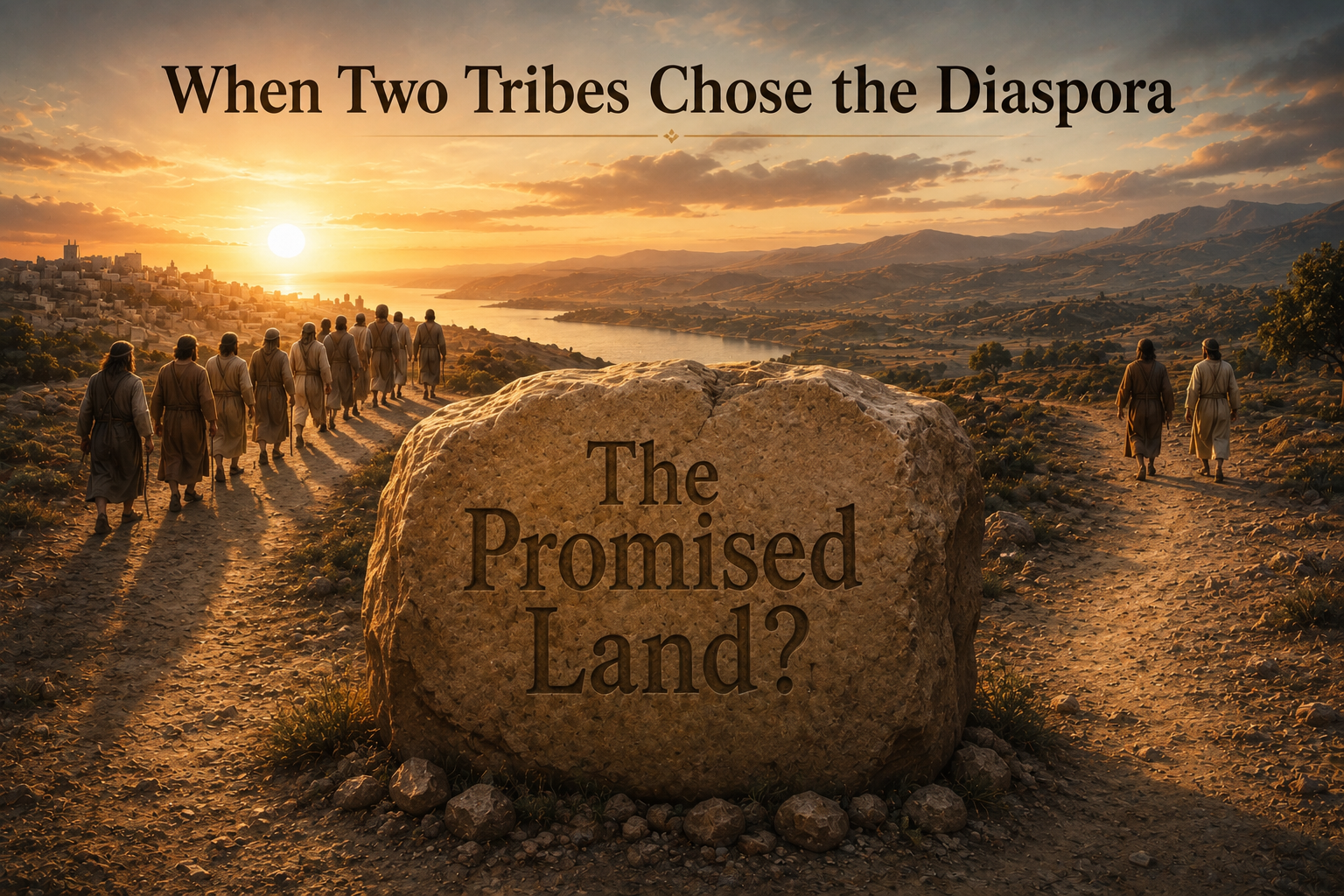
Long before Zionism, long before exile, and long before the modern Jewish world began debating the relationship between Israel and the Diaspora, the Torah posed a question that has become strikingly relevant once again. After forty years of wandering toward the Promised Land, after generations of longing for Zion, the tribes of Reuben and Gad stand before Moses with a startling request. They announce that they do not wish to cross the Jordan. They have found a home on the land east of the river.
For many of us, the story has always been about geography. But perhaps it is about something much larger. Perhaps it is the Torah’s first conversation about Jews who consciously choose to live outside the Land of Israel. Jewish history has conditioned us to think about dispersion primarily through the lens of exile. We remember expulsions, persecutions, forced migrations, and refugees. The Hebrew word galut carries centuries of pain and helplessness. Exile was something that happened to us. As an Israeli, I was raised to see Jewish history through a distinctly Zionist lens. Yet the tribes of Reuben and Gad are not exiles. Nobody drives them away. Nobody expels them. They consciously choose to make their home on the eastern side of the Jordan. For those of us who live in Israel, this distinction has become increasingly important.
For decades, many Israelis unconsciously assumed that Jews outside Israel were living in a kind of unfinished story, waiting, whether they realized it or not, to come home. The language reflected that assumption. Israelis spoke of “the Diaspora” almost as a temporary condition, not as a choice. Today, that gap in perspective has become impossible to ignore.
Over the past few years, as Israel grappled with fierce debates over the future of its democracy, and especially since October 7, I have spent considerable time learning with rabbis, educators, and Jewish leaders across North America. Like many Israelis, I expected difficult conversations about Israeli politics, the war, antisemitism, and the future of Zionism. Those conversations certainly exist. But underneath them I encountered another discussion altogether. A quieter one. A deeper one. It asks not whether Israel is making the right political decisions, but whether Jewish identity must always revolve around Israel in the first place. For many Israelis, simply hearing that question can feel unsettling. We were educated to believe that Zionism resolved the central dilemma of Jewish history. After two thousand years, the Jewish people returned home. The story had reached its destination.
Yet many Jews are asking a different question, not because they reject Judaism, but because they are searching for other ways of understanding it. Some speak about Jewish Peoplehood: the idea that what binds Jews together is not only a shared homeland but a shared covenant of memory, responsibility, culture, language, learning, and mutual care. Others wonder whether Judaism can remain deeply Jewish even if Israel is no longer the organizing center of every Jewish life. They are questions about what holds a people together. Ironically, they are questions Moses himself seems to ask. His first response to the two tribes sounds like outrage:
Shall your brothers go to war while you stay here?
Notice what he does not say: He does not question their place within the people of Israel. He does not accuse them of abandoning Judaism. Instead, he worries about something else entirely. Shared responsibility. Shared destiny. What troubles Moses is not geography. It is solidarity. In the end, he reaches a compromise. The tribes may indeed build their homes east of the Jordan. Their address is negotiable. Their responsibility is not. Before they settle, they must first cross the river alongside their brothers. They must fight for the collective future before returning to the place they have chosen as home. Perhaps that is the Torah’s deepest insight. The real question has never been where Jews live. The real question is whether they still see themselves as responsible for one another. That insight feels surprisingly contemporary.
Across Israel, increasing numbers of liberal Israelis quietly wonder whether they still have a future here. In recent years, I have watched painful conversations unfold on both sides of the ocean. Some Jews have become so disillusioned with Israel that they begin distancing themselves not only from Zionism but from Jewish life itself. In both cases, there is a temptation to throw out the baby with the bathwater, to confuse disappointment with one expression of Judaism for the abandonment of Judaism altogether.
Judaism has survived in deserts and capitals, in Babylonia and Spain, in Poland, Morocco, Argentina, Australia, and North America. Long before there was a Jewish state, there was a Jewish people. Long before there was political sovereignty, there was Torah, memory, argument, ritual, ethical responsibility, and community. None of this diminishes the miracle of Israel. Nor does it weaken my own commitment to its future. Quite the opposite. It reminds me that if Jewish identity depends on only one pillar, then it becomes dangerously fragile. If, however, Judaism also lives in covenant, in learning, in moral responsibility, in community, and in peoplehood, then it possesses the resilience that has sustained it for millennia.
Perhaps this is precisely what Parashat Matot-Masei invites us to remember. The Torah’s first “Diaspora Jews” were not expelled. They chose. And Moses ultimately accepted their choice. He asked only one thing of them: Never allow distance to become indifference.

Perhaps that remains the defining challenge of Jewish life today, not whether every Jew lives in Zion, but whether, wherever we live, we still cross the river together.
Shabbat Shalom