When We Look Away from the Victim: A Prosecutor’s Trial and the World’s Memory
My last trial as a prosecutor in the Family Violence Bureau has stayed with me like a shadow. The defendant faced charges of aggravated assault—domestic violence through strangulation. Anyone who has handled one of these cases knows what I knew back then: strangulation is attempted homicide in slow motion. When you squeeze someone’s throat and cut off their breathing, you flirt with the line between life and death.
The victim’s bruises were clearly visible across her neck—undeniable. Still, the jury found him not guilty. Not necessarily because they believed he was innocent, but because they disliked the police officer’s behavior. They didn’t trust his approach.
And the man who wrapped his hands around another person’s airway walked out of the courtroom.
For over a decade, I have carried that verdict with me. I believed in our justice system—trial by peers, proof beyond a reasonable doubt. But that case uncovered a truth I wish I hadn’t discovered: justice can fail when attention shifts away from the victim. Memories can be distorted. Focus can be diverted.
And lately, watching how the world reacts to Israel, I feel that same chill.
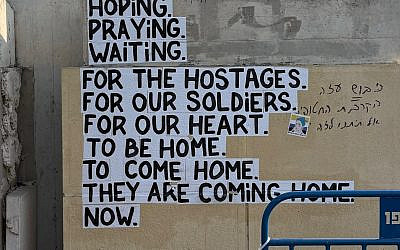
On October 7th, Hamas raped, burned, dismembered, and kidnapped civilians—including women, the elderly, and children. A massacre that was broadcast and celebrated. Families were shattered on camera. Bodies were desecrated. Hostages were dragged into tunnels. Just over two years later, only the remains of one hostage—Israeli police officer Ran Gvili—are still believed to be held in Gaza. Yet every discussion about the hostages seems to veer, mid-sentence, into Gaza.
I’m tired of this sudden shift. Not because Gaza isn’t important — it is very important. But those conversations need their own space. They must be handled carefully, deliberately, and fully — not as a reflexive distraction when the topic is the hostages. Too often, the shift becomes a diversion, a pivot, a way to hide the crime that caused this nightmare.
Just like that jury, the world has shifted its focus from the victim to the system.
From the strangled woman to the officer, they disliked. From the slaughtered and kidnapped Israelis to the geopolitical fallout. From the hands around a throat to the sideshow in the courtroom.
We see it in global discourse every day: protests in major cities where chants eclipse the names of those who were murdered. Campus rallies with lengthy manifestos that barely mention the families torn apart on October 7th. And Hollywood—initially outspoken for a brief moment—moved on. Sympathy posts disappeared. Celebrities who publicly supported Israel retracted statements under pressure and reappeared with Gaza-only messaging, as if the massacre itself were just background rather than the cause.
I understand that the region’s history is complicated. Anyone who discusses the Middle East without recognizing its complexities is either uninformed or dishonest. Every discussion becomes stuck in an endless cycle of cause and effect. Grief and pain are universal.
But complexity should not obscure memory because justice begins at the moment the initial harm occurs.
And if we forget that moment—if we bury it under later events—we risk losing sight of what we are truly trying to resolve. My jury overlooked the bruises visible on the victim’s throat. The world is forgetting the bodies in the kibbutz dining rooms, the burned families in safe rooms, the young people at a music festival whose final moments became propaganda clips.
I still think about the woman from my last trial. I don’t know if she ever found peace. What I do know is that forgetting her would be the greatest injustice.
And I see the discussion about Israel and the hostages today with the same fear. We need to talk about Gaza. It is necessary. But we cannot let that discussion take the place of justice or memory.
The murders, kidnappings, and rapes—the start of the story—cannot be erased because later parts are too painful. Justice means remembering those who suffered—and refusing to look away now.
We must remember Ran Gvili, the police officer whose remains have still not been returned to his family after 797 days—a man who displayed the moral integrity we hope for in law enforcement, and in a way so drastically different from the officer whose conduct cost me my case.