When words fall silent: Reflections on the murder of Charlie Kirk
I am still in shock. When I first read on X that Charlie Kirk had been shot, I didn’t recognize the name. But then I saw his picture, his videos, and I knew exactly who he was. He was everywhere — appearing in my feed, day after day. Personally, he was not “my cup of tea.” My wife, however, often listened to him, and the moment I learned what had happened, I called her. She was devastated, bewildered, like so many of us in those first minutes and hours. We are a generation of nebuchim, perplex, confused and pained, facing once again the senselessness of hatred and violence.
Charlie Kirk was a young voice of the new American right. He went onto university campuses, handed the microphone to those who opposed him, and debated — on free speech, abortion, gender, vaccines, guns, Israel, and countless other issues. Even when I strongly disagreed, I could not ignore his commitment to dialogue. However staged or provocative, it was still a choice for words over weapons. He stood his ground with arguments, not fists. And now that voice has been silenced by violence. Strikingly, the bullet hit his neck — the very source of his message, his words, his voice.
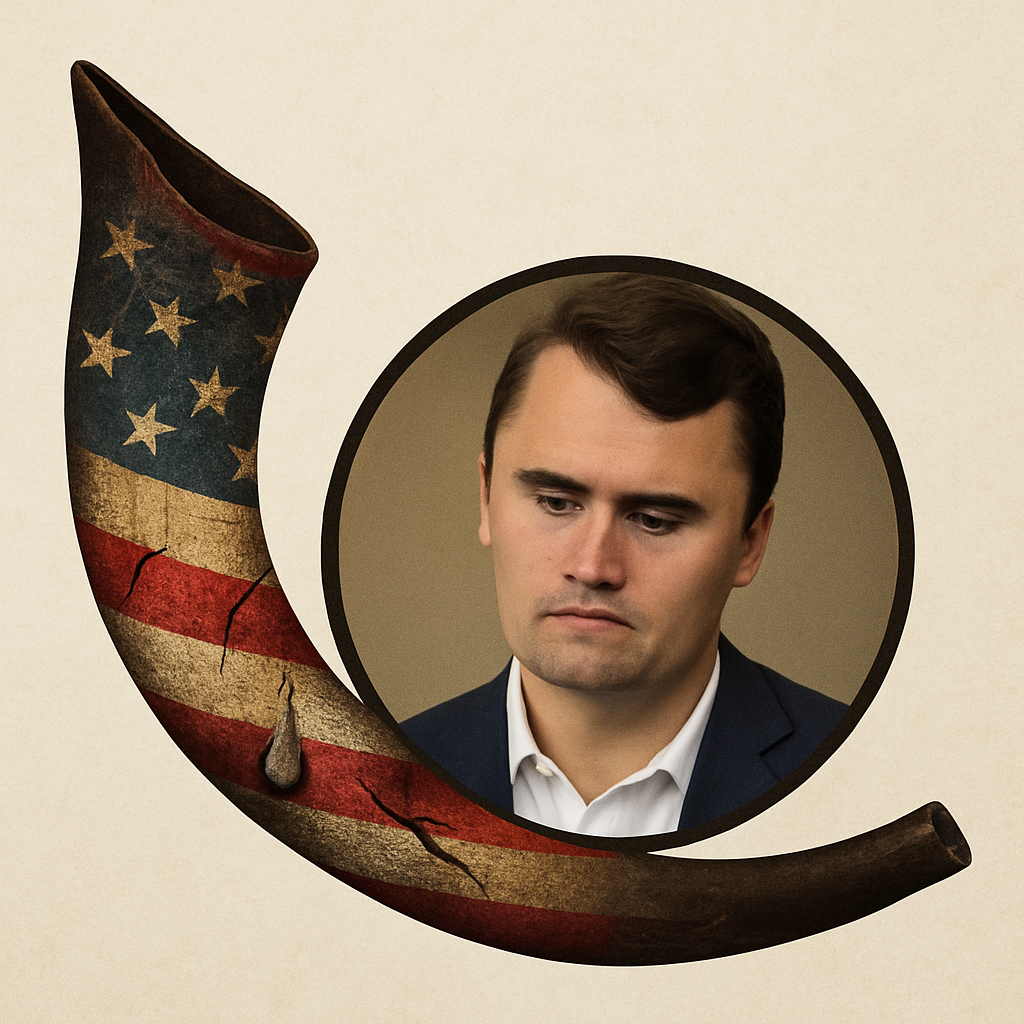
This moment should shake us awake. It should sound like the shofar of our times — a piercing call warning us that something is profoundly broken. Once again, we live in a world where the response to disagreement is not debate but a bullet. Saadia Gaon once taught that the shofar represents the voice of the prophets crying out for justice. In Judaism, we do not canonize saints or glorify martyrs, and Charlie Kirk should not become either. But the point is this: once again, intolerance and violence have ended the life of someone who believed that words, not weapons, are the battlefield. And bitterly, it was the very idea of weapons he defended that ultimately killed him.
Whether one agreed with Charlie Kirk is beside the point. The lesson he modeled — the courage to give the microphone to even his fiercest critic, and to respond not with censorship or silence, but with words — is now under fire. Again.
As we approach Rosh Hashanah and Yom Kippur, the Yamim Noraim, the High Holy Days, we are called to engage in ḥeshbon hanefesh — an accounting of the soul. How did we get here? How did we forget the ancient Jewish value that words, even sharp words, are the true battlefield of ideas? The beit midrash — the house of study — was built on disagreement, often passionate and fierce, yet always in the service of truth and learning, not destruction. We have lost that — not only as Jews, but as Americans.
We face multiple crises: hatred, mental health, and guns. Not one, but all together. And in the wake of this assassination, the responses came quickly — predictably, yet still heartbreakingly.
From sectors of the MAGA world came voices of vengeance, demonizing “the left,” “communists,” “wokeism,” with apocalyptic cries of “them or us,” “children of light against children of darkness.” Instead of calling for justice or solutions to the epidemic of violence, they fan the flames of civil war.
From the opposite extreme, a flood of young progressives — “woke” voices — celebrated his death, justifying it as deserved because his words, in their view, had caused harm to Palestinians and LGBTQ communities, or others. Instead of reflecting that violent rhetoric also paves the way for violent acts, they amplified the same hatred and vindication that pulls the trigger.
And, as always, antisemitic conspiracy theories followed within minutes. Accounts declared that Israel was behind it, weaving grotesque fantasies that Kirk had recently criticized Israel and that Prime Minister Netanyahu ordered his murder after his debate with Ben Shapiro. Once again, the old scapegoat, the old hatred, resurfaces.
At the speed of a bullet, the extremes of right, left, and antisemites of every stripe flooded the digital sphere with hatred, conspiracies, and violence.
A university campus — once meant to be a sanctuary for ideas — has become a crime scene. Instead of debate, death. Instead of words, weapons. And so the question hovers over us: How did we get here? But more urgently: How do we return?
The prayers of these High Holy Days offers us a clue: Hashiveinu Avinu ve-nashuvah, chadesh yameinu k’kedem. “Bring us back, O God, and we shall return; renew our days as of old” (Lamentations 5:21).
This is the essence of the Yamim Noraim. To ask: How do we return — to one another, to civility, to the sacred trust that words must prevail over weapons? Many despair, believing violence, hatred, and the collapse of dialogue are here to stay. To them, and to all of us, I recall the words of the prophet Zechariah calling the people of Israel “Asirei Tikvah” — prisoners of hope (Zechariah 9:12).
Even in the valley of despair, Judaism insists we are captive to hope. As we enter this new year, may the shofar we hear not just be a ritual sound, but an alarm to our conscience. A reminder that words must never be silenced by bullets. That disagreement must never collapse into hatred. That the truest strength of a people — whether Jewish or American — is found in the courage to argue, to debate, to wrestle with ideas without destroying one another.
Charlie Kirk’s voice has been silenced. The question left for us, as a society, is whether we will choose to listen to the echo of his model — the primacy of words — or whether we will allow the next bullet to speak louder.