


When Words Had Weight: Remembering the Age of the Typewriter
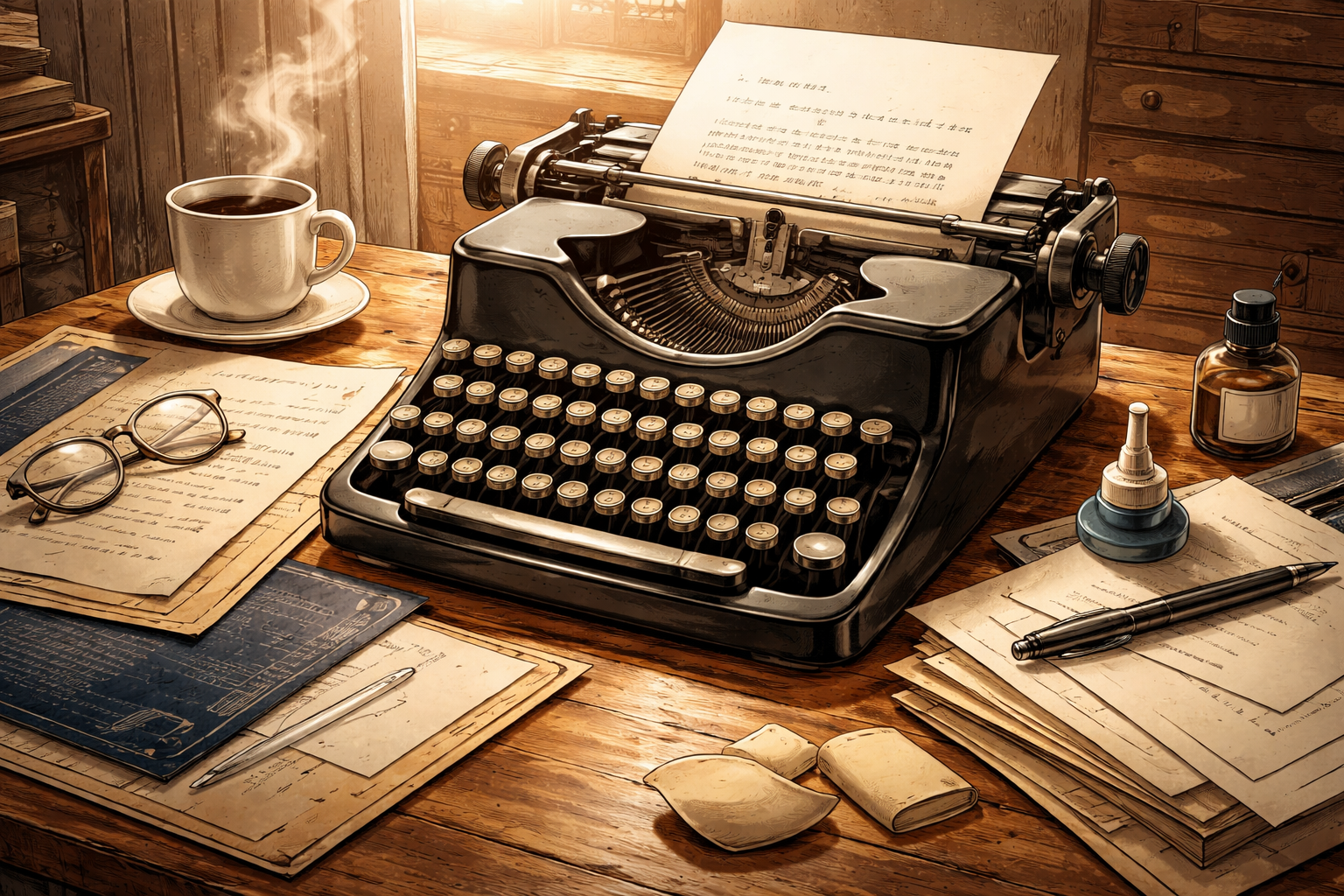
Last week, while rummaging through some old papers, I came across a document I had typed more than forty years ago. It was on onion-skin paper, complete with a few typos corrected by hand above the lines. Instantly, I was transported back to the moment I received my first portable typewriter as a bar mitzvah gift—a sturdy little machine that helped me through countless papers in high school and college.
Our grandchildren have probably never even seen a typewriter. But for me—and for many in my generation—it was an indispensable tool, despite what we would now consider its many limitations.
There was a time when writing was unmistakably physical. Words didn’t simply appear on a screen; they were struck into existence. Each letter required intention, pressure, and commitment. The typewriter demanded that you mean what you wrote, because once a key hit the ribbon, the page remembered it forever.
Correspondence was slower then, but it was also more deliberate. You didn’t dash off a note and hit “send.” You sat down. You rolled the paper carefully into the carriage, making sure the margins were straight. You thought about your opening sentence, because mistakes were costly. White-out could mask an error, but it never truly erased it; there was always a faint scar—a reminder that writing was a human act, imperfect by nature.
The typewriter itself has a fascinating history. The first practical version was invented in the late 1860s by Christopher Latham Sholes, a newspaper editor from Wisconsin. He set out to create a machine that could produce clear, legible text quickly, primarily for business and legal use. The design was refined and eventually licensed to Remington—the firearms and sewing machine manufacturer—which released the Remington No. 1 typewriter in 1874.
That early machine had quirks that now seem almost charming. It typed only in capital letters, and you couldn’t even see what you were typing until the page was removed. Yet it worked—and more importantly, it standardized written communication in a way handwriting never could.
Sholes’s most enduring contribution was the QWERTY keyboard. Despite popular myth, it wasn’t designed to slow typists down, but to prevent mechanical jams by spacing commonly used letter pairs apart. Long after those mechanical limitations disappeared, QWERTY remained—one of history’s most stubborn and enduring standards.
Over time, typewriters steadily improved. By the late nineteenth and early twentieth centuries, machines added lowercase letters, shift keys, and visible typing, allowing writers to see words appear in real time. What began as a clunky industrial device gradually evolved into something far more refined.
The introduction of the portable typewriter in the early twentieth century untethered writing from the office desk. Journalists, students, and novelists could write anywhere there was a flat surface and decent light. The typewriter also became deeply woven into professional life—especially for women, for whom typing opened new doors into the workforce as secretaries and office professionals.
Mid-century innovations emphasized ease and precision. Electric typewriters, introduced in the 1930s and widely adopted after World War II, reduced physical strain and increased speed. IBM’s Selectric typewriter, introduced in 1961, replaced individual keys with a rotating typeball, dramatically improving reliability and even allowing for interchangeable fonts—an almost futuristic idea at the time.
By the 1970s and early 1980s, typewriters had become remarkably sophisticated. Some models offered limited memory, correction tape instead of white-out, and even rudimentary display screens. In retrospect, these were clearly transitional machines—standing at the threshold between mechanical writing and the digital age.
One thing we have clearly lost with word processing is the ability to examine important documents and see an author’s handwritten corrections. Today’s technology produces a perfectly clean final draft—but once the changes are made, they disappear forever. I always found it fascinating to see what an author chose to revise or rethink, a window into the writing process that no longer exists for documents created over the past few decades.
And then there was carbon paper. Do you remember that? It added its own small dose of drama to typing. One wrong keystroke meant not one mistake, but two—or three—at the same time. Still, there was something deeply satisfying about separating the pages at the end, each copy warm from the effort, proof that the words had been made, not merely duplicated with a click.
The typewriter offered no font choices, no bold or italics, no resizing or reformatting. Everyone wrote in the same visual voice. Individuality came not from typography, but from rhythm, word choice, and tone. Your personality lived in your sentences, not in a drop-down menu.
And then there was the sound: the steady tap-tap-tap of the keys, the bell announcing the end of a line, the solid clack of the carriage return. Writing had a soundtrack. It filled a room. You could hear someone thinking.
Perhaps most of all, the typewriter imposed discipline. You couldn’t endlessly revise without retyping the entire page. That forced you to read your words more carefully before committing them to paper. There was a beginning, a middle, and an end—not just to the piece, but to the process itself.
Then came the word processor and the personal computer. The advantages were overwhelming: effortless revision, infinite copies, spellcheck, and eventually email. Almost overnight, the typewriter went from essential tool to nostalgic artifact.
I think word processors are miraculous—faster, cleaner, and infinitely forgiving. God bless cut-and-paste and all the other wonders the computer provides. Still, something was lost when writing stopped resisting us. The typewriter made you slow down, listen to your own thoughts, and accept that writing—like life—was often messy, noisy, and imperfect.
You might say the typewriter didn’t just change how we wrote; it changed how we thought about writing. And maybe that’s why, decades later, the memory of those tapping keys still carries a certain music.