

When Words Stop Meaning What They Mean
When Words Stop Meaning What They Mean
By Michael Gencher, Executive Director StandWithUs Australia
In Sydney, Australia, we witnessed something that should concern not only Australians, but anyone who still believes words matter.
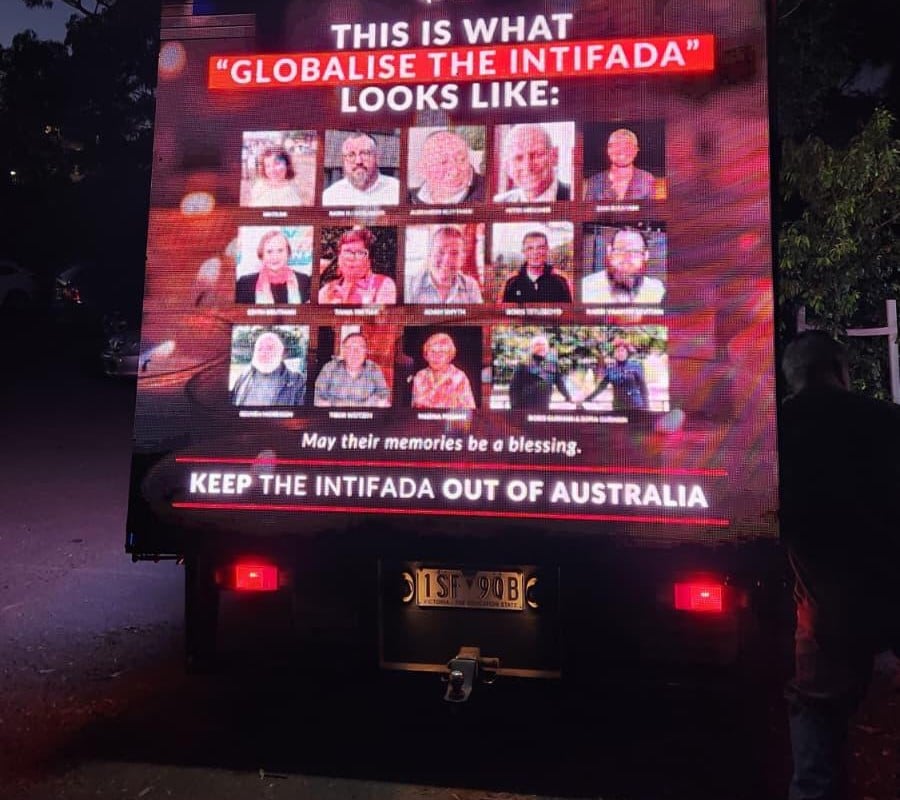
A public forum was scheduled at a City of Sydney venue titled: “Why It’s Right to Say: Globalise the Intifada.
Read that again slowly.
Not a discussion about peace. Not coexistence. Not reconciliation. A public event built around defending and promoting the phrase “Globalise the Intifada”.
The event was eventually cancelled after significant public backlash. That was the correct outcome. But the fact it was approved in the first place, defended by activists, and treated by some as legitimate civic discourse should alarm us far beyond Sydney.
For readers outside Australia, it is important to understand the scale of what happened. This was not a fringe argument hidden away in a private room. It became a major public controversy in Australia’s largest city, involving the City of Sydney, elected officials, media coverage, community organisations, police attention and serious public concern. It raised a larger question: how could a council venue in a multicultural democracy be used for a forum defending a slogan so many Australians associate with violence and intimidation?
Because this is no longer simply about one event, one slogan, or one city. It is about the manipulation of language itself.
George Orwell warned about this in Nineteen Eighty-Four. In Orwell’s world, “Newspeak” hollowed out the meaning of words, twisting language until people no longer recognised truth even when it stood directly in front of them. Violent ideas were softened. Dangerous concepts were sanitised. Reality became something shaped not by facts, but by repetition, intimidation, and political convenience.
That is what we are seeing around the phrase “Globalise the Intifada”.
We are now told it is merely a “call for resistance”. A “cry for justice”. A form of “political expression”. We are told Jewish people misunderstand it, that communities who feel threatened by it are overreacting, and that context somehow no longer matters.
But words do have context. History matters. Meaning matters.
The word “intifada” is not floating in a vacuum. Across the world, and especially for Jews, it is associated with waves of terror attacks, suicide bombings, shootings, stabbings, buses exploding, restaurants being destroyed, families murdered and civilians deliberately targeted.
That is the historical reality attached to the word.
Yet in modern activist discourse, we are increasingly asked to ignore that history and accept a rewritten version of reality where violent slogans are repackaged as progressive language.
This is Orwellian in the truest sense.
When “Globalise the Intifada” is framed as acceptable public discussion, society begins losing its ability to distinguish between activism and incitement. Between protest and intimidation. Between free speech and the glorification of violence.
Sydney has become a warning sign of where this leads.
Over the last few years, Australians have watched anti-Israel activism spill from university campuses into beaches, parks, community centres, and public institutions. What was once dismissed as fringe activism has steadily become more aggressive, more visible, and more socially accepted. Events once considered extreme are increasingly defended as normal civic participation. Slogans once recognised as inflammatory are now dressed up as serious political debate.
But now, more Australians are beginning to see this for exactly what it is. The masks are slipping. The attempt to defend and normalise a phrase like “Globalise the Intifada” in a public forum did not expose some hidden misunderstanding. It exposed the movement itself.
And the pressure does not fall equally.
Jewish Australians are repeatedly expected to explain why language tied to violence against Jews makes them uncomfortable, while those promoting that language are often afforded endless nuance, excuses, and reinterpretation.
That inversion tells us something has gone deeply wrong.
What was encouraging this week was seeing Australians from different faiths, cultures and political backgrounds come together to push back. At the counter gathering held in Sydney after the cancellation, there were Jews, Christians, Persians, Israelis, Australians, and Coptic Christians standing side by side.
They did not all agree on every political issue. They did not belong to one ideological camp. But they understood something simple: once societies normalise violent language through semantic games and political euphemisms, the consequences rarely remain theoretical for long.
The cancellation of the original event was welcome, but it cannot be treated as the end of the matter. One stopped forum does not end the attempt to normalise slogans like “Globalise the Intifada”. That language will continue to be used, excused and dressed up as legitimate political debate unless people remain clear, vigilant, and willing to push back.
The cancellation mattered because it showed that public pressure still counts. When dangerous language is challenged clearly enough, civic institutions can still be forced to draw a line. But it also exposed something troubling: the line was not drawn automatically. It took days of public concern, community mobilisation and pressure before the obvious decision was made. For Jewish Australians, and for many others, that delay was itself part of the problem.
That is the issue now confronting countries like Australia, the United States, Britain, and others across the Western world.
The debate is no longer only about Israel or the Middle East. It is about whether democratic societies still have the courage to call dangerous language what it is before it becomes normalised beyond recognition.
Because once words are stripped of their meaning, the danger does not disappear. It is simply made easier to excuse.
And that is the point Sydney should make clear to the world.
When a slogan tied to violence is defended as justice, when intimidation is dressed up as activism, and when communities are told to accept threats as debate, we are not witnessing the expansion of free speech. We are witnessing the collapse of moral clarity.
That is why this matters.
Not because one forum was cancelled, but because a line was drawn.
And now that line must hold.