
'A Brief History of Antisemitism' out in 2026
When ‘Zionist’ Becomes a Political Bogeyman
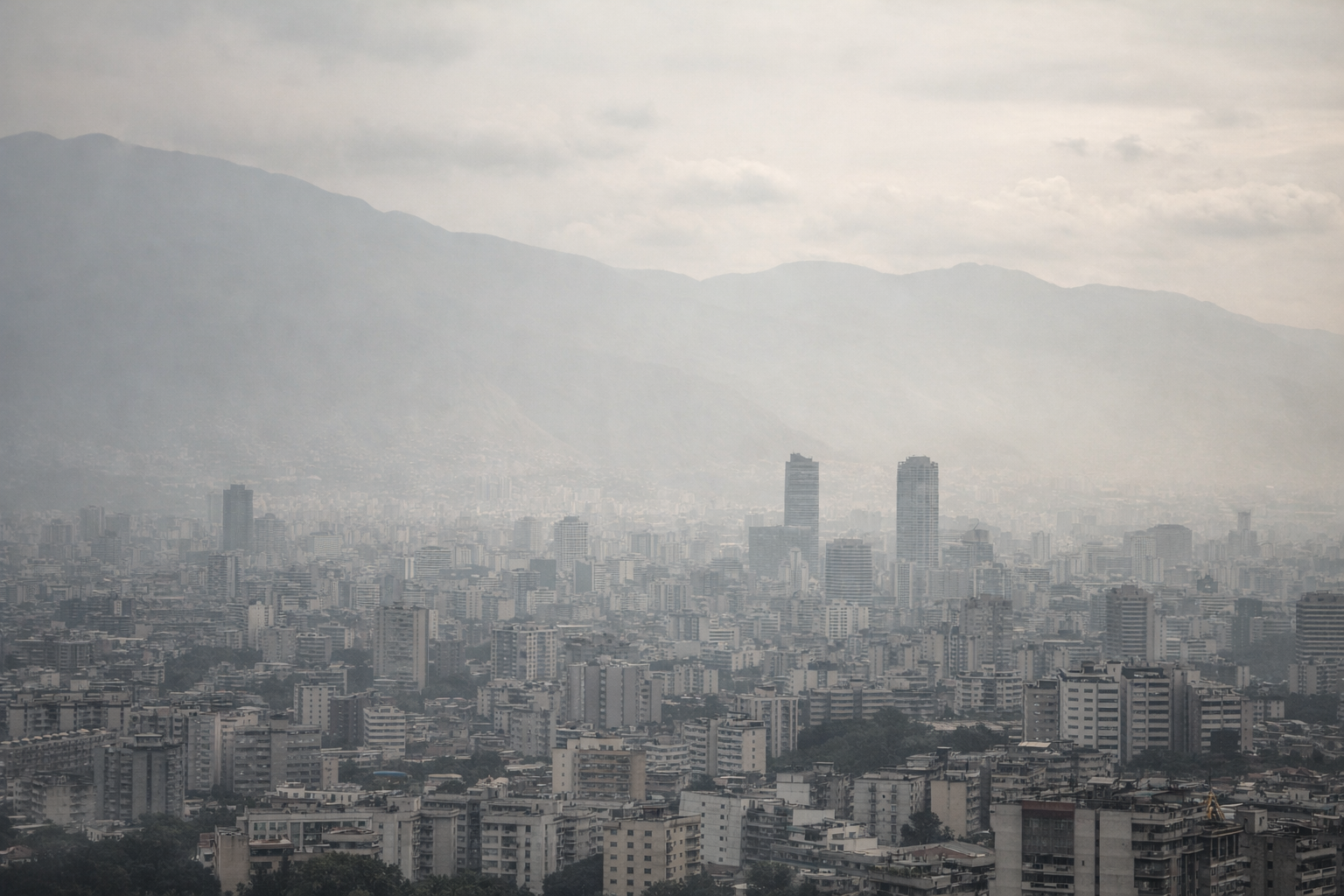
Venezuelan government rhetoric has increasingly framed “Zionists” as an external enemy.
In the aftermath of the weekend’s events in Venezuela, Delcy Rodríguez, Vice President and interim leader after Nicolás Maduro’s capture by U.S. forces, went on Venezuelan television and described U.S. action as something that ‘undoubtedly has Zionist overtones’ (‘tinte sionista’), calling it ‘shameful’.
International media reported loud explosions in Caracas as the U.S. operation unfolded, with Venezuelans waking to smoke, checkpoints, and uncertainty after a surprise U.S. strike and raid that captured Maduro.
The tinte sionista line is nonsense as an explanation. The U.S. government does not need Israel to conduct U.S. policy in Latin America. ‘Zionist’ is not a method of statecraft. It is not an institution. It does not explain a single concrete step in an operation.
Trump’s team, meanwhile, has been publicly signalling a different story: that Rodríguez is someone Washington can work with, even presenting her as ‘willing’ to go along with U.S. plans. Reuters summarised Trump’s framing and her public defiance in the same news cycle.
You do not need to assume secret negotiations to make sense of the rhetoric. In a regime that lives on anti-imperial performance, leaders often keep the posture even when events force improvisation. Whatever is happening behind closed doors, she still has to sound like she is fighting the same enemy her base has been trained to hate. In that setting, ‘Zionist’ language can function as much as internal signalling as it does as an external accusation.
When a government adds ‘Zionist’ to a story that is already full of ‘imperialism’, ‘mercenaries’, ‘CIA plots’, and ‘foreign sabotage’, evidence stops being the currency. Suspicion becomes the point. A messy, local political crisis becomes a cosmic fight against an almost metaphysical enemy. Evidence is never shown or needed, and the bait-and-switch works because ‘Zionism’ is being used in a way that can slide toward classic antisemitic patterns.
Rodríguez’s wording is also familiar. It belongs to a long Chavista habit: widening the circle of blame until it becomes foggy enough to shelter anything.
The strategy of fog
There are two ways to accuse a foreign state of wrongdoing.
One is plain nouns. ‘The U.S. did X, through Y channel, on Z date.’ It is falsifiable. It can be tested and challenged. Even propaganda has to do some work.
The other is the spectral villain. You name a force that feels powerful, hidden, and unaccountable. You imply it is everywhere. You let the public fill in the gaps. ‘Zionism’ plays that role very well because it can slide between meanings without ever declaring which one it is using.
Sometimes it is meant as ‘the Israeli government’. Sometimes it is meant as ‘the pro-Israel lobby’. Sometimes it is meant as ‘Israel’s intelligence services’. Sometimes it is simply a hiss-word for ‘the West’, ‘the rich’, ‘the press’, ‘global finance’, ‘people who run things’. The flexibility is the feature.
That flexibility is also why it so easily aligns to older antisemitic patterns. A word that can mean ‘a state’ one moment and ‘a secret global force’ the next will predictably pull people toward the oldest shortcut of all: there is a hidden hand, and it is Jewish.
Venezuelan leaders, authoritarian left
Chavismo presents itself as a moral project as much as a political one: a Bolivarian revolution, socialist, anti-imperialist, and aligned with a ‘multipolar’ world against U.S. dominance.
Hugo Chávez (president 1999–2013) made that posture central to his rule. Nicolás Maduro (his successor, in power since 2013 until his January 2026 capture) has leaned on it as legitimacy has frayed. In foreign policy that has often meant building relationships with states that share an anti-U.S. posture, including Iran.
Israel gets used as a symbol of U.S.-aligned power, more emblem than actor. ‘Palestine’ then becomes a useful political tool, the righteous victim, the moral proof that the revolution stands with the oppressed.
This is a recurring pattern in which the anti-imperial left borrows the Palestinian cause for its own positioning.
20 years of rhetoric
During the Lebanon war in 2006, Chávez likened Israeli actions to Hitler’s ‘fascist’ methods in comments reported at the time, part of an escalation in which Israel was cast not merely as an opponent but as a civilisational villain.
Then 2009. As Israel’s Gaza offensive unfolded, Venezuela expelled the Israeli ambassador, with Chávez calling the attacks a Palestinian ‘holocaust’. Days later, Venezuela broke diplomatic relations with Israel.
In the same period, Caracas saw an attack on a synagogue. Reuters reported armed men breaking in, destroying religious objects, and spray-painting walls amid the diplomatic crisis.
Later in 2009, the language became more toxic. Reportedly Chávez accused Israel of ‘genocide’ against Palestinians.
By February 2012, ‘Zionism’ was being used as a domestic smear, with antisemitic spillover. Pro-Chávez voices were reportedly targeting opposition candidate Henrique Capriles (a centre-right opposition leader running against Chávez) with attacks framed around ‘Zionism’ and his Jewish family background.
In 2013, after Chávez’s death, Maduro leaned into a different but related move: Nazi comparison as a tool of moral annihilation. Calling Capriles and the opposition ‘heirs of Hitler’.
Fast-forward to 2019, as the Juan Guaidó crisis peaked. Guaidó, the opposition figure who declared himself interim president and was recognised by several countries, gained another recogniser: Israel.
By 2024, Maduro was blaming ‘international Zionism’ for unrest after a disputed election, in language reported by The Times of Israel.
Then 2026 as discussed at the start of this article, Rodríguez reaches for the ‘tinte sionista’ framing to describe U.S. interference. Again, no details. No chain of involvement. No names. Just insinuation.
That is the common story: from condemnation of Israeli actions, and Israel as symbol of empire, to ‘Zionism’ as an abstract conspiratorial force, to ‘Zionism’ as a domestic smear, to ‘Zionism’ as the hidden hand behind any hostile event.
Here is the pattern:
State crisis
→ blame expands from concrete actors to metaphysical forces
→ ‘Zionism’ becomes a catch-all for hidden coordination
→ opponents become traitors, not rivals
→ intimidation becomes thinkable
You do not need a government to say ‘Jews did it’ for this to have consequences. You just need the repeated lesson that the enemy is secretive, powerful, and best recognised by vibes.
Venezuela’s alliances and anti-Zionism as shared identity
Venezuela’s alignment with Iran is not just trade. It sits inside a shared story about resisting the U.S. and building a counter-bloc. The press has documented that relationship across years, including the 2022 cooperation plan.
More recently, U.S. sanctions announcements have pointed to defence and technology links, including alleged UAV collaboration involving Iranian and Venezuelan entities.
In that geopolitical ecosystem, anti-Israel rhetoric often functions as a badge of membership. It signals that you are part of the ‘resistance’ side of the ledger. That can intensify pro-Palestinian positioning in ways that are morally sincere. It can also harden the reflex to frame conflict through civilisational conspiracies.
For the framers of this usage of the term, ‘Zionism’ becomes the glue-word connecting everything: the U.S., Israel, sanctions, internal dissent, NGOs, journalists, Jews, ‘global elites’. Once the glue sets, almost any claim can be made to stick.
The cost of toxic rhetoric
It would be comforting to treat this as rhetorical gamesmanship.
But Venezuela’s Jewish community has lived through moments where political speech and street-level threat came uncomfortably close. In February 2009 a synagogue attack placed it directly in the atmosphere of the diplomatic rupture and reported fears from community leaders and opposition figures.
Even when violence is not the outcome, there is a quieter cost. Jews become a symbolic proxy for the hated outside world. They are pressured to prove they are not agents. They are asked to answer for Israel. They become an easy target when people need a human shape for a distant enemy.
Why this all sounds familiar
Three antisemitic tropes sit right under the surface of ‘Zionist overtones’ rhetoric when it is used this way:
- The hidden hand: history’s engine is not policy or power or interest, but a secret coordinating force.
- Dual loyalty: political opponents, or local Jews, are treated as foreign instruments rather than citizens with ordinary disagreements.
- The cosmic villain: Jews (or ‘Zionists’) are not just wrong, they are the source of corruption in the world system.
None of these require explicit mention of Jews. They are older than the word ‘Zionism’. ‘Zionism’ simply gives them cover.
A quick test helps. Replace ‘Zionist’ with a plain noun and see what remains.
If a leader means ‘the Israeli government’, they can say that. If they mean ‘the U.S. and Israel coordinated this policy step’, they can offer particulars. When they do neither, and choose ‘overtones’, you are watching a different act. It is social myth-making and identity politics.
And when a government trains its population to read politics as undertones, it isn’t only attacking an external enemy. It is handing people the oldest scapegoat in the world: the Jews
Related Topics
Related Posts