Where Are Israel’s Shepherds to Save Us from the Wolves?
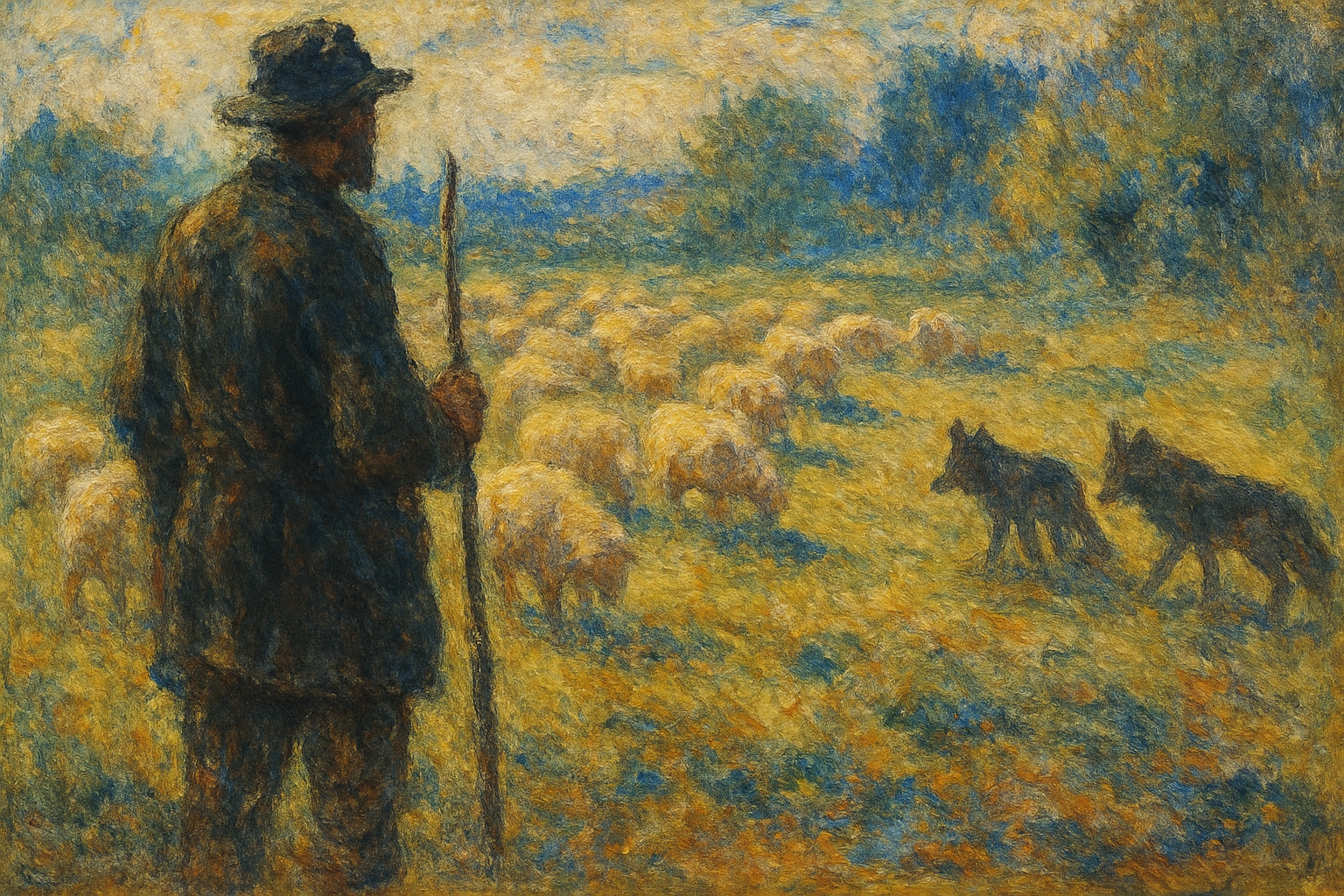
Israel needs leaders who guard the flock of Klal Yisrael, not wolves worried only about their next meal.
From the very beginning of our story, the Bible insists on a strange qualification for leadership: shepherding.
Abraham, Isaac, and Jacob all lived with flocks. Moses met G-d not in a palace but while tending sheep in Midian. David, Israel’s greatest king and the ancestor of the Messiah, was not discovered in a study hall or war room, but pulled in from the fields where he was looking for stray sheep.
It’s not a romantic detail. It’s a job description.
A shepherd’s entire role is the good of the flock.
Not the good of the shepherd.
Not the good of a faction of the flock.
The flock.
The shepherd stands between vulnerable, scattered animals and the wolves that stalk them. He stays awake at night listening for danger. He leads the flock to pasture and water, makes sure the weakest are not left behind, and lives attuned to the land, the weather, the limits of what creation can offer and sustain.
That is the biblical picture of leadership. And if we dare measure today’s leaders against that standard, we quickly discover a painful truth: modern Israel has many wolves and very few shepherds.
What Shepherds Know That Politicians Forget
Why does the Torah lean so heavily on shepherds?
Because shepherding cultivates three qualities upon which all true leadership rests:
- Responsibility for the vulnerable
Sheep are defenseless. They cannot negotiate with wolves. The shepherd accepts, as the core of his identity, that their survival is his responsibility. He cannot outsource it, and he cannot pretend not to notice. - Commitment to the whole flock
A shepherd does not manage a fan club or a voting base. He does not curate “my sheep” versus “their sheep.” If some wander off, he goes after them. If some are troublesome, he does not quietly hope the wolves will solve the problem for him. - Living within the limits of the land
A shepherd must know the terrain: when the grass is exhausted, when water is scarce, where the cliffs and ravines are. Leadership, in this model, is exercised in harmony with reality, not through denial, slogans, or magical thinking. The shepherd does not declare the desert a pasture by passing a law. He either finds pasture or he doesn’t—and the sheep will tell the truth with their survival.
Only after Israel enters the Land do we see a shift from shepherding to agriculture, ownership, and property. Fields can be fenced. Wealth can be hoarded. Land can be divided, inherited, and fought over. The emphasis tilts from shared vulnerability and mutual responsibility toward status, control, and internal competition.
The Torah and later Prophets warn, again and again, what happens when leaders forget they are shepherds and begin to see themselves as owners. The people fragment. Justice decays. The strong prey on the weak—and often do so in G-d’s name.
Samuel’s Test: The One Son Left with the Sheep
The clearest biblical test for leadership comes in the story of Samuel seeking a successor to Saul, who has failed as king. Saul’s failure is not primarily military; it is moral and spiritual. He will not fully own responsibility, will not fully obey, and is overly concerned with how he appears to the people rather than whether he truly serves them.
Sent to the house of Jesse, Samuel is shown one impressive son after another. Each looks like leadership material—physically imposing, presentable, “kingly.” G-d rejects each of them.
Samuel finally asks the crucial shepherd’s question: “Are these all the boys?” Only then does Jesse mention the forgotten one, the son not even invited to the selection: the shepherd out in the fields, searching for stray sheep.
David enters the story smelling of the flock, not of the court.
It is that shepherd who will confront Goliath—when soldiers and armor, generals and royal authority, are paralyzed by fear. It is that shepherd whom G-d chooses as king, and whose descendant is associated with Messiah, the ultimate vision of just and compassionate rule.
The test has not changed. The question is not: “Who looks like a leader?” The question is: “Who is already living as a shepherd?”
From Flock to Factions
Modern Israel’s story, tragically, has followed a similar arc to that biblical shift from shepherding to possession.
In the early decades, leaders imagined themselves—imperfectly, but sincerely—as responsible for Klal Yisrael, the whole people. The language of sacrifice and collective burden-sharing was not mere rhetoric. There were bitter disputes, but there was also a shared understanding that the survival and flourishing of the Jewish people, post-Holocaust and under constant threat, demanded some sense of common flock.
Over time, as the state stabilized and power solidified, the emphasis shifted.
- Parties carved the public into factions: sectors, tribes, socioeconomic islands.
- Leaders began to treat these segments as private flocks whose main purpose was to keep their shepherds in office and well-fed.
- The national interest became, all too often, the byproduct of coalition arithmetic, not the starting point.
We live now in a political ecosystem in which many of those who call themselves leaders behave more like wolves in shepherds’ clothing. They wrap themselves in the language of responsibility while feeding primarily on fear, anger, and grievance. They speak for “the people” but mean “my people.” They are far more focused on counting sheep for the next election than on protecting the flock from real dangers.
The result is fragmentation: many small flocks, each jealously guarded, suspicious of the others, easy prey when the wolves truly come.
What Wolves Want from Sheep
A wolf is not inherently interested in the well-being of its prey. It is interested in what the prey can provide: meat. In political terms: votes, power, budgets, immunity, prestige.
We see the wolfish mindset in leaders who:
- Treat national crises first as opportunities to entrench their position, not as tests of their responsibility.
- Devote more effort to attacking internal rivals than to strengthening Israel’s cohesion and resilience.
- Present themselves as defenders of “our” community while ignoring the broader public good and the long-term health of the state.
- Prefer short-term political survival over painful but necessary decisions that would protect the flock in the future.
These are not shepherds. These are wolves who have learned to speak fluent “concern for the people” while eyeing the fattest part of the flock.
What Would a Shepherd of Israel Look Like Today?
If we apply the ancient shepherd test to our current moment, what kind of leadership should we be seeking?
- Guardians of All Israel, Not Just Their Base
A true shepherd for Israel today would speak and act as if responsible for Jews across every sector—religious and secular, left and right, Mizrahi and Ashkenazi, Arab citizens and non-Jewish minorities, rich and poor, center and periphery. They would be willing to lose elections rather than sacrifice the basic dignity and safety of any part of the flock. - Truth-Tellers About the Land and Its Limits
Shepherd-leaders would face hard realities: security threats, demographic pressures, economic constraints, the limits of our environment, and the psychic scars of war and terror. They would not sell fantasies that everything can be had at once—maximum territory, maximum security, maximum subsidies, maximum freedom, zero sacrifice. They would instead say: Here are the real pastures and the real cliffs; here is where we can safely walk, and here is where the ground will give way. - Protectors of the Weak, Not Just Amplifiers of the Loud
In any flock, the strongest sheep do not need the shepherd as much. It is the aging, the injured, the lambs, the ones who fall behind who test the shepherd’s character. A shepherd of Israel today would be measured by how they deal with the powerless: the poor, the traumatized, the disabled, the elderly, those without political leverage. - Builders of Bridges Between Flocks
Our society has become a map of fenced-off enclosures—educational systems, media ecosystems, echo chambers. A shepherd-leader would work obsessively to open gates: shared service, shared institutions, shared narratives. They would insist that the story of Israel is not a zero-sum contest between tribes, but a single, fragile flock trying to survive in history.
From Saul to David—Again
The story of Samuel, Saul, and David is not ancient gossip. It is a warning.
Saul is a cautionary tale of a leader who was outwardly impressive but inwardly unsteady, torn between pleasing G-d, pleasing the people, and preserving himself. When this mixture finally proved untenable, G-d sent Samuel to find someone else—someone who, up to that moment, was quietly chasing after stray sheep.
We do not know where Israel’s future shepherds are today. They may not sit on the front benches of the Knesset. They may not feature regularly on primetime panels. They may be in classrooms, in reserve units, in social work, in local government, in civil society. They may be people who, when asked about their leadership ambitions, laugh and point to the current mess as proof that they should stay far away.
That, historically, is exactly where G-d tends to look.
Israel Does Not Need Better Wolves
Israel does not need more polished messaging, more sophisticated political tactics, or more ruthless infighting on behalf of “our” camp against “theirs.” It does not need more wolves who are better at disguising themselves in shepherds’ cloaks.
Israel needs men and women who already live as shepherds:
who feel the pain of the entire flock,
who grasp the limits of the land,
who will step between danger and the weak,
and who are willing to lose for themselves rather than see the flock torn apart.
The task before us is to learn to recognize such people, to invite them in from the fields, and to be willing—like Samuel—to reject every impressive candidate until the true shepherds are found.
Until then, we will remain what we are now: many anxious flocks, circling one another in fear, watched over by leaders who count us carefully, not to care for us, but to calculate how we might best be consumed.