

Where Are You? A Jewish-Christian Dialogue in the Age of Artificial Intelligence
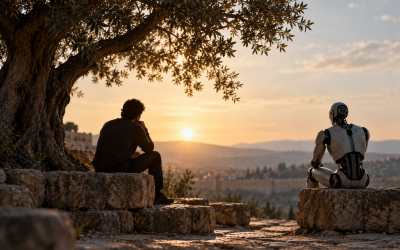
A recent brief comment by the Argentine Catholic thinker Alberto Benegas Lynch (h) led me back to a question I consider central to the age in which we are living—one intimately connected to the opening chapters of the Torah:
What does it mean to be human?
Responding to a text of mine, Benegas Lynch reminded his objection to the very expression “artificial intelligence.” He prefers to speak of “computer algorithms” because, he argues, intelligence implies free will, not programming or reprogramming.
For centuries, Judaism and Christianity—though following different pathways—shared a vocabulary in which concepts such as soul and free will occupied a central place. Much of that vocabulary developed through the encounter of the biblical tradition with Greek philosophy and, later, medieval thought.
I am not suggesting that these concepts are false or that we should abandon them. But for a significant part of the contemporary world, these concepts have lost some of their former explanatory power. To say that human beings differ from machines because we possess a “soul” or “free will” immediately requires us to explain what those words mean today.
The creation narrative tells us:
“God created the human being in His image; in the image of God (Tzelem Elohim) He created him” (Bereshit [Genesis] 1:27).
Yet the text does not tell us exactly what that image consists of. Intelligence? Reason? Consciousness? Freedom? Moral capacity?
The question acquires unexpected urgency when machines begin to perform activities that for centuries we regarded as distinctively human: thinking, reasoning, using language, learning, remembering, interpreting, and creating.
Faced with this challenge, we tend to respond by moving the boundary. We say: “The machine calculates, but it does not think.” When it appears to think, we say: “But it does not understand.” When it appears, functionally, to understand: “But it does not feel.” Then: “It has no consciousness.” Finally: “It has no soul.”
Each of these distinctions may be valid. What is unsettling is that each tends to appear after the previous one has ceased to distinguish us.
Perhaps we should try another path: stop defining the human being exclusively by the capacities we possess.
Bereshit offers another possibility. After eating from the tree, Adam hides, and God calls to him:
“Ayeka?” — “Where are you?” (Bereshit 3:9).
God is not asking for geographical information. He is addressing the human being.
Where are you in relation to what you have done? Where are you in relation to the other? Where are you before God? Where are you in relation to yourself?
Here, the human being appears not merely as one who thinks or chooses, but as one who can be called upon to answer.
And only one chapter later, another question appears. Cain has killed Abel:
“Where is Abel, your brother?”
Cain replies:
“Am I my brother’s keeper?”
These two questions belong, as I understand them, to the same conception of the human being:
Where are you? Where is your brother?
The first calls me to account for my own existence. The second introduces my responsibility toward the other.
Much later, when God calls Abraham, we encounter one of the great biblical responses:
“Hineni” — “Here I am.”
This is not merely a statement of physical presence. It expresses availability: I am here, ready to respond.
Between Ayeka and Hineni, then, another way of thinking about the human being emerges: not merely as the possessor of certain faculties, but as a being who is called upon to respond.
A newborn child cannot respond morally. Nor can someone who has profoundly lost their cognitive capacities. And yet their human dignity remains intact.
Indeed, it is precisely their vulnerability that calls upon us to respond.
Perhaps, then, being human does not consist simply in the capacity to respond, but in belonging to a relationship in which we are called—and in which our very existence calls for a response from the other.
Benegas Lynch proposes preserving human uniqueness through the concept of free will. From the Jewish tradition I am trying to articulate here, I wonder whether we might complement that category with another: responsibility.
I do not intend to resolve the difference. Quite the opposite.
What interests me is the possibility that this difference might become the beginning of a Jewish-Christian conversation about the human being in the age of artificial intelligence.
Perhaps Christianity has profound reasons for continuing to speak of soul and free will. Perhaps Judaism can contribute the ancient biblical structure of call, response, covenant, and responsibility. And perhaps both traditions need to ask how those intuitions can be translated today for a world that no longer necessarily shares their metaphysical categories.
Artificial intelligence makes that conversation urgent. Not because a machine necessarily compels us to abandon what our religious traditions have taught about the human being, but because it compels us to ask again what we meant by those teachings in the first place.
That is why I believe the question raised by Benegas Lynch is far more important than deciding between the expressions “artificial intelligence” and “computer algorithms.” Both are attempts to tell us what we have created.
The Jewish-Christian question comes before that one and goes deeper:
What are we?
Perhaps we should begin where the Bible begins—not with a definition, but with a call:
Ayeka — Where are you?
And with the human possibility of answering:
Hineni — Here I am.