Where Does Jewish India Live?
Recently, an Instagram post about the Jews of India has gone viral.
Technicolour and dynamic, it feels like a Coke commercial meets Live Aid – drone shots, swelling music, group embraces – and it succeeds in one crucial task: raising awareness. Awareness is not trivial. For many viewers, this may be the first time they’ve heard that there are Jews in India at all. In a digital ecosystem, awareness is currency. You can see it in the comments: astonishment, gratitude, discovery – in a world where literacy often yields to the authority of the image.
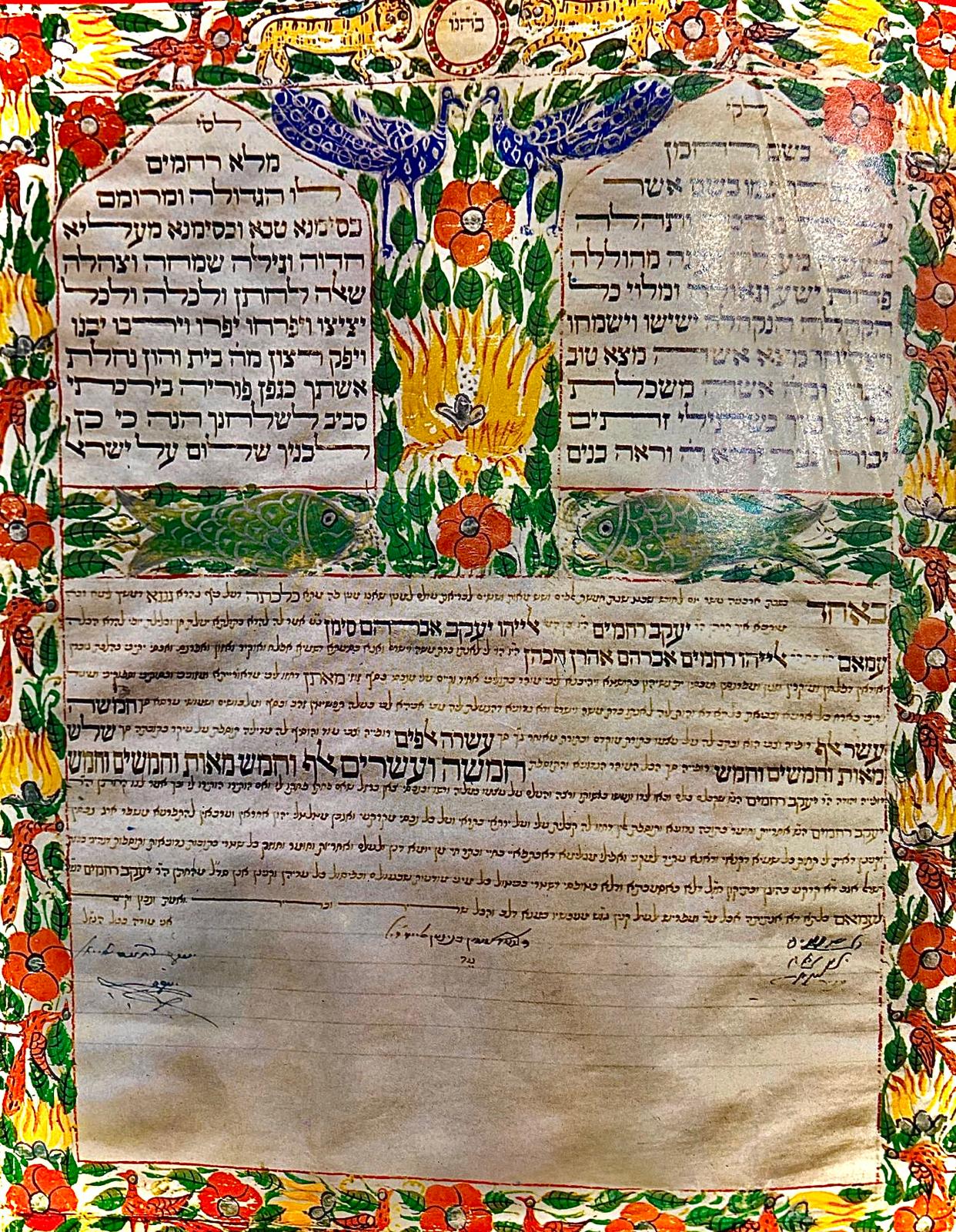
The phenomenon brings back an older memory. My German-born grandfather once asked to see my paternal grandparents’ Indian ketubah before allowing my mother’s hand in marriage. He likely wasn’t denying our Jewishness; he simply could not locate it. “Jews in India” did not fit his mental map. He needed proof that Jewish life could exist outside the familiar lanes of Europe and the Middle East.
Since then, I’ve spent much of my life widening that map – heightening awareness of Jewish communities across South and Southeast Asia, not only in India. At a time when Jewish visibility often feels fragile, any reminder of Jewish presence in far-flung geographies carries weight. The very existence of Jewish communities in India – ancient, layered, locally rooted yet globally connected – complicates simplistic narratives of Jewish history.
So yes: awareness matters.
But awareness is only the beginning.
The Indian Jewish experience today largely lives outside India. The communities that once flourished in Cochin and Calcutta have, over generations, emigrated and re-rooted elsewhere – in Israel, in Australia, in Canada, in the United Kingdom. The synagogues still stand in Kerala and Kolkata. Cemeteries are tended. Clocks on synagogue towers are restored. Yet the children who once filled those courtyards now speak Hebrew in Ashdod, English in Sydney, or French in Montreal.
Jewish India did not disappear. It moved.
And that shift changes the conversation.
When we film the Paradesi Synagogue in Kochi, or the Maghen David Synagogue in Kolkata, we are filming architecture. When caretakers – sometimes Muslim, sometimes Hindu – maintain Jewish cemeteries or hold the keys to former Jewish homes, they preserve something dignified and worthy of respect. There is beauty in that interfaith custodianship. It speaks to India’s layered civilizational fabric and to the possibility of honouring what is not one’s own.
But preservation is not the same as presence.
A synagogue without a minyan becomes a monument. A clock tower without congregants becomes a symbol. A “Jew Street” without Jewish families becomes heritage.
None of this is meaningless. But it is a different kind of meaning.
The viral aesthetic of contemporary storytelling – cinematic pacing, collective emotion, visual crescendo – compresses history into affirmation. It tells us: Look, this existed. Look, this was beautiful. Look, this is our family. For many viewers, that is powerful and necessary. It completes a picture of the world they didn’t know was missing.
Yet for those of us whose families lived that history – whose grandparents prayed in those synagogues, traded along those spice routes, negotiated colonial modernity in Calcutta’s mercantile districts – the questions are more complex. My father, for example, never returned, not even to visit. He never explained why. But I can imagine, knowing him, that he did not want to meet a reality that would not match the one he carried inside him.
For many Indian Jews, aliyah after 1948 was not symbolic; it was transformative. Entire communities relocated. Social structures were uprooted. Liturgical traditions were transplanted. Recipes travelled. Accents softened or disappeared. Children grew up in development towns rather than port cities. Geography shifted – and with it, the texture of identity.
In Israel today, the descendants of Cochin and Baghdadi Jews are not heritage. They are citizens. Their grandparents’ India is part of biography, not daily landscape. Curry leaves and coconut milk may survive in kitchens. Melodies may survive in synagogue services. Family stories may survive in fragments. But the streets themselves – Jew Town, Ezra Street – have become something else.
When diaspora returns to sovereignty, it alters the meaning of memory.
So what are we celebrating when we celebrate Jewish India?
If we are celebrating coexistence, then the caretakers matter. If we are celebrating architecture, then restoration matters. If we are celebrating pluralism, then visibility matters.
But if we are speaking about continuity – about lived Jewish time – then the story extends beyond India’s borders.
In an age of digital media, the grammar of belonging is increasingly visual. High production reads as legitimacy. Emotional condensation reads as authenticity. For younger generations encountering Jewish India for the first time through Instagram rather than through grandparents, this medium may become their primary access point.
There is nothing inherently wrong with that. Every generation receives history in its own form.
But awareness must lead somewhere.
For some, it will lead to tourism – a visit to Kochi or Kolkata to see the synagogues before they fade further. For others, it will lead to research: archives, genealogy, oral history. For still others, it will lead inward – to the rediscovery of recipes, prayer traditions, and family cadences now unfolding in Israeli neighbourhoods or Australian suburbs.
My own work is concerned not only with visibility, but with transmission. How do food, liturgy, language, and memory migrate? What survives when geography changes? What transforms? What is lost? These questions cannot be answered by drone footage alone. They require slowness. They require nuance. They require acknowledging rupture alongside celebration.
The Jewish story has always been one of movement: Babylon to Iberia. Iberia to Amsterdam. Baghdad to Calcutta. Calcutta to London. Cochin to Israel. Buildings remain in one place; people continue elsewhere.
Perhaps the real conversation is this: how do we honour both?
How do we respect the preservation of physical sites in India without confusing that preservation with living communal life? How do we ensure that the story of Jewish India is not frozen as a picturesque chapter, but understood as a migration that continues to shape Jewish life – including in Israel – today?
Awareness introduces. Inquiry deepens.
If a viral post ensures that more people know Jews once thrived in India, that is a gain. But the next step is to ask what that thriving became – how it reconfigured itself in a new national home, how it altered the cultural and culinary landscape of Israel, how it continues to echo in prayer and family narrative.
Jewish India is not only a place. It is a movement.
And movements, unlike monuments, do not stand still.
Awareness is currency. Continuity is responsibility. The first captures attention. The second sustains memory.