
Featured Post
Where does US aid to Israel actually go?
The billions sent to Israel do not disappear overseas — they circulate through American factories, weapons labs and strategic interests
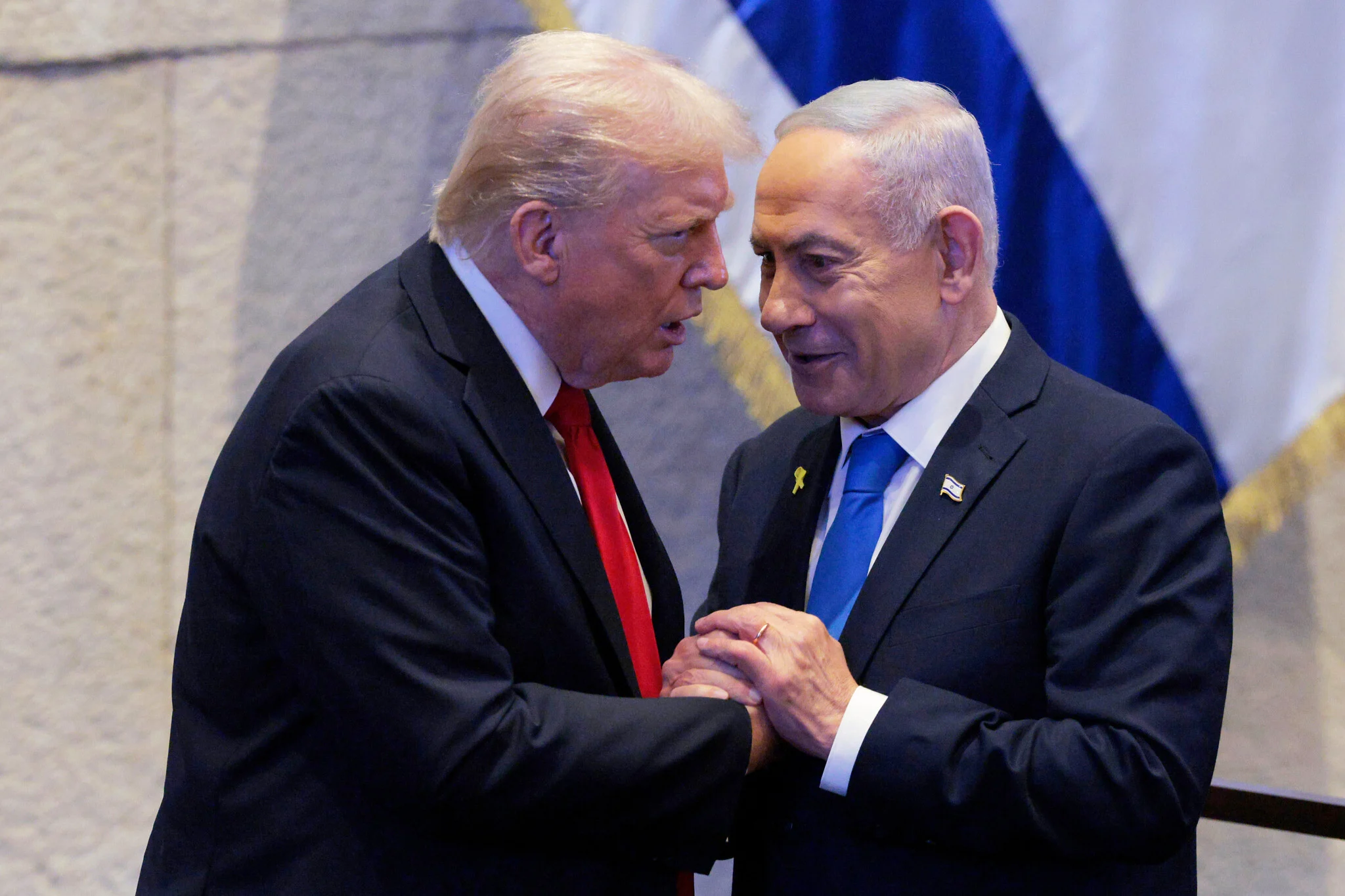
US President Donald Trump speaks with Prime Minister Benjamin Netanyahu in the Knesset, October 13, 2025. (Chip Somodevilla/Pool via AP)
Every year, the United States sends billions of dollars to Israel – money, critics say, that would be better spent on American schools, American hospitals and American workers.
Washington has committed over $300 billion in total assistance to Israel since 1948, and since October 2023, more than $16 billion of that has been in direct military aid. But the critics have made one fundamental error in determining who actually receives it.
The money the United States gives to Israel is not a foreign aid package of the sort it gives to Pakistan or Afghanistan; it is an American jobs programme with a Middle Eastern address.
The vehicle for most US military assistance to Israel is the Foreign Military Financing programme. This does not transfer cash to Jerusalem but instead extends a line of credit redeemable exclusively for American-made weapons and military services. Israel is hardly able to pocket the money; it spends it at Boeing, Lockheed Martin, Northrop Grumman and Caterpillar. It spends it on fighter jets, guided munitions and armoured vehicles built by American workers in American factories. The dollars that the critics say they are losing leave the US Treasury and return, almost immediately, to the American defence economy.
This means the senator denouncing aid to Israel from the Senate floor may be, without fully realising it, arguing against contracts in his own state.
But the procurement argument only captures the most visible return on this investment. The deeper dividend to see is technological: The United States and Israel build weapons together. American military projects are trialled on Israeli battlefields before they are handed to their own soldiers. And a family of missile defence systems now central to American strategic thinking – the Iron Dome, David’s Sling, the Arrow II and Arrow III – were developed through genuine bilateral engineering collaboration. American funding and Israeli ingenuity drive each programme forward.
So, what does America receive from this investment? Access to combat-tested technology, far from the quality of the testing that can be found on the ranges of Nevada. It is tested in live conflict against Iranian ballistic missiles, Hezbollah rockets and Hamas projectiles. Safe to say that these are a set of conditions no American facility can replicate.
Israel is, in this sense, the world’s most sophisticated live laboratory for American military doctrine and hardware. No other American ally on earth offers this combination: the technological sophistication of a top-tier defence partner and the operational tempo of a country that has been at war, in one form or another, for the last eighty years.
The Middle East is a region the United States simply cannot afford to neglect, but neither is it a region that it can afford to police directly. Israel absorbs an enormous share of that burden on Washington’s behalf. When Israeli forces degraded Hezbollah’s missile arsenal, intercepted Iranian drone swarms and systematically dismantled the infrastructure of America’s most destabilising regional adversaries, they did so without a single American soldier in the field.
Consider the precedent set in 1981, when Israel unilaterally destroyed Saddam Hussein’s Osirak nuclear reactor. All at zero cost to the American taxpayer. Israel is able to act on shared interests faster, cheaper and with fewer political costs than any direct American intervention could.
Israel votes with the United States in the United Nations 94% of the time. In a body where American resolutions are regularly blocked or watered down (if they are not simply ignored), this is certainly something to keep in mind. Compare that to Egypt, the second largest recipient of American money behind Israel since 1946. Egypt receives billions in American assistance and votes against Washington roughly 79% of the time. And what does it give in return? Or compare it to Saudi Arabia, whose UN alignment with the US sits at a similar low.
At this point, you may be driven to the familiar obligation that the relationship persists not because it delivers strategic value, but simply because Israel has engineered outsized political influence in Washington. But how much money does Israel pay to lobby Washington? In 2024, Israel spent approximately $14 million on foreign lobbying. If that sounds like a lot, consider those who spend double, triple that: South Korea spends $27 million; China spends $30 million; Saudi Arabia spends $44 million; Japan spends $50 million. Where is the outrage? But Simon, think about AIPAC! Let’s think about AIPAC. AIPAC is the domestic advocacy group most often cast as the puppet-master of American Middle East policy. It ranked roughly 75th among American lobbying organisations in 2024, the height of Israel’s war against Hamas in Gaza. It spent $3.5 million that year. Compare that to the U.S. Chamber of Commerce at $96 million, or to the National Association of Realtors at $86 million, or to Big Pharma at $60 million, or to Amazon at $50 million.
Out of the top 100 lobbying organisations in Washington, AIPAC accounts for approximately one-tenth of one per cent of total lobbying spending. Even when election spending is included, it represents about half of one per cent of political money nationwide.
If the money does not support the thesis, the thesis is doing work the evidence cannot.
Every expenditure has an opportunity cost, and the honest question Americans ought to be asking themselves is not whether this money could be spent elsewhere, but whether it could be spent better, with higher returns for the American working family. Other major recipients of American foreign assistance in the region absorb the funds, generate little (if any) in the way of intelligence cooperation or technology partnership, and reliably oppose American positions in international forums. Once again, where is the outrage at the, for instance, $1.3 billion allocated to Egypt for military assistance that the American taxpayer has yet to see any returns on?
Let’s look at the returns generated by Israel: interoperability, shared intelligence, co-developed defence systems, battlefield-tested military doctrine and a democratic ally – a democratic ally whose governments, whatever their domestic controversies, do not fund the enemies of the United States. (I can name a few.) Measured against any comparable investment in the American foreign policy portfolio, Israel is the best-performing asset Washington holds – in the most consequential region on earth.
Prime Minister Netanyahu has said publicly that Israel intends to achieve full defence-industry independence in the coming years. The procurement pipeline that currently anchors the relationship will, in time, narrow. When it does, what will remain is the compounded return of decades of co-developed technology and hardened intelligence channels. The critics looking at this transaction and seeing little more than a giveaway are not wrong that billions have changed hands. They are simply reading the ledger from the wrong end.
Related Topics