Jewish values, leadership, and honest conversation
Where the Challenge Left Me
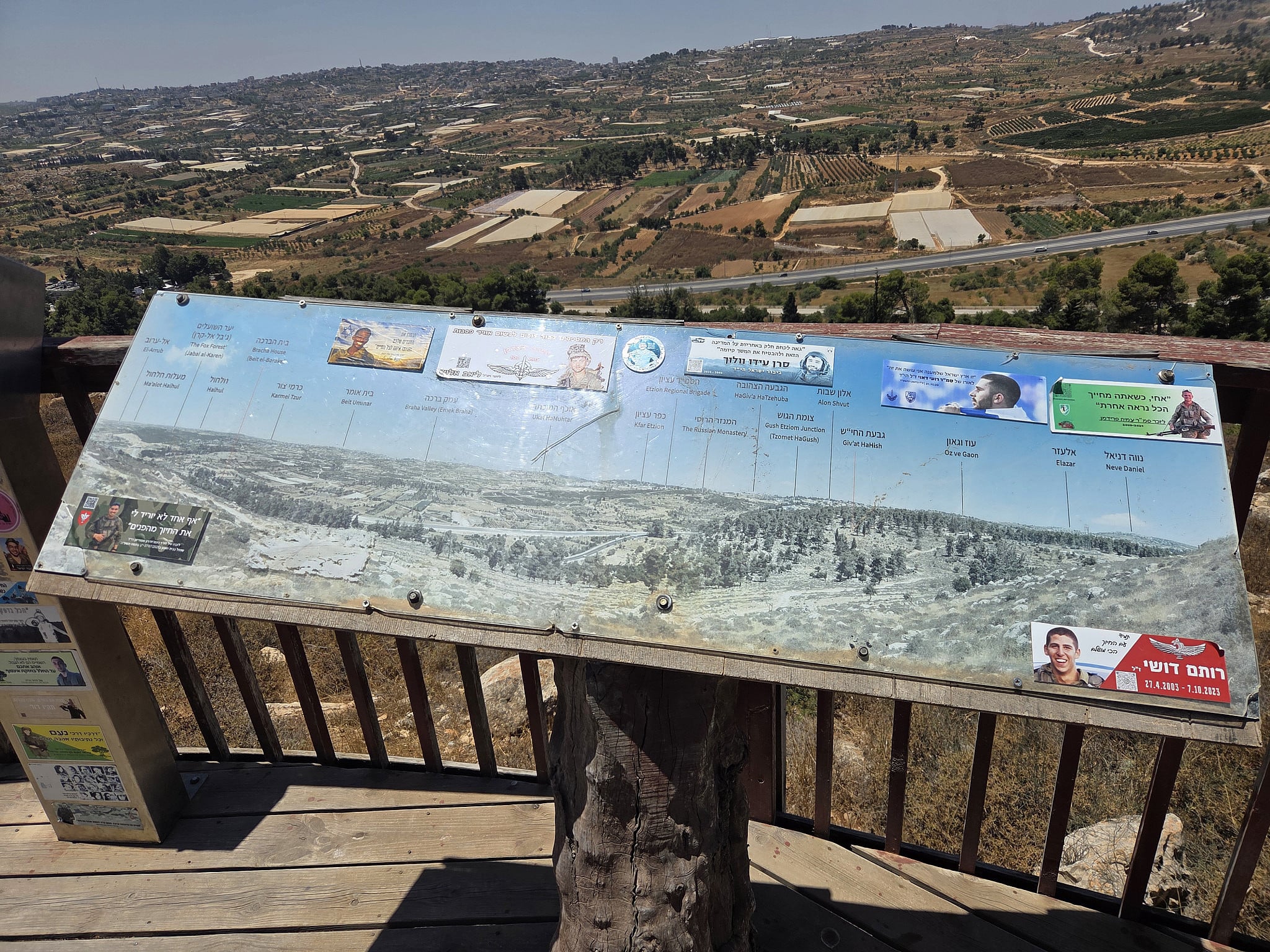
(Courtesy)
Here is the land as two families remember it. Khaled’s family lost their home in 1948, driven from their village near Beit Jibrin, and rebuilt in Gush Etzion. In 1967 they were driven out of Gush Etzion itself, fled to Jordan, and resettled a third time in Beit Ummar. In those same hills, a Jewish community had been under siege since the partition vote, and on May 13, 1948 — the day before Israel declared independence — its defenders surrendered and were massacred. Nineteen years later, after the Six-Day War, the children of those survivors came back and rebuilt Kfar Etzion on the same ground. Two histories, the same soil, both real: a Jewish community destroyed and restored by its own children; a Palestinian family displaced, resettled, and displaced again. Neither cancels the other.
Our Hartman group sat in a circle at the Dignity Center of Roots-Judur-Shorashim, and I met Khaled himself. Years after his family’s second displacement, his brother was killed by Israeli soldiers — shot, by the family’s account, without provocation. In the mourning that followed, bereaved Israeli parents from the Parents Circle, who had buried their own children in this same conflict, asked to come sit with the family of a young man killed by the side they belonged to. Khaled refused. They asked again. He refused again. Then, for reasons he still finds hard to fully explain, he said yes. That single yes, he told us, is the hinge his life since has turned on. He had every reason to nurse an unbreakable resentment.
Instead, he co-directs Roots, sitting week after week with the very Israeli settlers whose presence is, for him, an open wound, building the only shared Israeli-Palestinian community center in the West Bank — a few miles from the land his family once farmed. His own community sometimes calls him a collaborator for it. He keeps doing it anyway.The Israeli settlers who sit with him made a choice of their own — living inside the same fear Khaled’s history would justify aiming back at them, choosing engagement over the wall that fear would license. So did the young religious Zionists of Smol Emuni, an emerging group of national religious Jews whose values lead them to advocate for human rights even where their own community finds that costly. None of them are naive about the danger. They’ve simply decided the fear, however earned, can’t be the last word.
And the fear is earned. At Tekoa, on the same trip, we sat with two young Israeli women, seventeen and nineteen, who carry that history as lived danger, not distant memory. They don’t wish death on Palestinians. But they can’t see how you share a land with neighbors some of whom, they believe, want you dead — and they aren’t wrong that some do. I heard the same fear from more than a few Israelis this week: whether, immediately after October 7, their children would remain alive by week’s end. My own child lives in Israel; I asked that question too. Their fear and Khaled’s history are mirror images; neither got there by mistake.
This week is Shabbat Chazon, named for Isaiah’s opening cry. We tend to hear chazon — vision — as hopeful. It isn’t, not at first: it is a vision of coming destruction and exile, addressed entirely inward — this is what will happen to you, Israel, because of what you have done. Isaiah warns his own people, not the neighbors. Self-focused rebuke.
Much of the progressive Jewish conversation about this conflict shares that instinct, often to its credit: we ask what Israel must do better, since that’s within our own hands. But alone, self-focus can leave the other side with no moral agency — a condition to be managed, not people capable of their own teshuvah. That erasure runs both ways, and Khaled’s choice corrects it from the other direction: his yes wasn’t something Israelis talked him into, but his own act, at real cost inside his own community — a devar, in the language of this week’s Devarim: not a story told about him, but a thing now real in the world. The settlers at Roots, and Smol Emuni, are doing the same from their side of the fear.
Hardly anyone in Israel today is thinking seriously about a Palestinian state, for reasons anyone who lived through the last three years understands. But sensible people recognize the status quo — checkpoints, permits, a shared land with no shared future in view, mutual fear with no exit — is also unsustainable.
Khaled, the settlers at Roots, and Smol Emuni aren’t offering a solution. They’re doing something smaller: choosing engagement over the wall that fear, on both sides, would justify.
That’s where the glimmer of hope lives — though I don’t know how you scale a handful of such choices into something large enough to matter. Isaiah didn’t say either; he simply insisted the work start with the one being warned, not the one being blamed.
So I won’t end with a call to change — mine or anyone else’s. I don’t know yet what this day is asking of me, and I distrust a version of this piece that claims otherwise. What I know is smaller: fear on both sides is real and earned, its history real on both sides too, and a few people on both sides have chosen not to let it be final. Not a resolution. A few certainties left unexamined — which, at Hartman, is usually the point.
Related Topics
Related Posts