Cardiologist, professor, and Jewish community lay leader
Where Thresholds Meet
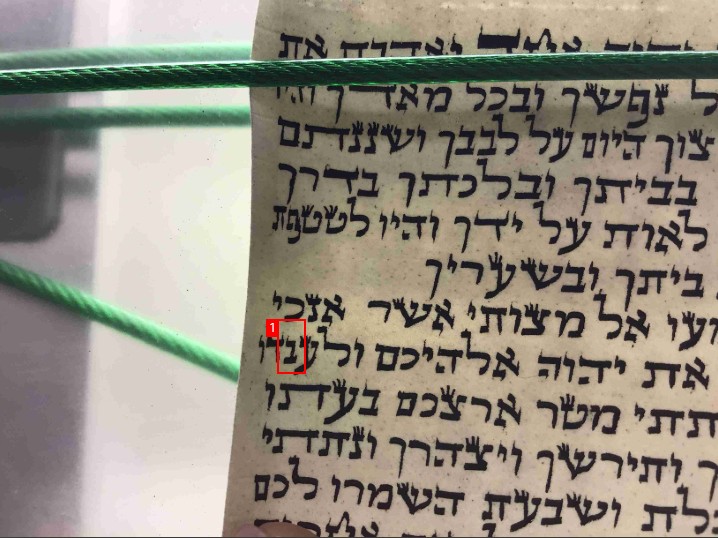
A questionable letter on one of my mezuzah scrolls, later repaired by the sofer. (courtesy)
On Illness, Intention, and the Meaning of a Jewish Doorway
Not many people know this, but I had bladder cancer when I was 29 years old. Although frightening at the time, it never returned and the years passed with routine surveillance that felt more like an inconvenience than anything else. But this past May, I had three new tumors. They were removed and, thank G-d, were low grade. We assumed it was a fluke and that I would have another thirty years of bladder boredom.
Unfortunately, a few weeks ago, we found five more bladder tumors. My illusion of safety vanished, and this time I am scared. They are being removed this Friday, when I will receive a dose of intravesical chemotherapy. A week later we will learn the pathology that will determine my diagnosis, prognosis, and need for further treatments.
As a physician, my first instinct was to meet this recurrence with the tools I know best: mechanisms, probabilities, and therapies. I moved quickly into oncologic reasoning: field cancerization, genetic testing, nutritional assessment, surgical options, and Bayesian estimates of grade, recurrence, and survival. That is the world I understand and trust.
But when I shared the news with my Rabbi, he listened, asked thoughtful questions, offered spiritual support, and then said, “We should check your mezuzahs.” His words stopped me. In an instant, I realized I was standing at a threshold – not only medically, but spiritually. I could do everything medically possible, yet I also needed to ask what this moment required of me spiritually.
I knew how to prepare for a physical biopsy, but I did not expect to be confronted with what felt like a spiritual one.
What a Mezuzah Is and Why It Sits on a Threshold
A mezuzah is a parchment scroll upon which a trained scribe writes two passages from the Torah (Deuteronomy 6:4–9 and 11:13–21) that contain the Shema prayer. These verses articulate Judaism’s central commitments: the unity of G-d, the requirement to love G-d with all of your heart, soul, and might, the responsibilities to teach our children and to speak and live our values, and to place these words on the doorposts of our homes. By the way, the mezuzah is the scroll itself; the case is a protective covering. On the back of the scroll, a scribe writes the letters “shin,” “dalet,” and “yud,” which form one of G-d’s names: Shaddai. This name also serves as an acronym for Shomer Delatot Yisrael, which translates to the “Guardian of the Doors of Israel.”
Some call a mezuzah a Jewish security system, but that metaphor never has resonated with me. I think it raises problematic theological questions and reduces a profound mitzvah to superstition. My mezuzot are reminders of G-d’s presence and of who I intend to be each time I pass beneath them. They are a declaration that this is a Jewish home, not a talisman for supernatural defense.
Why the doorway? Because it is a significant transition point – a shift from one sphere of life to another, such as moving from the inner, private world of the home to the outer world of public responsibility. In Chassidic thought, every gate or threshold is a moment of transition that requires focus and intention. The mezuzah is affixed at the threshold to ensure that a person’s spiritual awareness does not fade as they move between domains. It also binds the separate rooms of a home into one coherent dwelling and reminds the person crossing its boundary to bring inner intention and outward action into alignment.
Mezuzah Maintenance, Not Magic
Jewish law takes the mezuzah seriously and requires that mezuzot be checked at least twice every seven years (Shulchan Aruch, Yoreh De’ah 291:1). Maimonides – a physician and a sage – wrote that “a person must be extremely careful with the mitzvah of mezuzah because it is a constant obligation for everyone. Whenever one enters or leaves, one encounters God’s unity and remembers His love, and awakens from sleep and errors in vanity. This brings the person back to the straight path” (Mishneh Torah, Hilchot Mezuzah 6:13). But he also warns against reducing it to superstition: “These fools treat a great mitzvah that embodies God’s unity and love as if it were an amulet for their own benefit.”
This is why checking mezuzot during illness is a longstanding tradition. It is a matter of responsible upkeep at a moment when one is already examining what else in life may need repair. The Lubavitcher Rebbe emphasized repeatedly that mezuzot neither cause illness nor cure it; their purpose is to ensure that the spiritual structure of one’s life is sound while the medical system treats the body. That framing helps a person act seriously without falling into magical thinking or self-blame.
A Spiritual Biopsy
So, I gathered the eighteen mezuzot from my home and sent them to Machon Stam in New York. Their online tracker updates in real time and I followed it with an intensity that surprised me. It felt like waiting for pathology results. To my astonishment, several scrolls were pasul, meaning disqualified. Some letters had cracked or faded and some were unclear. A few scrolls could be repaired but several had to be replaced.
Something shifted when I saw those results and the metaphor became unavoidable. This was a biopsy, not of tissue, but of my practice and attention. A diagnosis of what needed repair. The emotional weight of this caught me off guard. It reminded me of other moments in Jewish life, like marriage and bris, where covenant, vulnerability, and responsibility meet. Repairing what could be repaired and replacing what could not reminded me of my purpose and prepared me for the thresholds I would soon cross: surgery, medical therapies, and the uncertainty ahead.
Science, Meaning, and the Body
As a physician, I do not believe that rituals directly alter cellular biology. But I respect that stress and psychological interpretation influence gene expression, inflammation, immune signaling, autonomic tone, and a range of physiological responses.
Chassidic thought articulates a parallel truth. I study a chapter of Tanya each week. Chapter 12 describes the Beinoni, whose work is to align outward behavior with divine will, even while inner struggle continues. It teaches that a person’s actions can remain anchored in the values the divine soul strives for, even on days when the emotional state seems to be getting the upper hand. Chapter 41 teaches that spiritual awareness should accompany a person at every moment and that “G-d stands over him and fills the earth with His glory.” Taken together, these chapters describe a life of steady refinement and of remembering who we intend to be as we move through the ordinary transitions of a day.
These teachings helped me understand the mezuzah as a reminder placed precisely at the threshold where life moves from one domain to another, urging me to cross that boundary with intention.
Where Thresholds Meet
Checking my mezuzot did not treat my cancer and will not change my prognosis. But it forced me to face my vulnerability and to ask how I want to cross the next threshold of my life. What do I want my home and my inner life to reflect?
I have a trusted uro-oncologist. I have learned the biology, am making changes that I can control, and following medical guidance. But illness placed me on a threshold between what my life had been and what it is now asking of me. This year, the physical and spiritual thresholds met. The doorway of my home and the doorway of my life converged in a single act. Checking my mezuzot became a moment of clarity and a way to steady myself as I stepped forward.
Fixing them did not cure me, of course, but it helped me decide how to cross the threshold with awareness and purpose, and to renew my commitment to growing in mitzvot and Torah study, the practices that steady my spirit while my physicians care for my body.
Related Topics