
Journalist | Documentary Filmmaker | Holocaust Educator
Featured Post
Which Israeli stories are we allowed to tell?
Films like NAZA should show Palestinian suffering, but when Jewish suffering is left out of the picture, the story the world sees is distorted
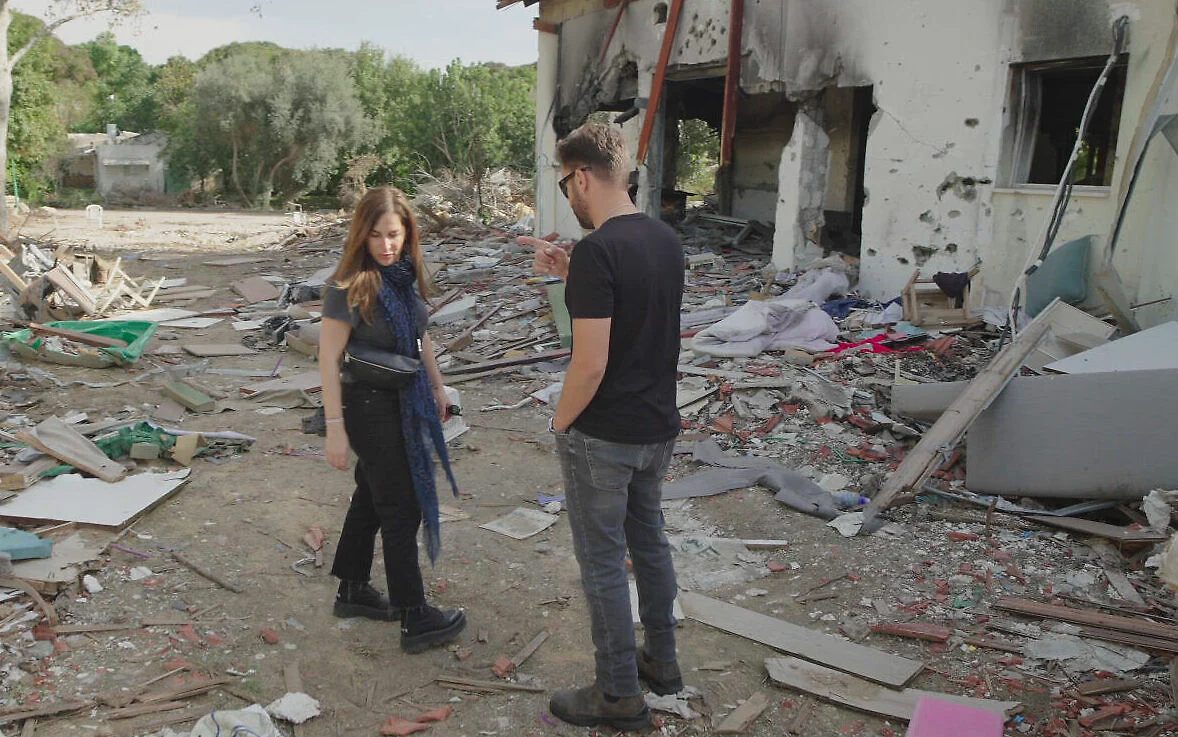
Filmmaker Leslie Gelrubin Benitah sees the devastation wrought on Kibbutz Be'eri during the Hamas assault of October 7, 2023, in this still from 'Milk and Honey, Blood and Tears.' (Courtesy)
At the 83rd Venice International Film Festival, NAZA, an Israeli documentary about Gaza, received a nearly 25-minute standing ovation and the Special Jury Prize. I watched the reaction with complicated emotions.
Not because I believe the film should not have been shown. Not because Palestinian suffering should not be documented. And not because Israeli filmmakers should be prevented from criticizing their own country. But because I am an American Jewish filmmaker who has spent the past two years discovering just how difficult it is to get the story of what happened to Israelis on October 7 onto a screen. And frankly, it is sad that I even feel the need to specify that I am American and Jewish before writing these words.
After October 7, I made “Milk & Honey,” a documentary about Kibbutz Be’eri and the lives shattered by the massacre. I spent two years following people whose world had been destroyed, documenting not only what happened to them on October 7, but what came after: displacement, grief, trauma, survival, and the painful attempt to rebuild. “Milk & Honey” was shown at the Miami Jewish Film Festival. But beyond Jewish film festivals and Jewish spaces, getting a film like mine seen has been extraordinarily difficult.
And I am far from alone. I have filmmaker friends — some far more accomplished than I am, including directors whose previous work has received the highest honors at Cannes and other major festivals — who made films about October 7 and its aftermath. They, too, filmed raw testimonies. They, too, documented suffering. They, too, put cameras in front of human beings trying to explain the unimaginable. And they, too, have encountered rejection after rejection.
Among them is my friend Georges Benayoun, a César-winning producer and filmmaker with decades of experience in the industry, who has faced the same struggle with “Looking for Yotam,” his documentary about Yotam Haim, who was kidnapped from Kibbutz Kfar Aza on October 7.
The subject is “too sensitive.” Too “touchy.” Too complicated.
And then Venice happens. An Israeli film about Gaza, built around raw, anonymous testimonies, is not considered too sensitive. It is welcomed onto one of the most prestigious stages in world cinema, awarded a major jury prize, and greeted with nearly 25 minutes of applause.
So I find myself asking a question that I cannot shake: Which Israeli stories are we allowed to tell?
When Israelis testify about Palestinian suffering, the international cultural world appears eager to listen. When Israelis testify about Jewish suffering, the doors seem considerably harder to open. Why? I am not asking this rhetorically. I genuinely want someone to explain it to me.
Would the same audience that stood for nearly 25 minutes for an Israeli documentary about Gaza be willing to sit through “Milk & Honey”? Would they watch the testimonies of people from Kibbutz Be’eri? Would they listen to Israelis describe what happened inside their homes, what they saw, whom they lost, and what became of their lives afterward? Would the festivals screen it in the first place? The experience of the past two years makes me fear that the answer is no.
And that matters, because film is not simply entertainment. Film shapes memory. It shapes empathy. It shapes the way millions of people who were not there come to understand what happened.
My friend and colleague Gila Stern put into words something I have been struggling with myself:
No, Venice is not Nazi Germany, and I’m not making that comparison. I’m talking about the mechanism.
The Nazis understood early that film could do what political speeches could not: take a complicated reality, assign the roles of victim and villain, appeal directly to emotion, and make one version of events feel unquestionably true.
Propaganda doesn’t have to be entirely fabricated. It can contain real images, real suffering and real testimony. Its power lies in what is selected, what is omitted, how it is framed — and whose humanity the audience is taught to see.
What makes this particularly painful is that Israeli filmmakers themselves are helping provide the ammunition. Some may see that as courageous dissent. Others see Israelis lending their own credibility to a narrative that will inevitably be weaponized against their country and, ultimately, against Jews around the world.
History has painful examples of Jews being used to legitimize forces hostile to other Jews. The circumstances are not equivalent, and we should not pretend they are. But the historical echo of lending Jewish credibility to the demonization of Jews should make us deeply uncomfortable.
A 25-minute standing ovation does not prove that a film is propaganda.
But it does show just how eagerly this particular narrative is being embraced.
And still, my argument is not that these films should disappear. Quite the opposite. Show them. Show Palestinian suffering. Show the accusations against Israel. Show the Israeli soldiers who want to speak anonymously about what they witnessed or did.
But then show us too.
Show “Milk & Honey.” Show the films my colleagues made. Show the survivors of Kibbutz Be’eri. Show the families. Show the hostages and those who came home. Show the people who ran from the Nova festival. Show the children who lost parents and the parents who lost children. Let audiences see all of it.
Because culture does not merely reflect public opinion. It can create it.
And when the world’s most influential cultural institutions repeatedly amplify one story while deciding that another is too “sensitive” to show, they are not simply observing the narrative. They are helping write it.
Jews, of all people, understand what can happen when the world becomes comfortable seeing us only as the villains.
So I return to the question that has been bothering me since Venice: If an audience can stand for nearly 25 minutes to applaud an Israeli film about Gaza, are they also willing to spend at least as much time watching and listening to what happened to us on October 7?
I would like to believe they are.
But first, the festivals have to let us into the room.
Related Topics
Related Posts