


Who Gets to Decide Who Is Right?

God, Trump, and a Soccer Referee in the Battle Over the Rules of the Game
The Oven of Akhnai is not really a story about an oven. The proof is simple: nearly two thousand years later, we are still telling the story, yet most of us cannot remember who thought the oven was ritually pure and who thought it was impure. What made this Talmudic debate immortal was a much larger question, one that every human society still wrestles with today: When we disagree, who gets to decide who is right and, more importantly, by what rules?
Throughout history, societies have invented different mechanisms for resolving disputes. There were times when truth was decided by trial by combat; in monarchies, the king decided; in authoritarian regimes, power often has the final word. In a democracy, we have built a system of elections, majority and minority rights, courts, separate branches of government, and limits on political power. Not because this system guarantees that the right side will always win, but because a society must agree how decisions will be made even when its members cannot agree on who is right.
And that is precisely the argument at the heart of the Oven of Akhnai Talmudic debate.
Rabbi Eliezer stands against the majority of the sages, convinced that Jewish law is on his side. He presents arguments, and when they fail to persuade his colleagues, he summons miracles to support his case: a carob tree uproots itself, a stream begins flowing backward, and the walls of the study hall start to collapse. The sages remain unconvinced. Finally, a heavenly voice declares that the law follows Rabbi Eliezer- God Himself has ruled. The debate should be over. But then Rabbi Joshua stands up and responds: “It is not in heaven.” He is not saying that God is wrong. He is saying something far more radical: God is no longer part of this decision-making mechanism. The Torah has already been given, the rules for interpreting and deciding it have already been established, and disputes must now be resolved according to those rules. Even truth descending directly from heaven cannot enter the game halfway through and change them.
That may be the great political idea hidden inside this Talmudic story: A system is judged not only by the quality of the decisions it produces, but by the legitimacy of the process through which those decisions are made.
Oddly enough, one of the clearest ways to understand this is on a soccer field. For decades, soccer had a remarkably simple mechanism for deciding what happened: the referee saw, the referee blew the whistle, and the referee’s decision became reality. Millions of people watching on television could see Diego Maradona score with his hand, but the goal remained on the scoreboard because, under the rules of the game at the time, the referee was the authority.
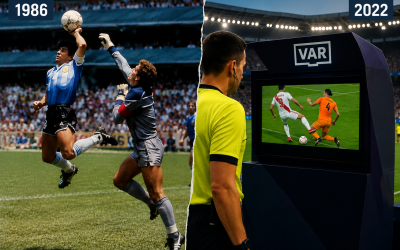
Then came VAR. The mechanism changed, but it changed as a rule. Soccer introduced technology, defined when it could be used and who was authorized to use it, and the new rule applied to everyone.
At the most recent World Cup, however, something different happened. After American player Folarin Balogun was sent off with a red card, Donald Trump personally contacted FIFA President Gianni Infantino and asked for the decision to be reviewed. FIFA’s disciplinary committee subsequently suspended the punishment, allowing Balogun to play. FIFA maintained that the committee acted independently, and Trump said he had merely requested a review. But the interesting question is not whether the red card was justified, or even whether Trump was right. The question is: Since when is the president of a country part of soccer’s appeals process?
Let us assume, for the sake of argument, that Trump was completely right. That only makes the problem clearer. If, whenever we dislike an outcome, someone with enough power, status, and the right phone number can enter the decision-making process, we are no longer correcting an error within the rules of the game. We are changing who gets to make the rules and who gets to overrule them.
And suddenly, the Oven of Akhnai stops being an ancient Talmudic story and becomes an urgently political text.
The struggle taking place today in Israel, the United States, and other democracies is not only about which decisions will be made. Beneath it lies an even more fundamental struggle: Who gets to make those decisions, through what process, and subject to what limits? Powerful leaders increasingly demand more authority in the name of their ability to “govern”: fewer restraints, fewer gatekeepers, fewer institutions capable of saying no, and greater freedom to intervene when the system produces an outcome they do not like.
And sometimes they may even be right on the merits. Courts make mistakes. Judges make mistakes. Experts make mistakes. Majorities make mistakes. VAR makes mistakes too. But the real test of the rules is precisely the moment when they produce a result we dislike. A rule we are willing to break for our benefit today is the very rule that will not be there to protect us tomorrow.
Perhaps that is why the Talmud ends the story with one of its most audacious images. The rabbis ask what God did at the moment when human beings rejected His heavenly voice. The answer: God smiled and said, “My children have defeated Me. My children have defeated Me.”
God smiles because even God understands that once there are rules, you do not change them simply because you are the most powerful presence in the room. Real authority is measured not by the ability to win every argument, but by the willingness to accept that power, too, must have limits.
So the important question in the Oven of Akhnai is not who was right about the oven, just as the important question on the soccer field is not whether the player deserved a red card, and the important question in a democracy is not whether I happen to like a court ruling, a law, or an election result. The question is who decides, according to which rules, and whether we are willing to defend those rules even when they work against us.
Because once the most powerful person in the room can change the rules of the game to produce the outcome he wants, the argument is no longer about an oven, a red card, or a court ruling.
It is about what happens to a system when power itself begins to decide how decisions are made.
May we have the wisdom to remember what even God was willing to accept: that true authority means knowing where power must end.