
Bridging faith. Defending truth. Confronting hate
Who Has the Right to Give Up Palestine? The Islamization of Sacred Jurisdiction
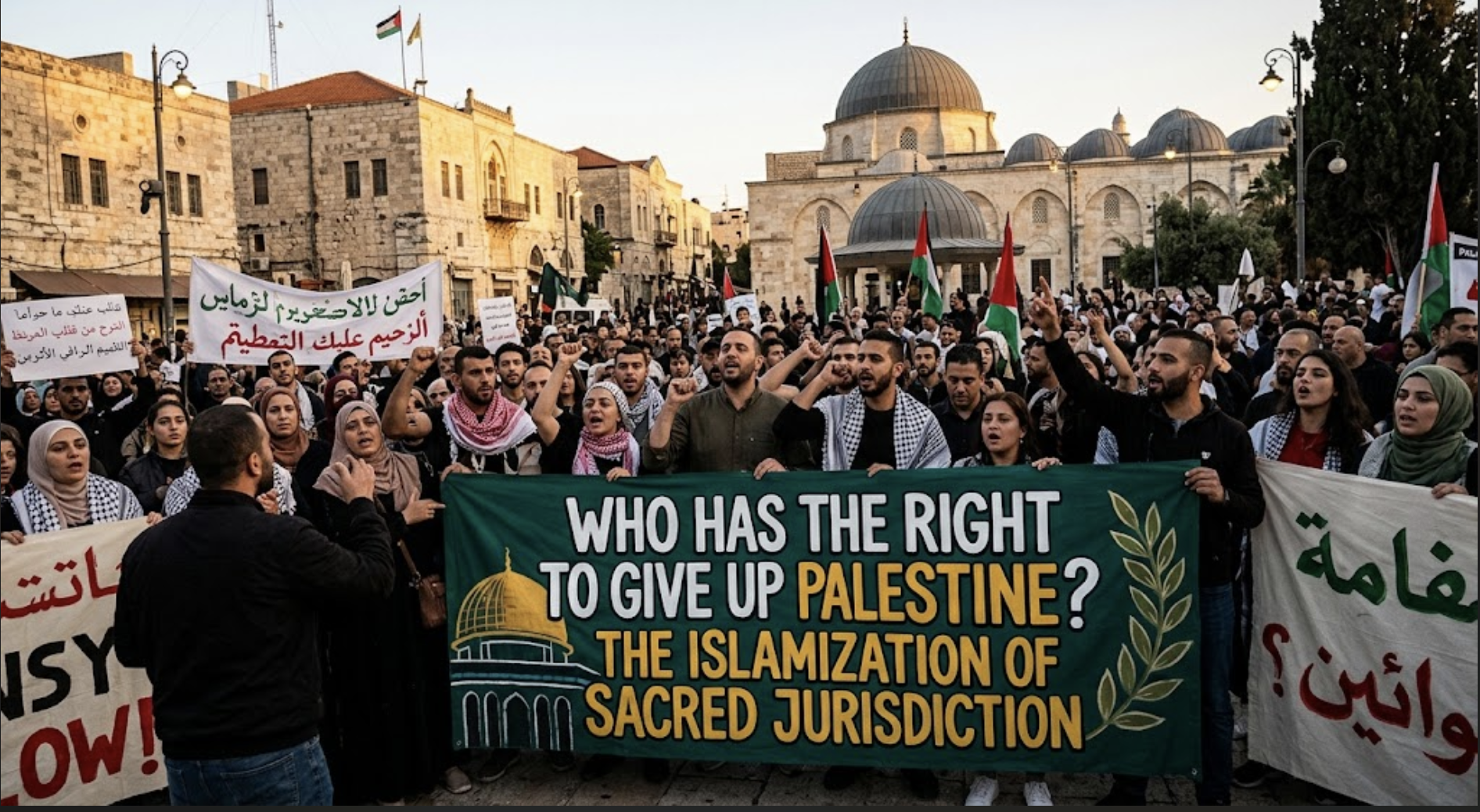
Image created from Google Gemini by Tim Orr
What shifted was not who would win political control of Palestine but who could legitimately be said to have authority over Palestine in the first place. For much of the twentieth century, combatants framed their struggle in familiar political terms like nationalism, sovereignty, liberation, colonialism, and self-determination. Palestine was understood foremost as the homeland of the Palestinians and, more broadly, as part of the Arab political and historical patrimony.
Islamist movements never denied those claims but argued that they were part of something bigger. Palestine remained Palestinian and Arab but also Islamic territory. The land acquired religious significance, and its fate became bound to the concerns of Muslims far beyond Palestine. Jerusalem was not just a disputed capital city but al-Quds; resistance was not simply national liberation but defense of holy land. Once these connections were made, the relevant political community could be expanded beyond the Palestinians or the Arab nation to include the Muslim ummah as a whole.
Scholars have often used the term “Islamization” to describe this process. But they have typically used it to point only to the growing influence of religious language, symbols, and political actors. I am arguing that its significance ran deeper, and was fundamentally jurisdictional. When I refer to jurisdictional Islamization, I mean the shifting of ultimate moral authority over Palestine away from nationally defined and territorially bounded actors and toward a transnational religious community thought to possess inalienable rights over land, obligation, and political authority.
Palestine as an Arab National Cause
The 1968 Palestinian National Charter provides a revealing contrast. But its frame of reference was radically nationalist: Palestine, the Palestinian people, the Arab nation, national liberation, homeland recovery … you’ll find these words on virtually every page. Article 15: Palestine Liberation is a national duty performed by the Arab nation and carried out in the first place by the Palestinian people. It matters because nationalism and Islamism can find themselves aligned on any number of short-term positions (anti-Zionism, violence as armed struggle, insistence on territorial recovery) but their motivations for doing so are radically different. Doubling-down on militancy, therefore, won’t necessarily indicate whether a position has been Islamized. We have to look at the language justifying the claim, who that claiming community is constructed to be, and who has veto power over it. The question was no longer simply if leaders should compromise — but if they could.
Islamization Before 1967
One could easily begin this story with the Arab defeat of 1967. Secular Arab nationalism had been dealt a serious blow by the Six-Day War, especially its Nasserist variant. Just as Arab unity and state power were promised to deliver liberation, Islamist movements were now able to point to military defeat as evidence that the problem was not simply strategic but moral and spiritual. Abandonment of Islam, in other words, was the cause of Arab failures.
But if we start here we lose sight of the many ways that Palestine had been integrated into Islamist political thinking long before 1967. Hasan al-Banna and the Muslim Brotherhood had treated Palestine as a major Islamic cause decades earlier. Brotherhood volunteers fought in the 1948 war, and al-Banna himself explicitly tied Palestine to the language of jihad and Islamic revivalism against foreign rule. Palestine therefore became both a tangible territorial cause as well as symbolic of the broader condition of the Muslim world. To that extent, the ideological roots of Islamization existed before the Six-Day War.
The war nevertheless altered the political landscape, though not primarily by creating an Islamist interpretation of Palestine. What changed was not the existence of an Islamist interpretation of Palestine but its perceived validity. The defeat allowed Islamists to argue that secular Arab leaders had failed not only militarily but morally and spiritually as well. Palestine could now be presented as evidence that Muslim political weakness reflected a deeper condition of religious decay. Soon, the question would evolve from “Why did the Arabs lose?” to “What has gone wrong with the Muslim world?”
From Homeland to Sacred Trust
Hamas offered one of the clearest expressions of this jurisdictional shift. Written in 1988, its charter stated that Palestine was an Islamic waqf (religious endowment) “which God bestowed on the Muslim generations until the Day of Judgment arrives.” The proclamation did more than express the holiness of Palestine. By declaring Palestine a waqf, the charter asserted that no leader, institution, or generation possessed the authority permanently to relinquish land held in trust for Muslims.
This claim dramatically alters the role of political institutions. When Palestine is contested ground, we assume elected leaders have the ability to negotiate borders, sovereignty, and settlement. The belief that Palestine is waqf challenges that assumption because it draws a legal distinction between custodianship and ownership. Political leaders are stewards of a previous promise, not proprietors who can freely renounce their charge.
If Palestine belongs primarily to the Palestinian people, then Palestinian leaders can theoretically determine its political future. If Palestine instead belongs to the Arab nation, then maybe Arab regimes warrant a larger political voice. But if Palestine is held in trust for all of Islam, then this generation has only limited control to relinquish what also belongs to future generations of Muslims.
Islamic legal arguments do not supersede politics. Muslim legal traditions are far richer and more varied than Islamist manifestos typically admit. Muslim jurists have historically disagreed over how to define territories, truces, treaties, public interest, political leadership, conquest and occupation. My point is that religious legal language can delegitimize unilateral control of Palestine.
From National Duty to Fard ʿAyn
The change in status of the land was only half the story. Islamization altered conceptions of obligation as well. Islamic jurisprudence classically distinguished between obligations that were collective (fard kifāya) and those that were individual (fard ʿayn). Debates about the application of these categories to warfare have varied, but always depended on context — invasion, ability, proximity and so forth — and who legitimately constituted a political authority.
The difference matters tremendously however. Collective duties leave greater discretion to political authorities, militaries, and organized institutions regarding how the obligation is fulfilled. Individual duties place responsibility directly on the believer. Once participation in the struggle is framed as an individual obligation, the state no longer necessarily controls how that obligation is defined or how far it extends.
The Hamas covenant of 1988 used precisely this rhetorical strategy. It declared that Palestine’s liberation was an individual religious obligation. The political impact of this move was to expand who counts as responsible for carrying out the fight. A secular nationalist movement in Palestine might seek charity or political support or donations from Muslims elsewhere. But an Islamic movement can require something more: that Muslims living outside of Palestine have obligations towards its liberation because that struggle is their religious duty as well.
Here lies the paradox of Islamization: it simultaneously de-nationalizes obligation and sacralizes territory. It both de-nationalizes obligations and makes territory sacred. The land becomes particularized, even divine; the body of believers becomes universalized.
Competing Sunni and Shiʿi Islamizations
Palestine’s location inside the ummah meant that the conflict surrounding it could no longer be contained to Arab politics. This helps explain why the Iranian Revolution of 1979 became such a touchstone for Palestinian transnational politics. Iran was neither Palestinian nor Arab. And yet the Islamic Republic worked to make Palestine central to its own project almost immediately after coming to power. Khomeini could make Palestine central to the Islamic Republic precisely because the Palestinian cause had already been reconceived as Islamic rather than exclusively Arab.
We see this dynamic in effect when Khomeini declared Quds Day in 1979. Khomeini issued his fatwa not simply to Iranians but to Muslims across the globe, framing Jerusalem as an issue that was of concern to the Islamic community as a whole. Palestine allowed revolutionary Iran to speak in a political idiom that transcended national and ethnic boundaries.
This is where discussions of a singular Islamization of Palestine start to fall apart. Sunni Islamist movements moved into Palestine overwhelmingly through the Muslim Brotherhood and its associated ideological traditions. Revolutionary Iran entered the Palestinian cause through an entirely different Shiʿi political and theological genealogy. These two genealogies had very different ideas about clerical rule, Islamic government, religious law, and revolution. But because Palestine was no longer an issue that belonged inside Arab politics alone, Islamists of both Sunni and Shiʿi varieties were able to stake their claims in the land.
Sunni Islamist movements would frequently talk about Palestine in terms of jihad, Muslim land under occupation, and the duty of the ummah. Revolutionary Iran spoke about Palestine with additional focus on martyrdom, anti-imperialism, revolutionary authenticity, and the establishment of Islamic government. Palestine was one place where Sunni and Shiʿi Islamist projects could overlap without necessarily deriving from the same theological lineage.
Sacred Jurisdiction and the Limits of Diplomatic Authority
The jurisdictional element is most easily observed in relation to attempts by governments to reach an agreement with Israel. Within a conventional diplomatic model, peace treaties are evaluated in terms of national interests, security needs, borders, and political tradeoffs. The Islamist paradigm forces a more fundamental question: can a ruler permanently relinquish control of land viewed as Muslim territory? Once that question is on the table, diplomacy itself is transformed into a question of theology.
The moral valence of compromise is altered as a result. Acceptance of Israel can be cast not just as a bad strategy, but as giving away what one ruler does not have the right to give. Normalization can be framed not simply as a bad foreign policy decision, but as treason against holy causes.
It also helps us understand why Islamization challenges the monopoly that the state claims over the Palestine issue. A head of state may normalize relations with Israel and declare the political dispute settled. An Islamist group can say the religious obligation is still upon us. Nationalism can absolutize territory too, but the uniquely Islamist move here is to question whether political elites have the right to give that territory away.
If Palestine belongs first and foremost to the Palestinians then their consent may appear determinative. If Palestine belongs to the ummah, then Palestinian consent can be acknowledged but overridden. The deeper question is whether today’s political elites can forfeit a claim they do not control but that is construed as belonging to a transnational religious community tied to both place and eternity.
Al-Aqsa and Sacred Geography
Islamists today have selectively mobilized Islamic law, Qurʾanic idiom, sacred memory, and eschatological traditions to make sense of a contemporary political conflict. That mobilization should not be confused, however, with the assertion that Muslim-Jewish strife is perennial or destined. Rather, processes of Islamization may be more profitably examined as contemporary politicizations of extant religious resources. The continuing political force of these religious resources is especially visible in the construction and mobilization of sacred geography.
The decision by Hamas to title their October 7, 2023 assault Ṭūfān al-Aqṣā, or “Al- Aqsa Flood” illustrates how the local fight over Gaza was made into a struggle over one of Islam’s holiest sites. Gaza is Palestinian in both geographic and political terms. Al-Aqsa Mosque, by contrast, holds religious significance for Muslims worldwide. Invoking al-Aqsa, therefore, widens the audience to whom the struggle is relevant and allows forms of identification that go beyond Palestinian nationalism.
Hamas 2017 and the Persistence of Islamization
Hamas’ such change was important because it showed that Islamization had not foreclosed strategic adjustment. Hamas disassociated Jews from Zionism and stated explicitly that its conflict was with the Zionist project and not with Jews merely for being Jews. Hamas also recognized the establishment of a Palestinian state along the June 1967 lines as a formula of national consensus, even if it did not recognize Israel or relinquish broader territorial claims. Taken together, these compromises signaled that Hamas was trying to alter its political positioning.
However Hamas did not simply return to the secular nationalist rhetoric of the defunct PLO Charter. Palestine remained couched in Arab and Islamic terms, Jerusalem was still considered holy, and the umma was still implicated in the movement’s political vision. Rather than privileging one over the other, Hamas was blending Palestinian nationalism with Islamic sacred geography. The result was a strategic turn toward Palestinian nationalism without a corresponding abandonment of the movement’s Islamic theological framework.
Who Can Surrender What Belongs to the Ummah?
The Arab–Israeli conflict is neither a primordial struggle fueled by religious hatred, nor a secular dispute over land. Palestine was born out of modern configurations of nationalism, empire, migration, war, state-making, and competing claims to sovereign authority. Its Islamization was historically constructed, not inevitable. till, Islamists made Palestine central to the sacred geography, legal imagination, and religious obligations of the ummah, thereby transforming the political meaning of the conflict..
Understanding these dynamics allows us to see how negotiated agreements may leave the Palestine question open within Islamist movements. Israel can be recognized by governments, Arab states can normalize with it, Palestinian leaders can agree to partitions and borders. Islamists can just say that none of these resolves the divine claim. The question now becomes not simply whether a settlement is agreeable, but whether those agreeing to it have authority to concede what has been constructed as belonging to a broader religious collective. Islamization allows for the possibility of a moral veto outside the institutions that typically end wars and territorial conflicts.
The real question then becomes: Can one generation relinquish territory understood as belonging to God and entrusted to the Muslim community across generations? It is also a battle over who can speak for the land, negotiate over it, and declare an end to the struggle. This is the lasting legacy of Palestine’s Islamization: turning a national struggle into a matter of sacred jurisdiction.
Related Topics
Related Posts